Ran Rao , Haoxiang Yang , Kailong Qiu , Min Xu , Hao Liu , Jinghao Shen , Weihao Wang , Runjie Nie , Huan Chen , Hongyuan Jiang
{"title":"Mechanical confinement triggers spreading and migration of immobile cells by deforming nucleus","authors":"Ran Rao , Haoxiang Yang , Kailong Qiu , Min Xu , Hao Liu , Jinghao Shen , Weihao Wang , Runjie Nie , Huan Chen , Hongyuan Jiang","doi":"10.1016/j.biomaterials.2025.123209","DOIUrl":null,"url":null,"abstract":"<div><div>Cells <em>in vivo</em> are often subject to the challenge of spatial confinement from neighboring cells and extracellular matrix (ECM) that are usually adhesive and deformable. Here, we showed that confinement makes initially quiescent round cells on soft adhesive substrates spread and migrate, exhibiting a phenotype similar to that of cells on unconfined stiff substrates. Interestingly, the confinement-induced cell spreading and migration exist widely in many cell types, and depend on formins, cell contractility and endonuclear YAP-TEAD interaction. Finally, we demonstrated the nucleus is a mechanosensor independent of ECM rigidity, and its flattening alone is sufficient to trigger YAP nuclear translocation, assembly of focal adhesions and stress fibers, cell spreading and migration. Thus, our findings revealed a new inside-out mechanism through which the nucleus directly detects and responds to external mechanical confinement, and could have important implications for cell migration in crowded micro-environments during cancer metastasis, wound healing and embryonic development.</div></div>","PeriodicalId":254,"journal":{"name":"Biomaterials","volume":"320 ","pages":"Article 123209"},"PeriodicalIF":12.9000,"publicationDate":"2025-09-01","publicationTypes":"Journal Article","fieldsOfStudy":null,"isOpenAccess":false,"openAccessPdf":"","citationCount":"0","resultStr":null,"platform":"Semanticscholar","paperid":null,"PeriodicalName":"Biomaterials","FirstCategoryId":"5","ListUrlMain":"https://www.sciencedirect.com/science/article/pii/S0142961225001280","RegionNum":1,"RegionCategory":"医学","ArticlePicture":[],"TitleCN":null,"AbstractTextCN":null,"PMCID":null,"EPubDate":"2025/2/25 0:00:00","PubModel":"Epub","JCR":"Q1","JCRName":"ENGINEERING, BIOMEDICAL","Score":null,"Total":0}
引用次数: 0
Abstract
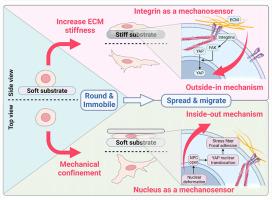
Cells in vivo are often subject to the challenge of spatial confinement from neighboring cells and extracellular matrix (ECM) that are usually adhesive and deformable. Here, we showed that confinement makes initially quiescent round cells on soft adhesive substrates spread and migrate, exhibiting a phenotype similar to that of cells on unconfined stiff substrates. Interestingly, the confinement-induced cell spreading and migration exist widely in many cell types, and depend on formins, cell contractility and endonuclear YAP-TEAD interaction. Finally, we demonstrated the nucleus is a mechanosensor independent of ECM rigidity, and its flattening alone is sufficient to trigger YAP nuclear translocation, assembly of focal adhesions and stress fibers, cell spreading and migration. Thus, our findings revealed a new inside-out mechanism through which the nucleus directly detects and responds to external mechanical confinement, and could have important implications for cell migration in crowded micro-environments during cancer metastasis, wound healing and embryonic development.
期刊介绍:
Biomaterials is an international journal covering the science and clinical application of biomaterials. A biomaterial is now defined as a substance that has been engineered to take a form which, alone or as part of a complex system, is used to direct, by control of interactions with components of living systems, the course of any therapeutic or diagnostic procedure. It is the aim of the journal to provide a peer-reviewed forum for the publication of original papers and authoritative review and opinion papers dealing with the most important issues facing the use of biomaterials in clinical practice. The scope of the journal covers the wide range of physical, biological and chemical sciences that underpin the design of biomaterials and the clinical disciplines in which they are used. These sciences include polymer synthesis and characterization, drug and gene vector design, the biology of the host response, immunology and toxicology and self assembly at the nanoscale. Clinical applications include the therapies of medical technology and regenerative medicine in all clinical disciplines, and diagnostic systems that reply on innovative contrast and sensing agents. The journal is relevant to areas such as cancer diagnosis and therapy, implantable devices, drug delivery systems, gene vectors, bionanotechnology and tissue engineering.




 京公网安备 11010802042870号
京ICP备2023020795号-1
京公网安备 11010802042870号
京ICP备2023020795号-1

 分享
分享
 求助内容:
求助内容: 应助结果提醒方式:
 扫码关注我们
