A unique VS2 nanosheet decorated metal-organic framework based highly synergistic electrocatalyst for the efficient detection of melamine in food samples
{"title":"A unique VS2 nanosheet decorated metal-organic framework based highly synergistic electrocatalyst for the efficient detection of melamine in food samples","authors":"Nandha Gopal Balasubramaniyan , Sethupathy Ramanathan , Narendra Pal Singh Chauhan , Panneerselvam Perumal","doi":"10.1016/j.matchemphys.2025.130660","DOIUrl":null,"url":null,"abstract":"<div><div>Herein, we design a novel electrocatalyst-based bimetallic (Fe/Cu) Metal-organic Framework intercalated with Vanadium disulfide (VS<sub>2</sub>) nanosheet acting as a suitable electrochemical sensor for the detection of Melamine. The MOF@VS<sub>2</sub> nanocomposite was synthesized using a one-step hydrothermal method. The analytical techniques for cyclic voltammetry (CV), electrochemical impedance spectroscopy (EIS), and differential pulse voltammetry (DPV) were used to examine the electrochemical studies of melamine detection. Interestingly, MOF@VS<sub>2</sub> nanocomposite coated with glass carbon electrode utilizes an oxidative pathway to break down melamine, followed by three steps. The initial oxidation reaction converts melamine directly into ammeline. Further, ammeline, undergoing additional oxidation, transforms into ammelide. As a result, the oxidation of ammelide yields cyanuric acid. Based on this mechanism, the proposed electrochemical sensor demonstrated a high oxidation potential of +0.24 V, a wide linear range (10–150 μM), a low detection limit of 0.42 nM, and superior electron transfer kinetics, making it more effective in melamine detection than coexisting molecules. The novel electrocatalyst of MOF@VS<sub>2</sub> nanocomposite brings about a high synergistic effect, good electrical conductivity, and a large surface area. This finding suggests its potential applications as a melamine sensor, particularly in the food safety and healthcare sectors.</div></div>","PeriodicalId":18227,"journal":{"name":"Materials Chemistry and Physics","volume":"338 ","pages":"Article 130660"},"PeriodicalIF":4.7000,"publicationDate":"2025-07-01","publicationTypes":"Journal Article","fieldsOfStudy":null,"isOpenAccess":false,"openAccessPdf":"","citationCount":"0","resultStr":null,"platform":"Semanticscholar","paperid":null,"PeriodicalName":"Materials Chemistry and Physics","FirstCategoryId":"88","ListUrlMain":"https://www.sciencedirect.com/science/article/pii/S0254058425003062","RegionNum":3,"RegionCategory":"材料科学","ArticlePicture":[],"TitleCN":null,"AbstractTextCN":null,"PMCID":null,"EPubDate":"2025/3/3 0:00:00","PubModel":"Epub","JCR":"Q2","JCRName":"MATERIALS SCIENCE, MULTIDISCIPLINARY","Score":null,"Total":0}
引用次数: 0
Abstract
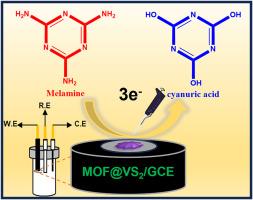
Herein, we design a novel electrocatalyst-based bimetallic (Fe/Cu) Metal-organic Framework intercalated with Vanadium disulfide (VS2) nanosheet acting as a suitable electrochemical sensor for the detection of Melamine. The MOF@VS2 nanocomposite was synthesized using a one-step hydrothermal method. The analytical techniques for cyclic voltammetry (CV), electrochemical impedance spectroscopy (EIS), and differential pulse voltammetry (DPV) were used to examine the electrochemical studies of melamine detection. Interestingly, MOF@VS2 nanocomposite coated with glass carbon electrode utilizes an oxidative pathway to break down melamine, followed by three steps. The initial oxidation reaction converts melamine directly into ammeline. Further, ammeline, undergoing additional oxidation, transforms into ammelide. As a result, the oxidation of ammelide yields cyanuric acid. Based on this mechanism, the proposed electrochemical sensor demonstrated a high oxidation potential of +0.24 V, a wide linear range (10–150 μM), a low detection limit of 0.42 nM, and superior electron transfer kinetics, making it more effective in melamine detection than coexisting molecules. The novel electrocatalyst of MOF@VS2 nanocomposite brings about a high synergistic effect, good electrical conductivity, and a large surface area. This finding suggests its potential applications as a melamine sensor, particularly in the food safety and healthcare sectors.
期刊介绍:
Materials Chemistry and Physics is devoted to short communications, full-length research papers and feature articles on interrelationships among structure, properties, processing and performance of materials. The Editors welcome manuscripts on thin films, surface and interface science, materials degradation and reliability, metallurgy, semiconductors and optoelectronic materials, fine ceramics, magnetics, superconductors, specialty polymers, nano-materials and composite materials.




 京公网安备 11010802042870号
京ICP备2023020795号-1
京公网安备 11010802042870号
京ICP备2023020795号-1

 分享
分享
 求助内容:
求助内容: 应助结果提醒方式:
 扫码关注我们
