Tim Hoffmann , Florian Behrendt , Lukas Dietz , Caroline T. Holick , Pascal Scharfenberg , Michael Gottschaldt , Bernd W. Sigusch , Ulrich S. Schubert
{"title":"Photoresponsive cryogels based on poly(2-oxazoline)s","authors":"Tim Hoffmann , Florian Behrendt , Lukas Dietz , Caroline T. Holick , Pascal Scharfenberg , Michael Gottschaldt , Bernd W. Sigusch , Ulrich S. Schubert","doi":"10.1016/j.eurpolymj.2025.113845","DOIUrl":null,"url":null,"abstract":"<div><div>Herein, we present the synthesis of two poly(2-oxazoline)-based photodegradable cross-linkers. For that 1-(piperazin-1-yl)ethan-1-one-<em>O</em>-methacryloyl oxime (<strong>PipOxim</strong>) was synthesized as new photocleavable, polymerizable endcapping agent for the termination of the cationic ring-opening polymerization (CROP) of 2-ethyl-2-oxazoline (EtOx), to yield in the bifunctional cross-linker <strong>B-Et(10)PipOxim</strong>. Secondly, bifunctional poly(2-ethyl-2-oxazoline)s (PEtOx) carrying photocleavable, polymerizable triazene phenyl methacrylate (TAz) ω-end groups were prepared by post-polymerization functionalization (<strong>B-Et(10,20,40)TAz</strong>). The process of decomposition under UV–Vis irradiation was successfully demonstrated for all cross-linkers that had been produced using UV–Vis spectroscopy. From the photodegradable POx-based cross-linkers, cryogels were prepared with 100% of the two different cross-linkers. Additionally, mixed cryogels made of <strong>B-Et(40)TAz</strong> and acrylic acid were produced. All cryogels were characterized by thermogravimetric analysis (TGA), solid-state NMR (ssNMR), scanning electron microscopy (SEM) and swelling investigations. Notably, the use of 92 mol% acrylic acid led to the formation of cryogels susceptible to a complete dissolution in water after exposure to UV–Vis light.</div></div>","PeriodicalId":315,"journal":{"name":"European Polymer Journal","volume":"229 ","pages":"Article 113845"},"PeriodicalIF":6.3000,"publicationDate":"2025-04-16","publicationTypes":"Journal Article","fieldsOfStudy":null,"isOpenAccess":false,"openAccessPdf":"","citationCount":"0","resultStr":null,"platform":"Semanticscholar","paperid":null,"PeriodicalName":"European Polymer Journal","FirstCategoryId":"92","ListUrlMain":"https://www.sciencedirect.com/science/article/pii/S0014305725001338","RegionNum":2,"RegionCategory":"化学","ArticlePicture":[],"TitleCN":null,"AbstractTextCN":null,"PMCID":null,"EPubDate":"2025/2/21 0:00:00","PubModel":"Epub","JCR":"Q1","JCRName":"POLYMER SCIENCE","Score":null,"Total":0}
引用次数: 0
Abstract
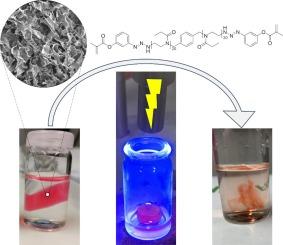
Herein, we present the synthesis of two poly(2-oxazoline)-based photodegradable cross-linkers. For that 1-(piperazin-1-yl)ethan-1-one-O-methacryloyl oxime (PipOxim) was synthesized as new photocleavable, polymerizable endcapping agent for the termination of the cationic ring-opening polymerization (CROP) of 2-ethyl-2-oxazoline (EtOx), to yield in the bifunctional cross-linker B-Et(10)PipOxim. Secondly, bifunctional poly(2-ethyl-2-oxazoline)s (PEtOx) carrying photocleavable, polymerizable triazene phenyl methacrylate (TAz) ω-end groups were prepared by post-polymerization functionalization (B-Et(10,20,40)TAz). The process of decomposition under UV–Vis irradiation was successfully demonstrated for all cross-linkers that had been produced using UV–Vis spectroscopy. From the photodegradable POx-based cross-linkers, cryogels were prepared with 100% of the two different cross-linkers. Additionally, mixed cryogels made of B-Et(40)TAz and acrylic acid were produced. All cryogels were characterized by thermogravimetric analysis (TGA), solid-state NMR (ssNMR), scanning electron microscopy (SEM) and swelling investigations. Notably, the use of 92 mol% acrylic acid led to the formation of cryogels susceptible to a complete dissolution in water after exposure to UV–Vis light.
期刊介绍:
European Polymer Journal is dedicated to publishing work on fundamental and applied polymer chemistry and macromolecular materials. The journal covers all aspects of polymer synthesis, including polymerization mechanisms and chemical functional transformations, with a focus on novel polymers and the relationships between molecular structure and polymer properties. In addition, we welcome submissions on bio-based or renewable polymers, stimuli-responsive systems and polymer bio-hybrids. European Polymer Journal also publishes research on the biomedical application of polymers, including drug delivery and regenerative medicine. The main scope is covered but not limited to the following core research areas:
Polymer synthesis and functionalization
• Novel synthetic routes for polymerization, functional modification, controlled/living polymerization and precision polymers.
Stimuli-responsive polymers
• Including shape memory and self-healing polymers.
Supramolecular polymers and self-assembly
• Molecular recognition and higher order polymer structures.
Renewable and sustainable polymers
• Bio-based, biodegradable and anti-microbial polymers and polymeric bio-nanocomposites.
Polymers at interfaces and surfaces
• Chemistry and engineering of surfaces with biological relevance, including patterning, antifouling polymers and polymers for membrane applications.
Biomedical applications and nanomedicine
• Polymers for regenerative medicine, drug delivery molecular release and gene therapy
The scope of European Polymer Journal no longer includes Polymer Physics.



 京公网安备 11010802042870号
京ICP备2023020795号-1
京公网安备 11010802042870号
京ICP备2023020795号-1

 分享
分享
 求助内容:
求助内容: 应助结果提醒方式:
 扫码关注我们
