Victor Vazquez-Villar , Ana Sousa-Herves , Antonio Cuesta-Casas , M. Paz Fernández-Liencres , Philippe J. Mésini , Amparo Ruiz-Carretero , Amparo Navarro , Juan Tolosa , Joaquín C. García-Martínez
{"title":"Fluorescent gels: Immobilization of non-fluorescence molecules beyond the aggregation induced emission","authors":"Victor Vazquez-Villar , Ana Sousa-Herves , Antonio Cuesta-Casas , M. Paz Fernández-Liencres , Philippe J. Mésini , Amparo Ruiz-Carretero , Amparo Navarro , Juan Tolosa , Joaquín C. García-Martínez","doi":"10.1016/j.eurpolymj.2025.113865","DOIUrl":null,"url":null,"abstract":"<div><div>Aggregation Induced Emission (AIE) has aroused the interest of the scientific community, revealing the mechanisms behind this phenomenon. The most common ones are the avoidance of electronic couplings which could quench the emission or non-radiative deactivation through vibrational modes, intramolecular rotations, photoisomerization, etc. This type of knowledge can be applied to the rational design of molecules that are trapped in an environment that prevents those non-radiative processes. Here we present oligo(styryl)benzene and bis(styryl)-4-(dicyanomethylene)-4H-pyran molecules designed to be non-fluorescence either in solution or in the solid/aggregate state, but they reach in some cases quantum yields of 50 % and 60 % when trapped in a gel matrix. These compounds deactivate in solution by vibrational relaxation and photoisomerization, the latter favored by the incorporation of cyano groups. The complete spectroscopic characterization of the gels together with quantum chemical calculations have allowed us to explain their photophysical behavior. In addition, compounds 1 and 4 were interacted with β-cyclodextrin and bacterial DNA (plasmid pUC19). An increase in fluorescence was observed which suggests an interaction between the dye and the supramolecular structure that blocks intramolecular motions and prevents aggregation. A more selective functionalization would allow the design of more fluorescent, higher contrast and more specific sensors.</div></div>","PeriodicalId":315,"journal":{"name":"European Polymer Journal","volume":"229 ","pages":"Article 113865"},"PeriodicalIF":6.3000,"publicationDate":"2025-04-16","publicationTypes":"Journal Article","fieldsOfStudy":null,"isOpenAccess":false,"openAccessPdf":"","citationCount":"0","resultStr":null,"platform":"Semanticscholar","paperid":null,"PeriodicalName":"European Polymer Journal","FirstCategoryId":"92","ListUrlMain":"https://www.sciencedirect.com/science/article/pii/S0014305725001533","RegionNum":2,"RegionCategory":"化学","ArticlePicture":[],"TitleCN":null,"AbstractTextCN":null,"PMCID":null,"EPubDate":"2025/2/28 0:00:00","PubModel":"Epub","JCR":"Q1","JCRName":"POLYMER SCIENCE","Score":null,"Total":0}
引用次数: 0
Abstract
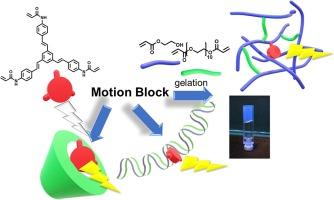
Aggregation Induced Emission (AIE) has aroused the interest of the scientific community, revealing the mechanisms behind this phenomenon. The most common ones are the avoidance of electronic couplings which could quench the emission or non-radiative deactivation through vibrational modes, intramolecular rotations, photoisomerization, etc. This type of knowledge can be applied to the rational design of molecules that are trapped in an environment that prevents those non-radiative processes. Here we present oligo(styryl)benzene and bis(styryl)-4-(dicyanomethylene)-4H-pyran molecules designed to be non-fluorescence either in solution or in the solid/aggregate state, but they reach in some cases quantum yields of 50 % and 60 % when trapped in a gel matrix. These compounds deactivate in solution by vibrational relaxation and photoisomerization, the latter favored by the incorporation of cyano groups. The complete spectroscopic characterization of the gels together with quantum chemical calculations have allowed us to explain their photophysical behavior. In addition, compounds 1 and 4 were interacted with β-cyclodextrin and bacterial DNA (plasmid pUC19). An increase in fluorescence was observed which suggests an interaction between the dye and the supramolecular structure that blocks intramolecular motions and prevents aggregation. A more selective functionalization would allow the design of more fluorescent, higher contrast and more specific sensors.
期刊介绍:
European Polymer Journal is dedicated to publishing work on fundamental and applied polymer chemistry and macromolecular materials. The journal covers all aspects of polymer synthesis, including polymerization mechanisms and chemical functional transformations, with a focus on novel polymers and the relationships between molecular structure and polymer properties. In addition, we welcome submissions on bio-based or renewable polymers, stimuli-responsive systems and polymer bio-hybrids. European Polymer Journal also publishes research on the biomedical application of polymers, including drug delivery and regenerative medicine. The main scope is covered but not limited to the following core research areas:
Polymer synthesis and functionalization
• Novel synthetic routes for polymerization, functional modification, controlled/living polymerization and precision polymers.
Stimuli-responsive polymers
• Including shape memory and self-healing polymers.
Supramolecular polymers and self-assembly
• Molecular recognition and higher order polymer structures.
Renewable and sustainable polymers
• Bio-based, biodegradable and anti-microbial polymers and polymeric bio-nanocomposites.
Polymers at interfaces and surfaces
• Chemistry and engineering of surfaces with biological relevance, including patterning, antifouling polymers and polymers for membrane applications.
Biomedical applications and nanomedicine
• Polymers for regenerative medicine, drug delivery molecular release and gene therapy
The scope of European Polymer Journal no longer includes Polymer Physics.



 京公网安备 11010802042870号
京ICP备2023020795号-1
京公网安备 11010802042870号
京ICP备2023020795号-1

 分享
分享
 求助内容:
求助内容: 应助结果提醒方式:
 扫码关注我们
