Comparative assessment of concentrated solar power and photovoltaic for power generation and green hydrogen potential in West Africa: A case study on Nigeria
C.J. Okeke , P.K. Egberibine , J.U. Edet , J. Wilson , R.E. Blanchard
{"title":"Comparative assessment of concentrated solar power and photovoltaic for power generation and green hydrogen potential in West Africa: A case study on Nigeria","authors":"C.J. Okeke , P.K. Egberibine , J.U. Edet , J. Wilson , R.E. Blanchard","doi":"10.1016/j.rser.2025.115548","DOIUrl":null,"url":null,"abstract":"<div><div>The transition towards sustainable energy, championed by the Nigerian Electricity Act (2023) underscores the importance of solar energy and green hydrogen in tackling energy poverty in sub-Saharan Africa, especially in Nigeria. However, uncertainty remains among investors and government entities regarding the optimal geographic, technical, and economic conditions for utility-scale renewable electricity projects. To address this, an evaluation of two solar technologies—Photovoltaic (PV) and Parabolic Trough CSP technology (PT-CSP)—was conducted under specific geographical and techno-economic criteria to support solar electricity and green hydrogen development across Nigeria. The study estimated Nigeria's energy demand and employed site evaluation, Multi-Criteria Decision-Making, the Analytic Hierarchy Process (AHP), and Geographic Information System (GIS) tools, alongside the NREL System Advisory Model (NREL-SAM) for power plant analysis. Results indicate that 105.63 GW<sub>e</sub> of grid capacity is required to meet Nigeria's energy demand, whereas 57.32 GW<sub>e</sub> from grid-connected solar plants needed to replace unsustainable grid supplying 54.3 % of estimated population. Lagos requires the highest capacity (4.93 GW<sub>e</sub>), followed by Rivers, Kano, Oyo, and Ogun. Land suitability assessment identified 0.79 % (6815.68 km<sup>2</sup>) of Nigeria as highly suitable for solar-hydrogen projects, while 18.49 % (158,450.45 km<sup>2</sup>) is less suitable with most of Nigeria moderately suitable. Regions are ranked with the North-Central and North-East identified as most viable for PV and PT-CSP projects. A comparative economic analysis shows PV is superior in Nigeria, generating twice the energy output and costing six times less per unit of electricity than PT-CSP. These findings offer guidance for optimal solar energy and green hydrogen deployment.</div></div>","PeriodicalId":418,"journal":{"name":"Renewable and Sustainable Energy Reviews","volume":"215 ","pages":"Article 115548"},"PeriodicalIF":18.0000,"publicationDate":"2025-06-01","publicationTypes":"Journal Article","fieldsOfStudy":null,"isOpenAccess":false,"openAccessPdf":"","citationCount":"0","resultStr":null,"platform":"Semanticscholar","paperid":null,"PeriodicalName":"Renewable and Sustainable Energy Reviews","FirstCategoryId":"1","ListUrlMain":"https://www.sciencedirect.com/science/article/pii/S1364032125002217","RegionNum":1,"RegionCategory":"工程技术","ArticlePicture":[],"TitleCN":null,"AbstractTextCN":null,"PMCID":null,"EPubDate":"2025/3/5 0:00:00","PubModel":"Epub","JCR":"Q1","JCRName":"ENERGY & FUELS","Score":null,"Total":0}
引用次数: 0
Abstract
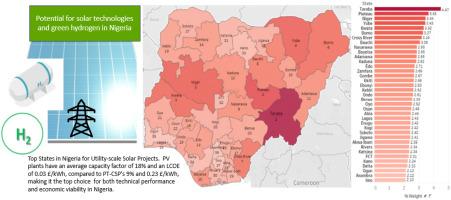
The transition towards sustainable energy, championed by the Nigerian Electricity Act (2023) underscores the importance of solar energy and green hydrogen in tackling energy poverty in sub-Saharan Africa, especially in Nigeria. However, uncertainty remains among investors and government entities regarding the optimal geographic, technical, and economic conditions for utility-scale renewable electricity projects. To address this, an evaluation of two solar technologies—Photovoltaic (PV) and Parabolic Trough CSP technology (PT-CSP)—was conducted under specific geographical and techno-economic criteria to support solar electricity and green hydrogen development across Nigeria. The study estimated Nigeria's energy demand and employed site evaluation, Multi-Criteria Decision-Making, the Analytic Hierarchy Process (AHP), and Geographic Information System (GIS) tools, alongside the NREL System Advisory Model (NREL-SAM) for power plant analysis. Results indicate that 105.63 GWe of grid capacity is required to meet Nigeria's energy demand, whereas 57.32 GWe from grid-connected solar plants needed to replace unsustainable grid supplying 54.3 % of estimated population. Lagos requires the highest capacity (4.93 GWe), followed by Rivers, Kano, Oyo, and Ogun. Land suitability assessment identified 0.79 % (6815.68 km2) of Nigeria as highly suitable for solar-hydrogen projects, while 18.49 % (158,450.45 km2) is less suitable with most of Nigeria moderately suitable. Regions are ranked with the North-Central and North-East identified as most viable for PV and PT-CSP projects. A comparative economic analysis shows PV is superior in Nigeria, generating twice the energy output and costing six times less per unit of electricity than PT-CSP. These findings offer guidance for optimal solar energy and green hydrogen deployment.
期刊介绍:
The mission of Renewable and Sustainable Energy Reviews is to disseminate the most compelling and pertinent critical insights in renewable and sustainable energy, fostering collaboration among the research community, private sector, and policy and decision makers. The journal aims to exchange challenges, solutions, innovative concepts, and technologies, contributing to sustainable development, the transition to a low-carbon future, and the attainment of emissions targets outlined by the United Nations Framework Convention on Climate Change.
Renewable and Sustainable Energy Reviews publishes a diverse range of content, including review papers, original research, case studies, and analyses of new technologies, all featuring a substantial review component such as critique, comparison, or analysis. Introducing a distinctive paper type, Expert Insights, the journal presents commissioned mini-reviews authored by field leaders, addressing topics of significant interest. Case studies undergo consideration only if they showcase the work's applicability to other regions or contribute valuable insights to the broader field of renewable and sustainable energy. Notably, a bibliographic or literature review lacking critical analysis is deemed unsuitable for publication.




 京公网安备 11010802042870号
京ICP备2023020795号-1
京公网安备 11010802042870号
京ICP备2023020795号-1

 分享
分享
 求助内容:
求助内容: 应助结果提醒方式:
 扫码关注我们
