{"title":"Deciphering the consequences of heavy metals and metalloid hazard in agricultural soil of West Bengal: A comprehensive soil to health risk analysis","authors":"Sourik Mondal, Arnab Sen","doi":"10.1016/j.scitotenv.2025.178976","DOIUrl":null,"url":null,"abstract":"<div><div>Heavy metals and metalloids (HMMs) pollution is an escalating global concern, driven by rapid industrialization, urbanization, and agricultural intensification. Contaminated soil not only compromise crop productivity but also introduce toxic elements into the food chain, posing serious risks to human health and ecological integrity. This study investigates the extent of HMMs-contamination (As, Cd, Pb, Ni, Cu, and Zn) in agricultural soils across the Gangetic plain and surrounding industrial regions of West Bengal, India, a microcosm of global challenges in soil pollution. Using Inductively Coupled Plasma – Atomic Emission Spectroscopy, we have analyzed a total 50 soil samples from Malda, Paschim Bardhaman, and Murshidabad districts. Results indicate significant contamination with arsenic (8.89–21.85 and 3.74–33.28 mg kg<sup>−1</sup>) and nickel, dominating the Gangetic plain soils due to overuse of contaminated groundwater and agrochemicals. While, industrial areas exhibited alarming levels of cadmium (0.89–3.39 mg kg<sup>−1</sup>), nickel (31.87–92.06 mg kg<sup>−1</sup>), and zinc. A pot experiment with soybean (<em>Glycine max</em>) seedlings revealed that HMMs-toxicity impaired growth, elevated reactive oxygen species, and caused DNA-damage. Human health risk assessments identified arsenic and cadmium as primary carcinogens (target carcinogenic risk >1.0 × 10<sup>−4</sup>) for adults and children under prolonged exposure. These findings underscore the urgency of global regulatory measures and innovative remediation strategies to mitigate soil pollution, safeguard food security, protect public health and prevent further environmental degradation. This also study highlights the Gangetic plain as a critical area reflecting broader environmental challenges, offering insights applicable to regions facing similar industrial and agricultural pressures worldwide.</div></div>","PeriodicalId":422,"journal":{"name":"Science of the Total Environment","volume":"970 ","pages":"Article 178976"},"PeriodicalIF":8.0000,"publicationDate":"2025-03-20","publicationTypes":"Journal Article","fieldsOfStudy":null,"isOpenAccess":false,"openAccessPdf":"","citationCount":"0","resultStr":null,"platform":"Semanticscholar","paperid":null,"PeriodicalName":"Science of the Total Environment","FirstCategoryId":"93","ListUrlMain":"https://www.sciencedirect.com/science/article/pii/S0048969725006114","RegionNum":1,"RegionCategory":"环境科学与生态学","ArticlePicture":[],"TitleCN":null,"AbstractTextCN":null,"PMCID":null,"EPubDate":"2025/3/4 0:00:00","PubModel":"Epub","JCR":"Q1","JCRName":"ENVIRONMENTAL SCIENCES","Score":null,"Total":0}
引用次数: 0
Abstract
Heavy metals and metalloids (HMMs) pollution is an escalating global concern, driven by rapid industrialization, urbanization, and agricultural intensification. Contaminated soil not only compromise crop productivity but also introduce toxic elements into the food chain, posing serious risks to human health and ecological integrity. This study investigates the extent of HMMs-contamination (As, Cd, Pb, Ni, Cu, and Zn) in agricultural soils across the Gangetic plain and surrounding industrial regions of West Bengal, India, a microcosm of global challenges in soil pollution. Using Inductively Coupled Plasma – Atomic Emission Spectroscopy, we have analyzed a total 50 soil samples from Malda, Paschim Bardhaman, and Murshidabad districts. Results indicate significant contamination with arsenic (8.89–21.85 and 3.74–33.28 mg kg−1) and nickel, dominating the Gangetic plain soils due to overuse of contaminated groundwater and agrochemicals. While, industrial areas exhibited alarming levels of cadmium (0.89–3.39 mg kg−1), nickel (31.87–92.06 mg kg−1), and zinc. A pot experiment with soybean (Glycine max) seedlings revealed that HMMs-toxicity impaired growth, elevated reactive oxygen species, and caused DNA-damage. Human health risk assessments identified arsenic and cadmium as primary carcinogens (target carcinogenic risk >1.0 × 10⁻⁴) for adults and children under prolonged exposure. These findings underscore the urgency of global regulatory measures and innovative remediation strategies to mitigate soil pollution, safeguard food security, protect public health and prevent further environmental degradation. This also study highlights the Gangetic plain as a critical area reflecting broader environmental challenges, offering insights applicable to regions facing similar industrial and agricultural pressures worldwide.
期刊介绍:
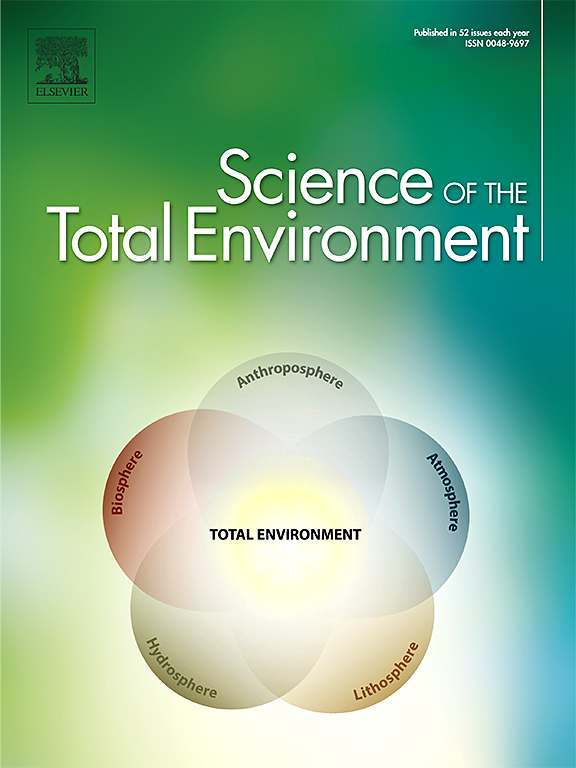
The Science of the Total Environment is an international journal dedicated to scientific research on the environment and its interaction with humanity. It covers a wide range of disciplines and seeks to publish innovative, hypothesis-driven, and impactful research that explores the entire environment, including the atmosphere, lithosphere, hydrosphere, biosphere, and anthroposphere.
The journal's updated Aims & Scope emphasizes the importance of interdisciplinary environmental research with broad impact. Priority is given to studies that advance fundamental understanding and explore the interconnectedness of multiple environmental spheres. Field studies are preferred, while laboratory experiments must demonstrate significant methodological advancements or mechanistic insights with direct relevance to the environment.




 京公网安备 11010802042870号
京ICP备2023020795号-1
京公网安备 11010802042870号
京ICP备2023020795号-1

 分享
分享
 求助内容:
求助内容: 应助结果提醒方式:
 扫码关注我们
