Daniela Vasconcelos Machado , Eduardo Duarte Marques , Andréa da Consolação de Oliveira Carvalho , Eduardo Paim Viglio , Everton Assunção Martins dos Santos , Rozane Valente Marins , Gerson Cardoso da Silva Júnior , Emmanoel Vieira Silva-Filho
{"title":"Baseflow CO₂ fluxes in small tropical rivers driven by hydrological dynamics","authors":"Daniela Vasconcelos Machado , Eduardo Duarte Marques , Andréa da Consolação de Oliveira Carvalho , Eduardo Paim Viglio , Everton Assunção Martins dos Santos , Rozane Valente Marins , Gerson Cardoso da Silva Júnior , Emmanoel Vieira Silva-Filho","doi":"10.1016/j.scitotenv.2025.179015","DOIUrl":null,"url":null,"abstract":"<div><div>Dry season CO<sub>2</sub> fluxes were estimated for 1418 small rivers and streams in the Upper São Francisco Basin (USFB), Brazil. This first basin-scale estimate revealed a substantial contribution of 1.52 Pg C yr<sup>−1</sup> (95 % confidence interval: 1.40 to 1.64 Pg C yr<sup>−1</sup>). pCO<sub>2</sub> values, calculated from pH and total alkalinity (TA) and subsequently corrected, ranged from 66 to 20,200 μatm (2191 ± 1791 μatm; coefficient of variation of 82 %). Approximately 95 % of rivers exhibited evasive fluxes with bed friction dissipation as the dominant control on turbulence in over 85 %. Analysis of gas transfer velocity (k<sub>600</sub>) parameterizations revealed significant inter-equation differences, high spatial variability, and strong slope influence. These findings highlight the potentially role of small tropical rivers and streams in global carbon cycling and provide the first CO<sub>2</sub> emission estimate for the USFB.</div></div>","PeriodicalId":422,"journal":{"name":"Science of the Total Environment","volume":"970 ","pages":"Article 179015"},"PeriodicalIF":8.0000,"publicationDate":"2025-03-20","publicationTypes":"Journal Article","fieldsOfStudy":null,"isOpenAccess":false,"openAccessPdf":"","citationCount":"0","resultStr":null,"platform":"Semanticscholar","paperid":null,"PeriodicalName":"Science of the Total Environment","FirstCategoryId":"93","ListUrlMain":"https://www.sciencedirect.com/science/article/pii/S0048969725006503","RegionNum":1,"RegionCategory":"环境科学与生态学","ArticlePicture":[],"TitleCN":null,"AbstractTextCN":null,"PMCID":null,"EPubDate":"2025/3/5 0:00:00","PubModel":"Epub","JCR":"Q1","JCRName":"ENVIRONMENTAL SCIENCES","Score":null,"Total":0}
引用次数: 0
Abstract
Dry season CO2 fluxes were estimated for 1418 small rivers and streams in the Upper São Francisco Basin (USFB), Brazil. This first basin-scale estimate revealed a substantial contribution of 1.52 Pg C yr−1 (95 % confidence interval: 1.40 to 1.64 Pg C yr−1). pCO2 values, calculated from pH and total alkalinity (TA) and subsequently corrected, ranged from 66 to 20,200 μatm (2191 ± 1791 μatm; coefficient of variation of 82 %). Approximately 95 % of rivers exhibited evasive fluxes with bed friction dissipation as the dominant control on turbulence in over 85 %. Analysis of gas transfer velocity (k600) parameterizations revealed significant inter-equation differences, high spatial variability, and strong slope influence. These findings highlight the potentially role of small tropical rivers and streams in global carbon cycling and provide the first CO2 emission estimate for the USFB.
对巴西上奥弗朗西斯科盆地(USFB) 1418条小河和溪流的旱季二氧化碳通量进行了估算。第一次盆地尺度估算显示了1.52 Pg C / yr - 1的实质性贡献(95%置信区间:1.40至1.64 Pg C / yr - 1)。pCO2值由pH值和总碱度(TA)计算并进行校正,范围为66 ~ 20,200 μatm(2191±1791 μatm);变异系数为82%)。约95%的河流具有规避通量,其中河床摩擦耗散是85%以上河流湍流的主要控制因素。气体传递速度(k600)参数化分析显示,方程间差异显著,空间变异性高,坡度影响强。这些发现强调了小型热带河流和溪流在全球碳循环中的潜在作用,并为USFB提供了第一个二氧化碳排放估算。
期刊介绍:
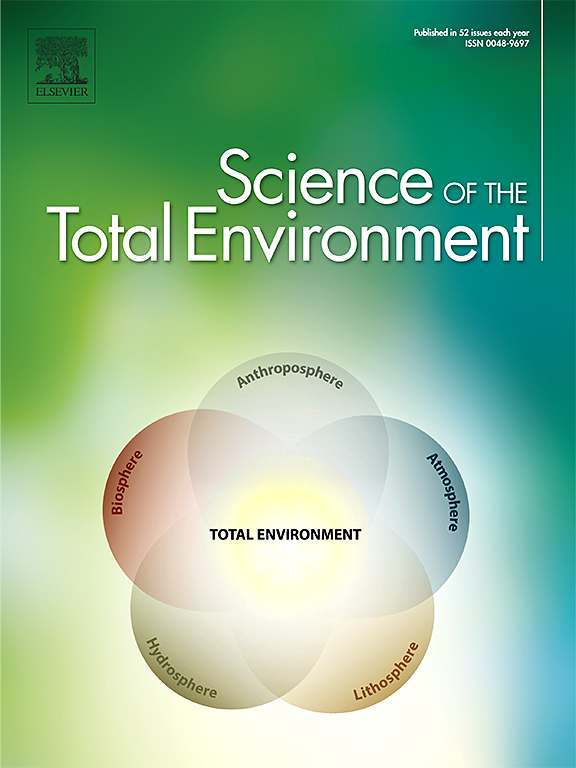
The Science of the Total Environment is an international journal dedicated to scientific research on the environment and its interaction with humanity. It covers a wide range of disciplines and seeks to publish innovative, hypothesis-driven, and impactful research that explores the entire environment, including the atmosphere, lithosphere, hydrosphere, biosphere, and anthroposphere.
The journal's updated Aims & Scope emphasizes the importance of interdisciplinary environmental research with broad impact. Priority is given to studies that advance fundamental understanding and explore the interconnectedness of multiple environmental spheres. Field studies are preferred, while laboratory experiments must demonstrate significant methodological advancements or mechanistic insights with direct relevance to the environment.




 京公网安备 11010802042870号
京ICP备2023020795号-1
京公网安备 11010802042870号
京ICP备2023020795号-1

 分享
分享
 求助内容:
求助内容: 应助结果提醒方式:
 扫码关注我们
