Georgia Petra, Evangelos I Kritsotakis, Nikolaos Gouvas, Dimitrios Schizas, Konstantinos Toutouzas, Michael Karanikas, George Pappas-Gogos, Georgios Stylianidis, George Zacharioudakis, Aggelos Laliotis, Grigorios Christodoulidis, Ioannis Kehagias, Konstantinos Lasithiotakis
{"title":"Multicentre prospective study on the diagnostic and prognostic validity of malnutrition assessment tools in surgery.","authors":"Georgia Petra, Evangelos I Kritsotakis, Nikolaos Gouvas, Dimitrios Schizas, Konstantinos Toutouzas, Michael Karanikas, George Pappas-Gogos, Georgios Stylianidis, George Zacharioudakis, Aggelos Laliotis, Grigorios Christodoulidis, Ioannis Kehagias, Konstantinos Lasithiotakis","doi":"10.1093/bjs/znaf013","DOIUrl":null,"url":null,"abstract":"<p><strong>Background: </strong>Malnutrition is a risk factor for postoperative morbidity but the optimal tool for the assessment of malnutrition is unclear.</p><p><strong>Methods: </strong>This is a prospective multicentre cohort study. Consecutive patients undergoing elective or emergency major abdominal surgery for benign or malignant disease in 12 Greek hospitals between January 2022 and December 2023 were included. Patients unable to provide nutrition history and/or informed consent were excluded. Subjective global assessment (SGA) was used as a reference standard for malnutrition diagnosis. GLIM (global leadership initiative on malnutrition), MNA-SF (mini nutrition assessment short form), MST (malnutrition screening tool), MUST (malnutrition universal screening tool), NRI (nutritional risk index), NRS-2002 (nutrition risk scale 2002), PONS (perioperative nutrition screen) and SNAQ (short nutrition assessment questionnaire) tools were applied for malnutrition risk assessments. Indicators of diagnostic accuracy (sensitivity, specificity, diagnostic odds ratio, areas under the receiver operating characteristic curve-AUC), construct validity (convergent associations with relevant variables) and prognostic validity (logistic regression) were appraised.</p><p><strong>Results: </strong>1649 patients were included (58% colorectal, 21% upper gastrointestinal, 14% hepatobiliary operations). SGA defined 562 (34.1%) patients as malnourished with excellent construct and prognostic validity. Malnutrition risk assessments varied from 24.0% using NRS-2002 to 58.6% with the MNA-SF. On their ordinal scales, MNA-SF (AUC = 0.83, 95% c.i. 0.81 to 0.85) and MUST (AUC = 0.79, 95% c.i. 0.77 to 0.82) had the best discriminatory abilities with minimal between-centre heterogeneity. As binary classifiers, MNA-SF (OR = 30.2; 95% c.i. 20.2 to 45.1) and MUST (OR = 16.1; 95% c.i. 12.4 to 21.1) had the highest diagnostic ORs but only MUST had sensitivity and specificity close to 80%. MUST performed well in construct and prognostic validity appraisals.</p><p><strong>Conclusion: </strong>This study supports the use of the MUST as it is the most valid nutritional screening tool in patients after major abdominal surgery.</p>","PeriodicalId":136,"journal":{"name":"British Journal of Surgery","volume":"112 2","pages":""},"PeriodicalIF":8.8000,"publicationDate":"2025-02-01","publicationTypes":"Journal Article","fieldsOfStudy":null,"isOpenAccess":false,"openAccessPdf":"https://www.ncbi.nlm.nih.gov/pmc/articles/PMC11879291/pdf/","citationCount":"0","resultStr":null,"platform":"Semanticscholar","paperid":null,"PeriodicalName":"British Journal of Surgery","FirstCategoryId":"3","ListUrlMain":"https://doi.org/10.1093/bjs/znaf013","RegionNum":1,"RegionCategory":"医学","ArticlePicture":[],"TitleCN":null,"AbstractTextCN":null,"PMCID":null,"EPubDate":"","PubModel":"","JCR":"Q1","JCRName":"SURGERY","Score":null,"Total":0}
引用次数: 0
Abstract
Background: Malnutrition is a risk factor for postoperative morbidity but the optimal tool for the assessment of malnutrition is unclear.
Methods: This is a prospective multicentre cohort study. Consecutive patients undergoing elective or emergency major abdominal surgery for benign or malignant disease in 12 Greek hospitals between January 2022 and December 2023 were included. Patients unable to provide nutrition history and/or informed consent were excluded. Subjective global assessment (SGA) was used as a reference standard for malnutrition diagnosis. GLIM (global leadership initiative on malnutrition), MNA-SF (mini nutrition assessment short form), MST (malnutrition screening tool), MUST (malnutrition universal screening tool), NRI (nutritional risk index), NRS-2002 (nutrition risk scale 2002), PONS (perioperative nutrition screen) and SNAQ (short nutrition assessment questionnaire) tools were applied for malnutrition risk assessments. Indicators of diagnostic accuracy (sensitivity, specificity, diagnostic odds ratio, areas under the receiver operating characteristic curve-AUC), construct validity (convergent associations with relevant variables) and prognostic validity (logistic regression) were appraised.
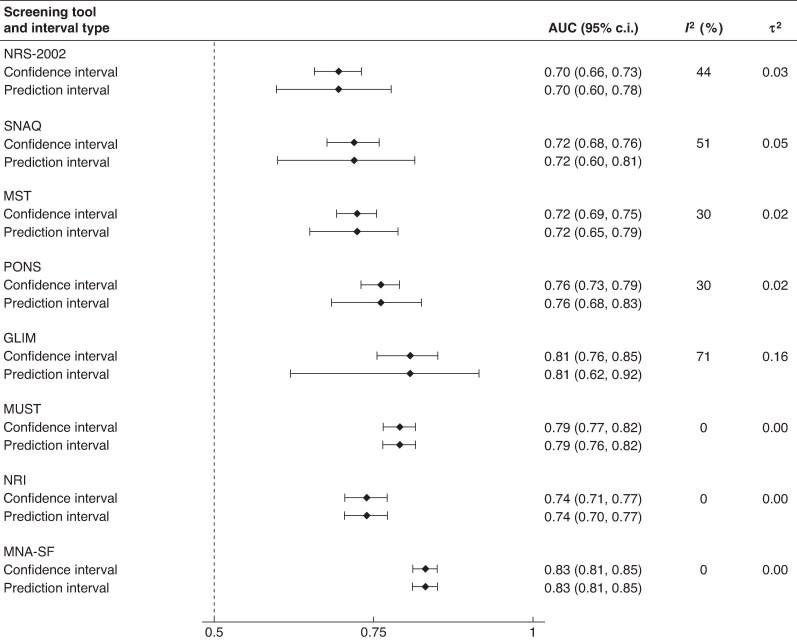
Results: 1649 patients were included (58% colorectal, 21% upper gastrointestinal, 14% hepatobiliary operations). SGA defined 562 (34.1%) patients as malnourished with excellent construct and prognostic validity. Malnutrition risk assessments varied from 24.0% using NRS-2002 to 58.6% with the MNA-SF. On their ordinal scales, MNA-SF (AUC = 0.83, 95% c.i. 0.81 to 0.85) and MUST (AUC = 0.79, 95% c.i. 0.77 to 0.82) had the best discriminatory abilities with minimal between-centre heterogeneity. As binary classifiers, MNA-SF (OR = 30.2; 95% c.i. 20.2 to 45.1) and MUST (OR = 16.1; 95% c.i. 12.4 to 21.1) had the highest diagnostic ORs but only MUST had sensitivity and specificity close to 80%. MUST performed well in construct and prognostic validity appraisals.
Conclusion: This study supports the use of the MUST as it is the most valid nutritional screening tool in patients after major abdominal surgery.
期刊介绍:
The British Journal of Surgery (BJS), incorporating the European Journal of Surgery, stands as Europe's leading peer-reviewed surgical journal. It serves as an invaluable platform for presenting high-quality clinical and laboratory-based research across a wide range of surgical topics. In addition to providing a comprehensive coverage of traditional surgical practices, BJS also showcases emerging areas in the field, such as minimally invasive therapy and interventional radiology.
While the journal appeals to general surgeons, it also holds relevance for specialty surgeons and professionals working in closely related fields. By presenting cutting-edge research and advancements, BJS aims to revolutionize the way surgical knowledge is shared and contribute to the ongoing progress of the surgical community.





 京公网安备 11010802042870号
京ICP备2023020795号-1
京公网安备 11010802042870号
京ICP备2023020795号-1

 分享
分享
 求助内容:
求助内容: 应助结果提醒方式:
 扫码关注我们
