Jonlin Chen, Ariel Gabay, Lillian A Boe, Ronnie L Shammas, Carrie Stern, Andrea Pusic, Babak J Mehrara, Chris Gibbons, Jonas A Nelson
{"title":"Machine Learning Accurately Predicts Patient-Reported Outcomes 1 Year After Breast Reconstruction.","authors":"Jonlin Chen, Ariel Gabay, Lillian A Boe, Ronnie L Shammas, Carrie Stern, Andrea Pusic, Babak J Mehrara, Chris Gibbons, Jonas A Nelson","doi":"10.1097/SLA.0000000000006688","DOIUrl":null,"url":null,"abstract":"<p><strong>Objective: </strong>To develop and evaluate machine learning algorithms for predicting patient-reported outcomes following breast reconstruction.</p><p><strong>Summary of background data: </strong>Machine learning may inform PROs in breast reconstruction, possibly enhancing shared decision-making and tailoring patient care.</p><p><strong>Methods: </strong>Data on patient characteristics, reconstructive technique, and BREAST-Q scores from women undergoing breast reconstruction at Memorial Sloan Kettering Cancer Center (MSKCC) between January 2010 and March 2024 was retrospectively collected. Five machine learning algorithms were developed and validated on this data to predict improved versus not improved BREAST-Q scores after reconstruction. Models were externally validated models using multicenter data from the Mastectomy Reconstruction Outcomes Consortium (MROC). Models were evaluated using the area under the receiver operator curve, sensitivity, specificity, and Brier score.</p><p><strong>Results: </strong>A total of 4,776 patients (2,687 from MSKCC, 2,089 from MROC) were included in model development and validation. Machine learning algorithms demonstrated AUCs of 0.97 for physical wellbeing of the abdomen, 0.86 for satisfaction with breast, 0.79 for sexual wellbeing, 0.78 for physical wellbeing of the chest, and 0.74 for psychosocial wellbeing. Variables that contributed the most to model predictions across all domains were preoperative BREAST-Q scores, timing of radiation, BMI, age, and reconstructive technique.</p><p><strong>Conclusions: </strong>Machine learning algorithms can accurately predict PROs before breast reconstruction. Ultimately, this data-driven approach may streamline shared decision-making and enhance patient-centered care.</p>","PeriodicalId":8017,"journal":{"name":"Annals of surgery","volume":" ","pages":""},"PeriodicalIF":6.4000,"publicationDate":"2025-03-05","publicationTypes":"Journal Article","fieldsOfStudy":null,"isOpenAccess":false,"openAccessPdf":"","citationCount":"0","resultStr":null,"platform":"Semanticscholar","paperid":null,"PeriodicalName":"Annals of surgery","FirstCategoryId":"3","ListUrlMain":"https://doi.org/10.1097/SLA.0000000000006688","RegionNum":1,"RegionCategory":"医学","ArticlePicture":[],"TitleCN":null,"AbstractTextCN":null,"PMCID":null,"EPubDate":"","PubModel":"","JCR":"Q1","JCRName":"SURGERY","Score":null,"Total":0}
引用次数: 0
Abstract
Objective: To develop and evaluate machine learning algorithms for predicting patient-reported outcomes following breast reconstruction.
Summary of background data: Machine learning may inform PROs in breast reconstruction, possibly enhancing shared decision-making and tailoring patient care.
Methods: Data on patient characteristics, reconstructive technique, and BREAST-Q scores from women undergoing breast reconstruction at Memorial Sloan Kettering Cancer Center (MSKCC) between January 2010 and March 2024 was retrospectively collected. Five machine learning algorithms were developed and validated on this data to predict improved versus not improved BREAST-Q scores after reconstruction. Models were externally validated models using multicenter data from the Mastectomy Reconstruction Outcomes Consortium (MROC). Models were evaluated using the area under the receiver operator curve, sensitivity, specificity, and Brier score.
Results: A total of 4,776 patients (2,687 from MSKCC, 2,089 from MROC) were included in model development and validation. Machine learning algorithms demonstrated AUCs of 0.97 for physical wellbeing of the abdomen, 0.86 for satisfaction with breast, 0.79 for sexual wellbeing, 0.78 for physical wellbeing of the chest, and 0.74 for psychosocial wellbeing. Variables that contributed the most to model predictions across all domains were preoperative BREAST-Q scores, timing of radiation, BMI, age, and reconstructive technique.
Conclusions: Machine learning algorithms can accurately predict PROs before breast reconstruction. Ultimately, this data-driven approach may streamline shared decision-making and enhance patient-centered care.
期刊介绍:
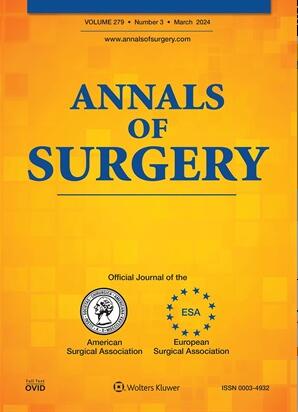
The Annals of Surgery is a renowned surgery journal, recognized globally for its extensive scholarly references. It serves as a valuable resource for the international medical community by disseminating knowledge regarding important developments in surgical science and practice. Surgeons regularly turn to the Annals of Surgery to stay updated on innovative practices and techniques. The journal also offers special editorial features such as "Advances in Surgical Technique," offering timely coverage of ongoing clinical issues. Additionally, the journal publishes monthly review articles that address the latest concerns in surgical practice.



 京公网安备 11010802042870号
京ICP备2023020795号-1
京公网安备 11010802042870号
京ICP备2023020795号-1

 分享
分享
 求助内容:
求助内容: 应助结果提醒方式:
 扫码关注我们
