Xin Nie, Mingzhu Zou, Chenhui Song, Ping Zhang, Di Ma, Di Cui, Gang Cheng, Lin Li
{"title":"Survival impact and risk factors of skeletal muscle loss during first-line EGFR-TKIs therapy in advanced lung adenocarcinoma patients.","authors":"Xin Nie, Mingzhu Zou, Chenhui Song, Ping Zhang, Di Ma, Di Cui, Gang Cheng, Lin Li","doi":"10.1186/s12885-025-13775-z","DOIUrl":null,"url":null,"abstract":"<p><strong>Purpose: </strong>The impact of epidermal growth factor receptor (EGFR) tyrosine kinase inhibitors (TKIs) on muscle mass in individuals with advanced lung cancer has yet to be fully delineated. This study aimed to examine the dynamics of skeletal muscle mass during EGFR-TKIs targeted therapy, elucidate its clinical relevance, and explore the potential mechanisms.</p><p><strong>Methods: </strong>We retrospectively recruited 104 patients with EGFR-mutant advanced lung adenocarcinoma who received icotinib or afatinib as first-line treatment. Skeletal muscle changes were assessed by abdominal CT obtained before and during treatment with EGFR-TKIs. The mean interval (± SD) between two CT scans was 109 days (± 16 days). Targeted panel sequencing of tumor tissue was used to detect genetic alterations. Functional enrichment analysis of genes interacting with EGFR-TKIs and muscle loss was performed to elucidate the potential toxicological mechanisms.</p><p><strong>Results: </strong>A total of 42 (40.4%) patients experienced muscle loss during targeted therapy. Genetic analysis indicated muscle loss group had a higher proportion of MDM2 amplification and PIK3CA alterations (p = 0.011 & p = 0.045, respectively).Patients with baseline low muscle density and experienced ≥ Grade 2 diarrhea had higher rate of muscle loss (p = 0.005 & p < 0.001, respectively). Multivariate analysis revealed that muscle loss was independently associated with shorter PFS (hazard ratio [HR] 1.86, 95% confidence interval [CI]: 1.09 ∼ 3.18; p = 0.023). Besides, we found genes associated with icotinib, afatinib and muscle loss were significantly enriched in MAPK signaling pathway and calcium signaling pathway.</p><p><strong>Conclusions: </strong>This study highlights the high prevalence and detrimental impact of muscle loss during EGFR-TKIs treatment.</p>","PeriodicalId":9131,"journal":{"name":"BMC Cancer","volume":"25 1","pages":"393"},"PeriodicalIF":3.4000,"publicationDate":"2025-03-04","publicationTypes":"Journal Article","fieldsOfStudy":null,"isOpenAccess":false,"openAccessPdf":"https://www.ncbi.nlm.nih.gov/pmc/articles/PMC11881361/pdf/","citationCount":"0","resultStr":null,"platform":"Semanticscholar","paperid":null,"PeriodicalName":"BMC Cancer","FirstCategoryId":"3","ListUrlMain":"https://doi.org/10.1186/s12885-025-13775-z","RegionNum":2,"RegionCategory":"医学","ArticlePicture":[],"TitleCN":null,"AbstractTextCN":null,"PMCID":null,"EPubDate":"","PubModel":"","JCR":"Q2","JCRName":"ONCOLOGY","Score":null,"Total":0}
引用次数: 0
Abstract
Purpose: The impact of epidermal growth factor receptor (EGFR) tyrosine kinase inhibitors (TKIs) on muscle mass in individuals with advanced lung cancer has yet to be fully delineated. This study aimed to examine the dynamics of skeletal muscle mass during EGFR-TKIs targeted therapy, elucidate its clinical relevance, and explore the potential mechanisms.
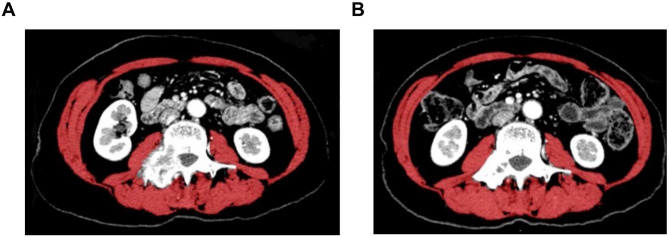
Methods: We retrospectively recruited 104 patients with EGFR-mutant advanced lung adenocarcinoma who received icotinib or afatinib as first-line treatment. Skeletal muscle changes were assessed by abdominal CT obtained before and during treatment with EGFR-TKIs. The mean interval (± SD) between two CT scans was 109 days (± 16 days). Targeted panel sequencing of tumor tissue was used to detect genetic alterations. Functional enrichment analysis of genes interacting with EGFR-TKIs and muscle loss was performed to elucidate the potential toxicological mechanisms.
Results: A total of 42 (40.4%) patients experienced muscle loss during targeted therapy. Genetic analysis indicated muscle loss group had a higher proportion of MDM2 amplification and PIK3CA alterations (p = 0.011 & p = 0.045, respectively).Patients with baseline low muscle density and experienced ≥ Grade 2 diarrhea had higher rate of muscle loss (p = 0.005 & p < 0.001, respectively). Multivariate analysis revealed that muscle loss was independently associated with shorter PFS (hazard ratio [HR] 1.86, 95% confidence interval [CI]: 1.09 ∼ 3.18; p = 0.023). Besides, we found genes associated with icotinib, afatinib and muscle loss were significantly enriched in MAPK signaling pathway and calcium signaling pathway.
Conclusions: This study highlights the high prevalence and detrimental impact of muscle loss during EGFR-TKIs treatment.
期刊介绍:
BMC Cancer is an open access, peer-reviewed journal that considers articles on all aspects of cancer research, including the pathophysiology, prevention, diagnosis and treatment of cancers. The journal welcomes submissions concerning molecular and cellular biology, genetics, epidemiology, and clinical trials.





 京公网安备 11010802042870号
京ICP备2023020795号-1
京公网安备 11010802042870号
京ICP备2023020795号-1

 分享
分享
 求助内容:
求助内容: 应助结果提醒方式:
 扫码关注我们
