Bülent Alyanak, Murat İnanır, Selime Ilgın Sade, Serkan Kablanoğlu
{"title":"Efficacy of Game-Based EMG-Biofeedback Therapy in Post-Stroke Dysphagia: A Randomized Controlled Trial.","authors":"Bülent Alyanak, Murat İnanır, Selime Ilgın Sade, Serkan Kablanoğlu","doi":"10.1007/s00455-025-10819-1","DOIUrl":null,"url":null,"abstract":"<p><p>The aim of this study was to investigate the effects of game-based electromyography (EMG)-biofeedback therapy on swallowing functions and quality of life in patients with post-stroke dysphagia. This prospective, assessor-blind, randomized controlled trial included 33 patients with post-stroke dysphagia. The study group performed the Mendelsohn maneuver and effortful swallow using game-based EMG-biofeedback, while the control group performed the same tasks with only verbal feedback for 30 min across a total of 15 sessions. In addition, both groups received oral motor exercises and thermal-tactile stimulation for equal durations. Patients were evaluated immediately before and after the treatment using clinical swallowing assessments, including the Functional Oral Intake Scale (FOIS), Penetration-Aspiration Scale (PAS), Dysphagia Outcome and Severity Scale (DOSS), and Dysphagia Handicap Index (DHI). Statistically significant improvements were observed in FOIS scores (p = 0.038), PAS-Liquid scores (p = 0.026), and DOSS scores (p = 0.003) in the study group, while no significant changes were noted in the control group. PAS-Semisolid scores improved in both groups (study group, p = 0.002; control group, p = 0.023); however, post-treatment scores were significantly higher in the study group compared to the control group (p = 0.031). Although significant improvements in DHI total, physical, emotional, and functional scores were observed in both groups at the end of treatment (all p < 0.05), post-treatment DHI scores were significantly higher in the study group compared to the control group (all p < 0.05). The addition of game-based EMG-biofeedback to conventional therapy improved clinical and radiological outcomes, as evidenced by improvements in FOIS, PAS-Liquid, and DOSS scores, and led to statistically significant improvements in PAS-Semisolid and DHI scores. In conclusion, the inclusion of game-based EMG-biofeedback therapy in swallowing rehabilitation programs may have a positive impact on treatment outcomes.</p>","PeriodicalId":11508,"journal":{"name":"Dysphagia","volume":" ","pages":"1289-1301"},"PeriodicalIF":3.0000,"publicationDate":"2025-12-01","publicationTypes":"Journal Article","fieldsOfStudy":null,"isOpenAccess":false,"openAccessPdf":"https://www.ncbi.nlm.nih.gov/pmc/articles/PMC12662894/pdf/","citationCount":"0","resultStr":null,"platform":"Semanticscholar","paperid":null,"PeriodicalName":"Dysphagia","FirstCategoryId":"3","ListUrlMain":"https://doi.org/10.1007/s00455-025-10819-1","RegionNum":3,"RegionCategory":"医学","ArticlePicture":[],"TitleCN":null,"AbstractTextCN":null,"PMCID":null,"EPubDate":"2025/3/5 0:00:00","PubModel":"Epub","JCR":"Q1","JCRName":"OTORHINOLARYNGOLOGY","Score":null,"Total":0}
引用次数: 0
Abstract
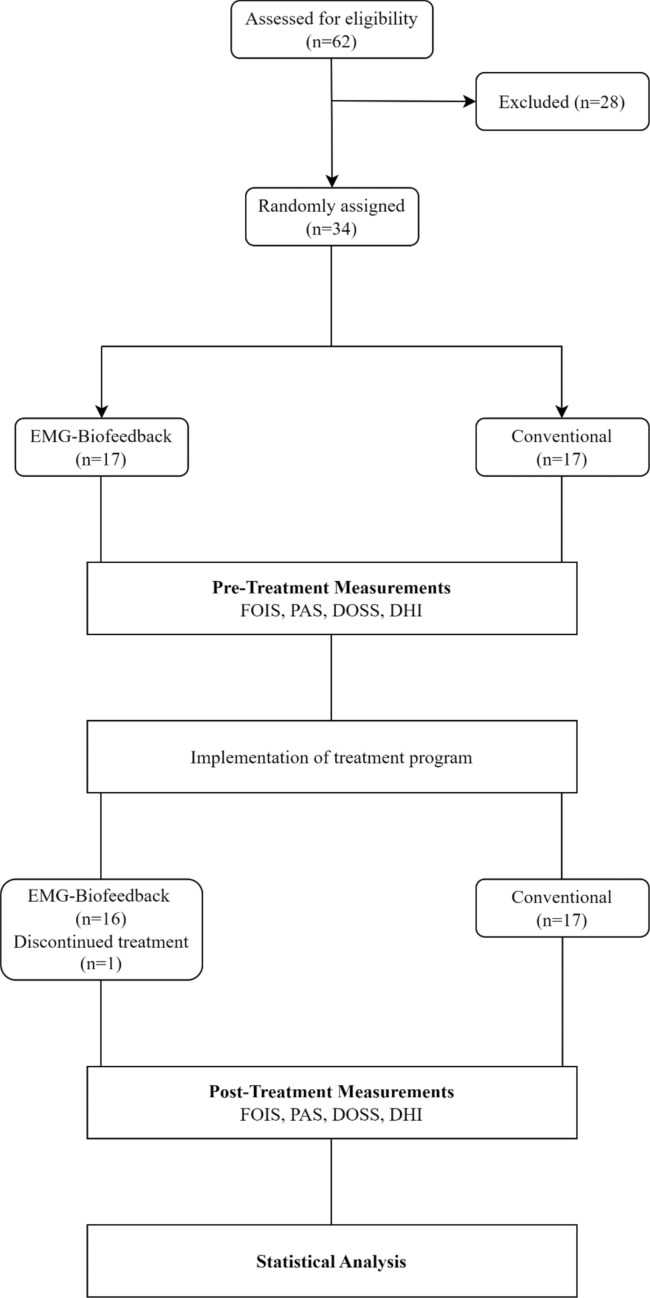
The aim of this study was to investigate the effects of game-based electromyography (EMG)-biofeedback therapy on swallowing functions and quality of life in patients with post-stroke dysphagia. This prospective, assessor-blind, randomized controlled trial included 33 patients with post-stroke dysphagia. The study group performed the Mendelsohn maneuver and effortful swallow using game-based EMG-biofeedback, while the control group performed the same tasks with only verbal feedback for 30 min across a total of 15 sessions. In addition, both groups received oral motor exercises and thermal-tactile stimulation for equal durations. Patients were evaluated immediately before and after the treatment using clinical swallowing assessments, including the Functional Oral Intake Scale (FOIS), Penetration-Aspiration Scale (PAS), Dysphagia Outcome and Severity Scale (DOSS), and Dysphagia Handicap Index (DHI). Statistically significant improvements were observed in FOIS scores (p = 0.038), PAS-Liquid scores (p = 0.026), and DOSS scores (p = 0.003) in the study group, while no significant changes were noted in the control group. PAS-Semisolid scores improved in both groups (study group, p = 0.002; control group, p = 0.023); however, post-treatment scores were significantly higher in the study group compared to the control group (p = 0.031). Although significant improvements in DHI total, physical, emotional, and functional scores were observed in both groups at the end of treatment (all p < 0.05), post-treatment DHI scores were significantly higher in the study group compared to the control group (all p < 0.05). The addition of game-based EMG-biofeedback to conventional therapy improved clinical and radiological outcomes, as evidenced by improvements in FOIS, PAS-Liquid, and DOSS scores, and led to statistically significant improvements in PAS-Semisolid and DHI scores. In conclusion, the inclusion of game-based EMG-biofeedback therapy in swallowing rehabilitation programs may have a positive impact on treatment outcomes.
期刊介绍:
Dysphagia aims to serve as a voice for the benefit of the patient. The journal is devoted exclusively to swallowing and its disorders. The purpose of the journal is to provide a source of information to the flourishing dysphagia community. Over the past years, the field of dysphagia has grown rapidly, and the community of dysphagia researchers have galvanized with ambition to represent dysphagia patients. In addition to covering a myriad of disciplines in medicine and speech pathology, the following topics are also covered, but are not limited to: bio-engineering, deglutition, esophageal motility, immunology, and neuro-gastroenterology. The journal aims to foster a growing need for further dysphagia investigation, to disseminate knowledge through research, and to stimulate communication among interested professionals. The journal publishes original papers, technical and instrumental notes, letters to the editor, and review articles.





 京公网安备 11010802042870号
京ICP备2023020795号-1
京公网安备 11010802042870号
京ICP备2023020795号-1

 分享
分享
 求助内容:
求助内容: 应助结果提醒方式:
 扫码关注我们
