Philipp von Heimburg, Ronny Baber, Anja Willenberg, Philip Wölfle, Jürgen Kratzsch, Wieland Kiess, Mandy Vogel
{"title":"Effect of sex, pubertal stage, body mass index, oral contraceptive use, and C-reactive protein on vitamin D binding protein reference values.","authors":"Philipp von Heimburg, Ronny Baber, Anja Willenberg, Philip Wölfle, Jürgen Kratzsch, Wieland Kiess, Mandy Vogel","doi":"10.3389/fendo.2025.1470513","DOIUrl":null,"url":null,"abstract":"<p><strong>Objective: </strong>Vitamin D binding protein (DBP) regulates the transport and availability of vitamin D. We aimed to establish age- and sex-specific reference ranges for serum concentrations of DBP in healthy infants, children, and adolescents. In addition, we investigated DBP's associations with age, sex, puberty, body mass index (BMI), and oral contraceptive use.</p><p><strong>Design and methods: </strong>2,503 serum samples from children and adolescents aged 3 months to 17 years from the LIFE Child cohort were analyzed to study DBP levels in this population (49.3% female subjects, 50.7% male subjects). Age- and sex-dependent reference percentiles were established using generalized additive models. We used linear mixed effects models to assess DBP's associations with age, sex, pubertal status, the BMI standard deviation score (SDS), and oral contraceptives. To investigate associations between DBP and vitamin D metabolites, we applied univariate regression analysis. We used hierarchical regression models and linear mixed effects models to assess DBP's associations with bone parameters, hormones, and inflammatory markers.</p><p><strong>Results: </strong>Mean DBP values differed between males (347 mg/l) and females (366 mg/l) (p < 0.001). Age had no significant association with DBP levels. In both males and females, DBP levels remained relatively stable from infancy through late adolescence. Children and adolescents with obesity had lower mean DBP levels compared with normal-weight subjects (ß = -14.28, p < 0.001). The BMI-SDS was inversely associated with DBP levels in males (ß = -5.7, p < 0.001). Female subjects using oral contraceptives had higher levels of DBP (ß = 141.38, p < 0.001). DBP was positively associated with the vitamin D metabolites: 25(OH)D<sub>3</sub> (females: ß = 0.8, p < 0.001; males: ß = 1.2, p < 0.001) and 1,25(OH)<sub>2</sub>-D<sub>3</sub> (females: ß = 0.3, p < 0.001; males: ß = 0.4, p < 0.001). An inverse association between osteocalcin and DBP (females: ß = -0.1, p < 0.022; males: ß = -0.1, p = 0.027) was found. CRP levels were also positively associated with DBP levels (females: ß = 2.8, p = 0.001; males: ß = 5.1, p < 0.001).</p><p><strong>Conclusion: </strong>We established age- and sex-specific reference ranges for the serum concentration of DBP. We suggest that BMI, pubertal stages, oral contraceptive use, and inflammation markers need to be considered when interpreting DBP as a stabilizer and regulator of vitamin D metabolism and vitamin D status in children and adolescents.</p><p><strong>Clinical trial registration: </strong>ClinicalTrial.gov, identifier NCT02550236.</p>","PeriodicalId":12447,"journal":{"name":"Frontiers in Endocrinology","volume":"16 ","pages":"1470513"},"PeriodicalIF":4.6000,"publicationDate":"2025-02-18","publicationTypes":"Journal Article","fieldsOfStudy":null,"isOpenAccess":false,"openAccessPdf":"https://www.ncbi.nlm.nih.gov/pmc/articles/PMC11876044/pdf/","citationCount":"0","resultStr":null,"platform":"Semanticscholar","paperid":null,"PeriodicalName":"Frontiers in Endocrinology","FirstCategoryId":"3","ListUrlMain":"https://doi.org/10.3389/fendo.2025.1470513","RegionNum":2,"RegionCategory":"医学","ArticlePicture":[],"TitleCN":null,"AbstractTextCN":null,"PMCID":null,"EPubDate":"2025/1/1 0:00:00","PubModel":"eCollection","JCR":"Q2","JCRName":"ENDOCRINOLOGY & METABOLISM","Score":null,"Total":0}
引用次数: 0
Abstract
Objective: Vitamin D binding protein (DBP) regulates the transport and availability of vitamin D. We aimed to establish age- and sex-specific reference ranges for serum concentrations of DBP in healthy infants, children, and adolescents. In addition, we investigated DBP's associations with age, sex, puberty, body mass index (BMI), and oral contraceptive use.
Design and methods: 2,503 serum samples from children and adolescents aged 3 months to 17 years from the LIFE Child cohort were analyzed to study DBP levels in this population (49.3% female subjects, 50.7% male subjects). Age- and sex-dependent reference percentiles were established using generalized additive models. We used linear mixed effects models to assess DBP's associations with age, sex, pubertal status, the BMI standard deviation score (SDS), and oral contraceptives. To investigate associations between DBP and vitamin D metabolites, we applied univariate regression analysis. We used hierarchical regression models and linear mixed effects models to assess DBP's associations with bone parameters, hormones, and inflammatory markers.
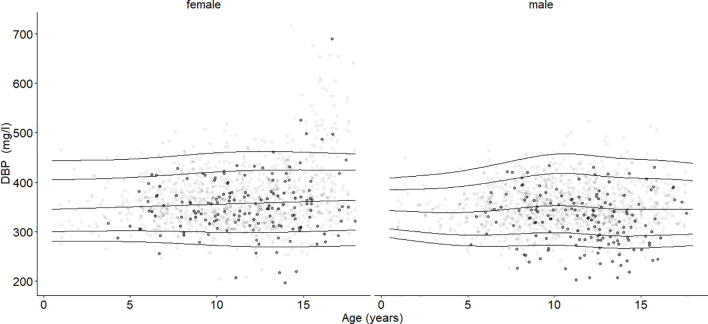
Results: Mean DBP values differed between males (347 mg/l) and females (366 mg/l) (p < 0.001). Age had no significant association with DBP levels. In both males and females, DBP levels remained relatively stable from infancy through late adolescence. Children and adolescents with obesity had lower mean DBP levels compared with normal-weight subjects (ß = -14.28, p < 0.001). The BMI-SDS was inversely associated with DBP levels in males (ß = -5.7, p < 0.001). Female subjects using oral contraceptives had higher levels of DBP (ß = 141.38, p < 0.001). DBP was positively associated with the vitamin D metabolites: 25(OH)D3 (females: ß = 0.8, p < 0.001; males: ß = 1.2, p < 0.001) and 1,25(OH)2-D3 (females: ß = 0.3, p < 0.001; males: ß = 0.4, p < 0.001). An inverse association between osteocalcin and DBP (females: ß = -0.1, p < 0.022; males: ß = -0.1, p = 0.027) was found. CRP levels were also positively associated with DBP levels (females: ß = 2.8, p = 0.001; males: ß = 5.1, p < 0.001).
Conclusion: We established age- and sex-specific reference ranges for the serum concentration of DBP. We suggest that BMI, pubertal stages, oral contraceptive use, and inflammation markers need to be considered when interpreting DBP as a stabilizer and regulator of vitamin D metabolism and vitamin D status in children and adolescents.
期刊介绍:
Frontiers in Endocrinology is a field journal of the "Frontiers in" journal series.
In today’s world, endocrinology is becoming increasingly important as it underlies many of the challenges societies face - from obesity and diabetes to reproduction, population control and aging. Endocrinology covers a broad field from basic molecular and cellular communication through to clinical care and some of the most crucial public health issues. The journal, thus, welcomes outstanding contributions in any domain of endocrinology.
Frontiers in Endocrinology publishes articles on the most outstanding discoveries across a wide research spectrum of Endocrinology. The mission of Frontiers in Endocrinology is to bring all relevant Endocrinology areas together on a single platform.






 京公网安备 11010802042870号
京ICP备2023020795号-1
京公网安备 11010802042870号
京ICP备2023020795号-1

 分享
分享
 求助内容:
求助内容: 应助结果提醒方式:
 扫码关注我们
