Shunichiro Tomura, Melanie J Wilkinson, Mark Cooper, Owen Powell
{"title":"Improved genomic prediction performance with ensembles of diverse models.","authors":"Shunichiro Tomura, Melanie J Wilkinson, Mark Cooper, Owen Powell","doi":"10.1093/g3journal/jkaf048","DOIUrl":null,"url":null,"abstract":"<p><p>The improvement of selection accuracy of genomic prediction is a key factor in accelerating genetic gain for crop breeding. Traditionally, efforts have focused on developing superior individual genomic prediction models. However, this approach has limitations due to the absence of a consistently \"best\" individual genomic prediction model, as suggested by the No Free Lunch Theorem. The No Free Lunch Theorem states that the performance of an individual prediction model is expected to be equivalent to the others when averaged across all prediction scenarios. To address this, we explored an alternative method: combining multiple genomic prediction models into an ensemble. The investigation of ensembles of prediction models is motivated by the Diversity Prediction Theorem, which indicates the prediction error of the many-model ensemble should be less than the average error of the individual models due to the diversity of predictions among the individual models. To investigate the implications of the No Free Lunch and Diversity Prediction Theorems, we developed a naïve ensemble-average model, which equally weights the predicted phenotypes of individual models. We evaluated this model using 2 traits influencing crop yield-days to anthesis and tiller number per plant-in the teosinte nested association mapping dataset. The results show that the ensemble approach increased prediction accuracies and reduced prediction errors over individual genomic prediction models. The advantage of the ensemble was derived from the diverse predictions among the individual models, suggesting the ensemble captures a more comprehensive view of the genomic architecture of these complex traits. These results are in accordance with the expectations of the Diversity Prediction Theorem and suggest that ensemble approaches can enhance genomic prediction performance and accelerate genetic gain in crop breeding programs.</p>","PeriodicalId":12468,"journal":{"name":"G3: Genes|Genomes|Genetics","volume":" ","pages":""},"PeriodicalIF":2.2000,"publicationDate":"2025-05-08","publicationTypes":"Journal Article","fieldsOfStudy":null,"isOpenAccess":false,"openAccessPdf":"https://www.ncbi.nlm.nih.gov/pmc/articles/PMC12060242/pdf/","citationCount":"0","resultStr":null,"platform":"Semanticscholar","paperid":null,"PeriodicalName":"G3: Genes|Genomes|Genetics","FirstCategoryId":"99","ListUrlMain":"https://doi.org/10.1093/g3journal/jkaf048","RegionNum":3,"RegionCategory":"生物学","ArticlePicture":[],"TitleCN":null,"AbstractTextCN":null,"PMCID":null,"EPubDate":"","PubModel":"","JCR":"Q3","JCRName":"GENETICS & HEREDITY","Score":null,"Total":0}
引用次数: 0
Abstract
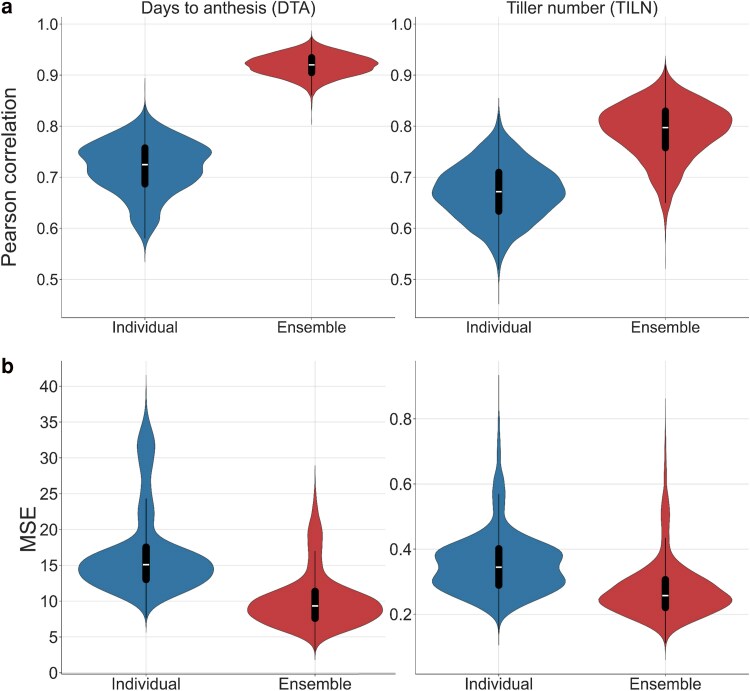
The improvement of selection accuracy of genomic prediction is a key factor in accelerating genetic gain for crop breeding. Traditionally, efforts have focused on developing superior individual genomic prediction models. However, this approach has limitations due to the absence of a consistently "best" individual genomic prediction model, as suggested by the No Free Lunch Theorem. The No Free Lunch Theorem states that the performance of an individual prediction model is expected to be equivalent to the others when averaged across all prediction scenarios. To address this, we explored an alternative method: combining multiple genomic prediction models into an ensemble. The investigation of ensembles of prediction models is motivated by the Diversity Prediction Theorem, which indicates the prediction error of the many-model ensemble should be less than the average error of the individual models due to the diversity of predictions among the individual models. To investigate the implications of the No Free Lunch and Diversity Prediction Theorems, we developed a naïve ensemble-average model, which equally weights the predicted phenotypes of individual models. We evaluated this model using 2 traits influencing crop yield-days to anthesis and tiller number per plant-in the teosinte nested association mapping dataset. The results show that the ensemble approach increased prediction accuracies and reduced prediction errors over individual genomic prediction models. The advantage of the ensemble was derived from the diverse predictions among the individual models, suggesting the ensemble captures a more comprehensive view of the genomic architecture of these complex traits. These results are in accordance with the expectations of the Diversity Prediction Theorem and suggest that ensemble approaches can enhance genomic prediction performance and accelerate genetic gain in crop breeding programs.
期刊介绍:
G3: Genes, Genomes, Genetics provides a forum for the publication of high‐quality foundational research, particularly research that generates useful genetic and genomic information such as genome maps, single gene studies, genome‐wide association and QTL studies, as well as genome reports, mutant screens, and advances in methods and technology. The Editorial Board of G3 believes that rapid dissemination of these data is the necessary foundation for analysis that leads to mechanistic insights.
G3, published by the Genetics Society of America, meets the critical and growing need of the genetics community for rapid review and publication of important results in all areas of genetics. G3 offers the opportunity to publish the puzzling finding or to present unpublished results that may not have been submitted for review and publication due to a perceived lack of a potential high-impact finding. G3 has earned the DOAJ Seal, which is a mark of certification for open access journals, awarded by DOAJ to journals that achieve a high level of openness, adhere to Best Practice and high publishing standards.





 京公网安备 11010802042870号
京ICP备2023020795号-1
京公网安备 11010802042870号
京ICP备2023020795号-1

 分享
分享
 求助内容:
求助内容: 应助结果提醒方式:
 扫码关注我们
