Peter Simons, Virginie Bondu, Laura Shevy, Stephen Young, Angela Wandinger-Ness, Cristian G Bologa, Tione Buranda
{"title":"A model for predicting bacteremia species based on host immune response.","authors":"Peter Simons, Virginie Bondu, Laura Shevy, Stephen Young, Angela Wandinger-Ness, Cristian G Bologa, Tione Buranda","doi":"10.3389/fcimb.2025.1451293","DOIUrl":null,"url":null,"abstract":"<p><strong>Introduction: </strong>Clinicians encounter significant challenges in quickly and accurately identifying the bacterial species responsible for patient bacteremia and in selecting appropriate antibiotics for timely treatment. This study introduces a novel approach that combines immune response data from routine blood counts with assessments of immune cell activation, specifically through quantitative measurements of Rho family GTPase activity. The combined data were used to develop a machine-learning model capable of distinguishing specific classes of bacteria and their associations.</p><p><strong>Methods: </strong>We aimed to determine whether different classes of bacteria elicit distinct patterns of host immune responses, as indicated by quantitative differences in leukocyte populations from routine complete blood counts with differential. Concurrently, we conducted quantitative measurements of activated Rac1 (Rac1•GTP) levels using a novel 'G-Trap assay' we developed. With the G-Trap, we measured Rac1•GTP in peripheral blood monocytes (PBMC) and polymorphonuclear (PMN) cells from blood samples collected from 28 culture-positive patients and over 80 non-infected patients used as controls.</p><p><strong>Results: </strong>Our findings indicated that 18 of the 28 patients with bacteremia showed an increase of ≥ 3-fold in Rac1•GTP levels compared to the controls. The remaining ten patients with bacteremia exhibited either neutrophilia or pancytopenia and displayed normal to below-normal Rac1 GTPase activity, which is consistent with bacteria-induced immunosuppression. To analyze the data, we employed partial least squares discriminant analysis (PLS-DA), a supervised method that optimizes group separation and aids in building a novel machine-learning model for pathogen identification.</p><p><strong>Discussion: </strong>The results demonstrated that PLS-DA effectively differentiates between specific pathogen groups, and external validation confirmed the predictive model's utility. Given that bacterial culture confirmation may take several days, our study underscores the potential of combining routine assays with a machine-learning model as a valuable clinical decision-support tool. This approach could enable prompt and accurate treatment on the same day that patients present to the clinic.</p>","PeriodicalId":12458,"journal":{"name":"Frontiers in Cellular and Infection Microbiology","volume":"15 ","pages":"1451293"},"PeriodicalIF":4.8000,"publicationDate":"2025-02-18","publicationTypes":"Journal Article","fieldsOfStudy":null,"isOpenAccess":false,"openAccessPdf":"https://www.ncbi.nlm.nih.gov/pmc/articles/PMC11876111/pdf/","citationCount":"0","resultStr":null,"platform":"Semanticscholar","paperid":null,"PeriodicalName":"Frontiers in Cellular and Infection Microbiology","FirstCategoryId":"3","ListUrlMain":"https://doi.org/10.3389/fcimb.2025.1451293","RegionNum":2,"RegionCategory":"医学","ArticlePicture":[],"TitleCN":null,"AbstractTextCN":null,"PMCID":null,"EPubDate":"2025/1/1 0:00:00","PubModel":"eCollection","JCR":"Q2","JCRName":"IMMUNOLOGY","Score":null,"Total":0}
引用次数: 0
Abstract
Introduction: Clinicians encounter significant challenges in quickly and accurately identifying the bacterial species responsible for patient bacteremia and in selecting appropriate antibiotics for timely treatment. This study introduces a novel approach that combines immune response data from routine blood counts with assessments of immune cell activation, specifically through quantitative measurements of Rho family GTPase activity. The combined data were used to develop a machine-learning model capable of distinguishing specific classes of bacteria and their associations.
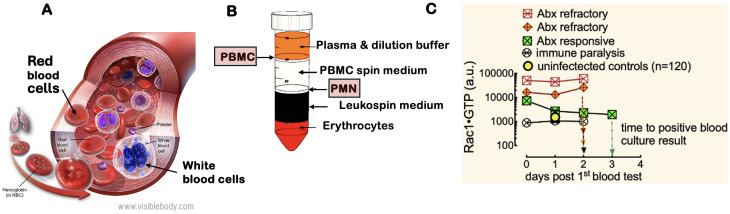
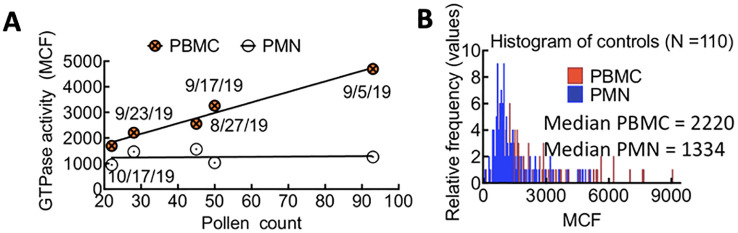
Methods: We aimed to determine whether different classes of bacteria elicit distinct patterns of host immune responses, as indicated by quantitative differences in leukocyte populations from routine complete blood counts with differential. Concurrently, we conducted quantitative measurements of activated Rac1 (Rac1•GTP) levels using a novel 'G-Trap assay' we developed. With the G-Trap, we measured Rac1•GTP in peripheral blood monocytes (PBMC) and polymorphonuclear (PMN) cells from blood samples collected from 28 culture-positive patients and over 80 non-infected patients used as controls.
Results: Our findings indicated that 18 of the 28 patients with bacteremia showed an increase of ≥ 3-fold in Rac1•GTP levels compared to the controls. The remaining ten patients with bacteremia exhibited either neutrophilia or pancytopenia and displayed normal to below-normal Rac1 GTPase activity, which is consistent with bacteria-induced immunosuppression. To analyze the data, we employed partial least squares discriminant analysis (PLS-DA), a supervised method that optimizes group separation and aids in building a novel machine-learning model for pathogen identification.
Discussion: The results demonstrated that PLS-DA effectively differentiates between specific pathogen groups, and external validation confirmed the predictive model's utility. Given that bacterial culture confirmation may take several days, our study underscores the potential of combining routine assays with a machine-learning model as a valuable clinical decision-support tool. This approach could enable prompt and accurate treatment on the same day that patients present to the clinic.
期刊介绍:
Frontiers in Cellular and Infection Microbiology is a leading specialty journal, publishing rigorously peer-reviewed research across all pathogenic microorganisms and their interaction with their hosts. Chief Editor Yousef Abu Kwaik, University of Louisville is supported by an outstanding Editorial Board of international experts. This multidisciplinary open-access journal is at the forefront of disseminating and communicating scientific knowledge and impactful discoveries to researchers, academics, clinicians and the public worldwide.
Frontiers in Cellular and Infection Microbiology includes research on bacteria, fungi, parasites, viruses, endosymbionts, prions and all microbial pathogens as well as the microbiota and its effect on health and disease in various hosts. The research approaches include molecular microbiology, cellular microbiology, gene regulation, proteomics, signal transduction, pathogenic evolution, genomics, structural biology, and virulence factors as well as model hosts. Areas of research to counteract infectious agents by the host include the host innate and adaptive immune responses as well as metabolic restrictions to various pathogenic microorganisms, vaccine design and development against various pathogenic microorganisms, and the mechanisms of antibiotic resistance and its countermeasures.





 京公网安备 11010802042870号
京ICP备2023020795号-1
京公网安备 11010802042870号
京ICP备2023020795号-1

 分享
分享
 求助内容:
求助内容: 应助结果提醒方式:
 扫码关注我们
