Na Deng, Siqin Xie, Qin Liu, Huiyi Peng, Leyao Fang, Junxi Shen, Xiaoyuan Lin
{"title":"The intestinal microbiota modulates the visceral sensitivity involved in IBS induced by restraint combined with tail clustering.","authors":"Na Deng, Siqin Xie, Qin Liu, Huiyi Peng, Leyao Fang, Junxi Shen, Xiaoyuan Lin","doi":"10.3389/fcimb.2025.1549617","DOIUrl":null,"url":null,"abstract":"<p><strong>Objective: </strong>To compare three common stimuli that induce emotional stress to identify the optimal method for establishing an animal model that aligns with the clinical pathogenesis of irritable bowel syndrome (IBS) and to explore the gut microbiota mechanisms underlying IBS development.</p><p><strong>Methods: </strong>Thirty-six SPF-grade female Kunming mice were randomly divided into four groups: the normal control (NC) group, the restraint stress (BM) group, the tail clamp stress (CTM) group, and the restraint combined with tail clamp stress (BCTM) group, with 9 mice in each group. The NC group was fed normally without any stimulation. The BM group was subjected to restraint stress. The CTM group received intermittent tail clamp stress. The BCTM group underwent both restraint stress and intermittent tail clamp stress. The stimulation time for each group was 1 hour, and the modeling duration was 7 days. General behavioral changes in the mice were observed. The fecal water content was measured and calculated. The pain threshold, gastric residue rate, small intestine propulsion rate, and serum levels of short-chain fatty acids (SCFAs), serotonin (5-HT), interleukin-10 (IL-10), and tumor necrosis factor-alpha (TNF-α) were assessed. Histopathological analysis of the small intestine and colon tissues was performed. 16S rRNA high-throughput sequencing was subsequently conducted. The effects of different stimuli on mouse symptoms, gastrointestinal motility, visceral hypersensitivity, inflammation levels, and the gut microbiota were analyzed, and correlation analysis was performed.</p><p><strong>Results: </strong>Compared with the NC group, the BM, CTM, and BCTM groups of mice presented varying degrees of emotional hyperreactivity, accompanied by significantly reduced food intake and fecal water content and markedly elevated levels of inflammation, all of which are indicative of IBS symptoms. Among them, the BCTM group presented the most pronounced emotional hyperreactivity and irritability. The mice in the BCTM group had significantly higher gastric residue rates and 5-HT levels, with a marked reduction in pain tolerance. The gut microbiota of the mice in the BM, CTM, and BCTM groups all exhibited dysbiosis, with changes in the diversity, structural composition, and function of the microbial community. Specific bacterial taxa were enriched in each stress group, and their corresponding KEGG pathways were also significantly altered. Correlation analysis revealed that SCFAs were significantly positively correlated with the small intestine propulsion rate, whereas 5-HT was positively correlated with the gastric residue rate and negatively correlated with the pain threshold. SCFAs were positively correlated with IL-10 and TNF-α, and 5-HT was significantly positively correlated with IL-10 and TNF-α. In the BCTM group, the characteristic bacteria <i>Acinetobacter</i> and <i>Akkermansia</i> were significantly correlated with SCFAs and 5-HT.</p><p><strong>Conclusion: </strong>1. The restraint combined with the tail clamp stress method is superior among the three stress protocols and successfully induces the IBS mouse model. 2. <i>Acinetobacte</i>r and <i>Akkermansia</i> may contribute to the development of IBS induced by restraint combined with tail clamp stress through the regulation of SCFAs and 5-HT.</p>","PeriodicalId":12458,"journal":{"name":"Frontiers in Cellular and Infection Microbiology","volume":"15 ","pages":"1549617"},"PeriodicalIF":4.8000,"publicationDate":"2025-02-20","publicationTypes":"Journal Article","fieldsOfStudy":null,"isOpenAccess":false,"openAccessPdf":"https://www.ncbi.nlm.nih.gov/pmc/articles/PMC11882872/pdf/","citationCount":"0","resultStr":null,"platform":"Semanticscholar","paperid":null,"PeriodicalName":"Frontiers in Cellular and Infection Microbiology","FirstCategoryId":"3","ListUrlMain":"https://doi.org/10.3389/fcimb.2025.1549617","RegionNum":2,"RegionCategory":"医学","ArticlePicture":[],"TitleCN":null,"AbstractTextCN":null,"PMCID":null,"EPubDate":"2025/1/1 0:00:00","PubModel":"eCollection","JCR":"Q2","JCRName":"IMMUNOLOGY","Score":null,"Total":0}
引用次数: 0
Abstract
Objective: To compare three common stimuli that induce emotional stress to identify the optimal method for establishing an animal model that aligns with the clinical pathogenesis of irritable bowel syndrome (IBS) and to explore the gut microbiota mechanisms underlying IBS development.
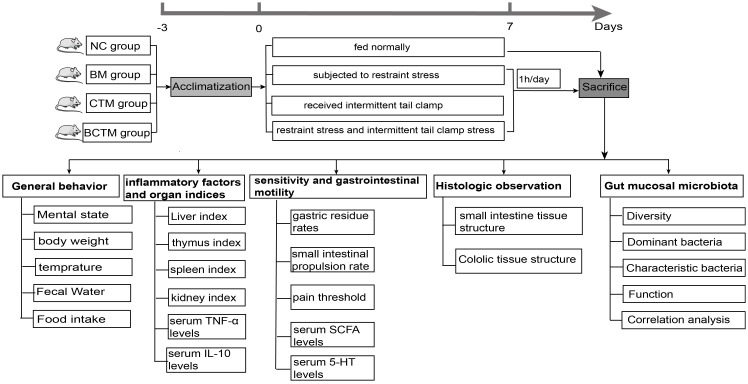
Methods: Thirty-six SPF-grade female Kunming mice were randomly divided into four groups: the normal control (NC) group, the restraint stress (BM) group, the tail clamp stress (CTM) group, and the restraint combined with tail clamp stress (BCTM) group, with 9 mice in each group. The NC group was fed normally without any stimulation. The BM group was subjected to restraint stress. The CTM group received intermittent tail clamp stress. The BCTM group underwent both restraint stress and intermittent tail clamp stress. The stimulation time for each group was 1 hour, and the modeling duration was 7 days. General behavioral changes in the mice were observed. The fecal water content was measured and calculated. The pain threshold, gastric residue rate, small intestine propulsion rate, and serum levels of short-chain fatty acids (SCFAs), serotonin (5-HT), interleukin-10 (IL-10), and tumor necrosis factor-alpha (TNF-α) were assessed. Histopathological analysis of the small intestine and colon tissues was performed. 16S rRNA high-throughput sequencing was subsequently conducted. The effects of different stimuli on mouse symptoms, gastrointestinal motility, visceral hypersensitivity, inflammation levels, and the gut microbiota were analyzed, and correlation analysis was performed.
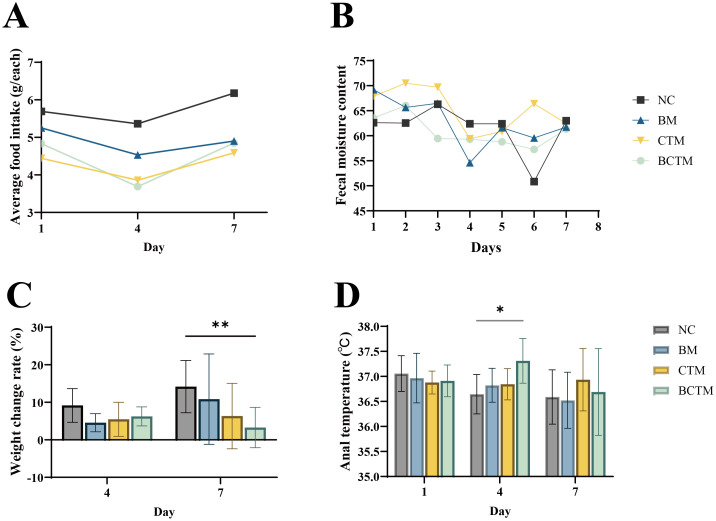
Results: Compared with the NC group, the BM, CTM, and BCTM groups of mice presented varying degrees of emotional hyperreactivity, accompanied by significantly reduced food intake and fecal water content and markedly elevated levels of inflammation, all of which are indicative of IBS symptoms. Among them, the BCTM group presented the most pronounced emotional hyperreactivity and irritability. The mice in the BCTM group had significantly higher gastric residue rates and 5-HT levels, with a marked reduction in pain tolerance. The gut microbiota of the mice in the BM, CTM, and BCTM groups all exhibited dysbiosis, with changes in the diversity, structural composition, and function of the microbial community. Specific bacterial taxa were enriched in each stress group, and their corresponding KEGG pathways were also significantly altered. Correlation analysis revealed that SCFAs were significantly positively correlated with the small intestine propulsion rate, whereas 5-HT was positively correlated with the gastric residue rate and negatively correlated with the pain threshold. SCFAs were positively correlated with IL-10 and TNF-α, and 5-HT was significantly positively correlated with IL-10 and TNF-α. In the BCTM group, the characteristic bacteria Acinetobacter and Akkermansia were significantly correlated with SCFAs and 5-HT.
Conclusion: 1. The restraint combined with the tail clamp stress method is superior among the three stress protocols and successfully induces the IBS mouse model. 2. Acinetobacter and Akkermansia may contribute to the development of IBS induced by restraint combined with tail clamp stress through the regulation of SCFAs and 5-HT.
期刊介绍:
Frontiers in Cellular and Infection Microbiology is a leading specialty journal, publishing rigorously peer-reviewed research across all pathogenic microorganisms and their interaction with their hosts. Chief Editor Yousef Abu Kwaik, University of Louisville is supported by an outstanding Editorial Board of international experts. This multidisciplinary open-access journal is at the forefront of disseminating and communicating scientific knowledge and impactful discoveries to researchers, academics, clinicians and the public worldwide.
Frontiers in Cellular and Infection Microbiology includes research on bacteria, fungi, parasites, viruses, endosymbionts, prions and all microbial pathogens as well as the microbiota and its effect on health and disease in various hosts. The research approaches include molecular microbiology, cellular microbiology, gene regulation, proteomics, signal transduction, pathogenic evolution, genomics, structural biology, and virulence factors as well as model hosts. Areas of research to counteract infectious agents by the host include the host innate and adaptive immune responses as well as metabolic restrictions to various pathogenic microorganisms, vaccine design and development against various pathogenic microorganisms, and the mechanisms of antibiotic resistance and its countermeasures.





 京公网安备 11010802042870号
京ICP备2023020795号-1
京公网安备 11010802042870号
京ICP备2023020795号-1

 分享
分享
 求助内容:
求助内容: 应助结果提醒方式:
 扫码关注我们
