A novel recurrent ARL3 variant c.209G > A p.(Gly70Glu) causes variable non-syndromic dominant retinal dystrophy with defective lipidated protein transport in human retinal stem cell models.
Julio C Corral-Serrano, Veronika Vaclavik, Stijn Van de Sompele, Karolina Kaminska, Katarina Jovanovic, Pascal Escher, Filip Van den Broeck, Francesca Cancellieri, Vasileios Toulis, Bart P Leroy, Julie de Zaeytijd, Zhixuan You, Daniele Ottaviani, Mathieu Quinodoz, Gabriela Bordeanu, Alison J Hardcastle, Frauke Coppieters, Viet H Tran, Michael E Cheetham, Carlo Rivolta, Elfride De Baere
{"title":"A novel recurrent ARL3 variant c.209G > A p.(Gly70Glu) causes variable non-syndromic dominant retinal dystrophy with defective lipidated protein transport in human retinal stem cell models.","authors":"Julio C Corral-Serrano, Veronika Vaclavik, Stijn Van de Sompele, Karolina Kaminska, Katarina Jovanovic, Pascal Escher, Filip Van den Broeck, Francesca Cancellieri, Vasileios Toulis, Bart P Leroy, Julie de Zaeytijd, Zhixuan You, Daniele Ottaviani, Mathieu Quinodoz, Gabriela Bordeanu, Alison J Hardcastle, Frauke Coppieters, Viet H Tran, Michael E Cheetham, Carlo Rivolta, Elfride De Baere","doi":"10.1093/hmg/ddaf029","DOIUrl":null,"url":null,"abstract":"<p><p>Inherited retinal dystrophies (IRDs) are characterized by their high clinical and genetic heterogeneity. Despite significant advances in the identification of genes associated with IRDs, many individuals and families still have not received a definite molecular diagnosis. Here, we performed clinical examinations and conducted genetic testing in five families with IRD. Whole exome sequencing in the five index cases revealed a heterozygous missense variant, c.209G > A, p.(Gly70Glu) in the ARL3 gene (NM_004311.4). A de novo occurrence was demonstrated in one affected individual and autosomal dominant inheritance in nine affected individuals from four families. Their phenotypes displayed variable expressivity, and ranged from rod-cone to cone-rod dystrophy with photophobia. Human induced pluripotent stem cells (hiPSCs) were generated from dermal fibroblasts from the individual with the de novo ARL3 variant and were differentiated to retinal pigment epithelium cells (RPE) and retinal organoids. Immunofluorescence analyses in these models showed decreased INPP5E localization within the cilia of RPE and connecting cilia of retinal organoids, as well as reduced PDE6⍺ in the organoid outer segments, suggesting that the p.(Gly70Glu) variant causes IRD by defective lipidated protein transport in photoreceptors and/or RPE. This is the first study of ARL3 dysfunction in human retinal cells, highlighting its importance for retinal homeostasis, as well as a variability in the clinical presentation of ARL3-associated IRD.</p>","PeriodicalId":13070,"journal":{"name":"Human molecular genetics","volume":" ","pages":"821-834"},"PeriodicalIF":3.2000,"publicationDate":"2025-04-17","publicationTypes":"Journal Article","fieldsOfStudy":null,"isOpenAccess":false,"openAccessPdf":"https://www.ncbi.nlm.nih.gov/pmc/articles/PMC12010153/pdf/","citationCount":"0","resultStr":null,"platform":"Semanticscholar","paperid":null,"PeriodicalName":"Human molecular genetics","FirstCategoryId":"99","ListUrlMain":"https://doi.org/10.1093/hmg/ddaf029","RegionNum":2,"RegionCategory":"生物学","ArticlePicture":[],"TitleCN":null,"AbstractTextCN":null,"PMCID":null,"EPubDate":"","PubModel":"","JCR":"Q3","JCRName":"BIOCHEMISTRY & MOLECULAR BIOLOGY","Score":null,"Total":0}
引用次数: 0
Abstract
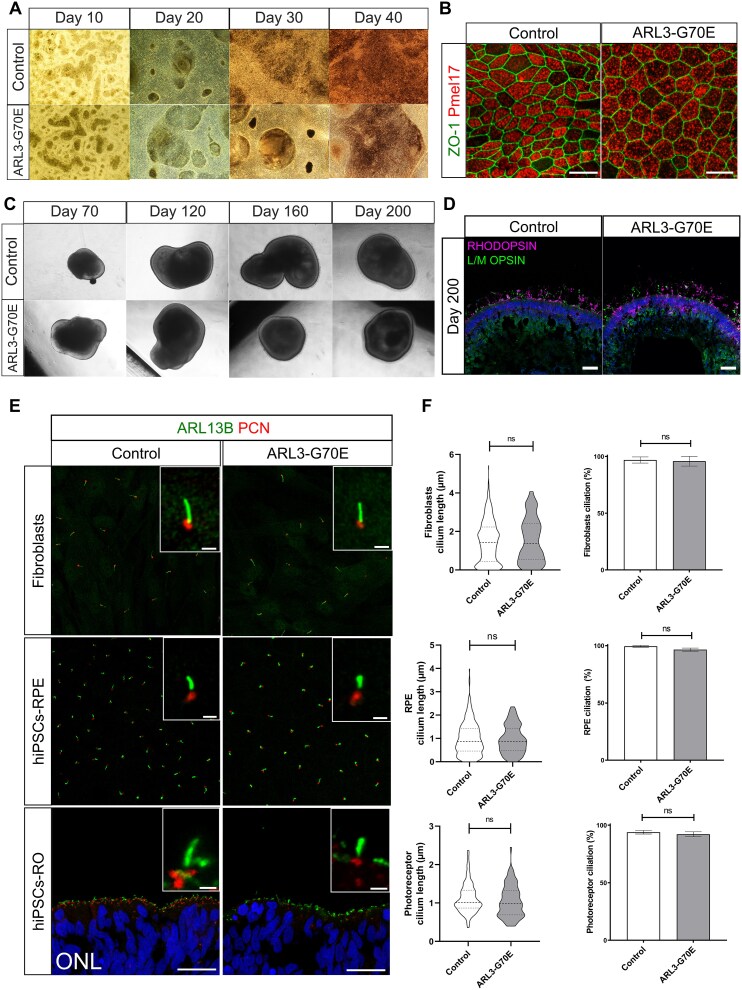
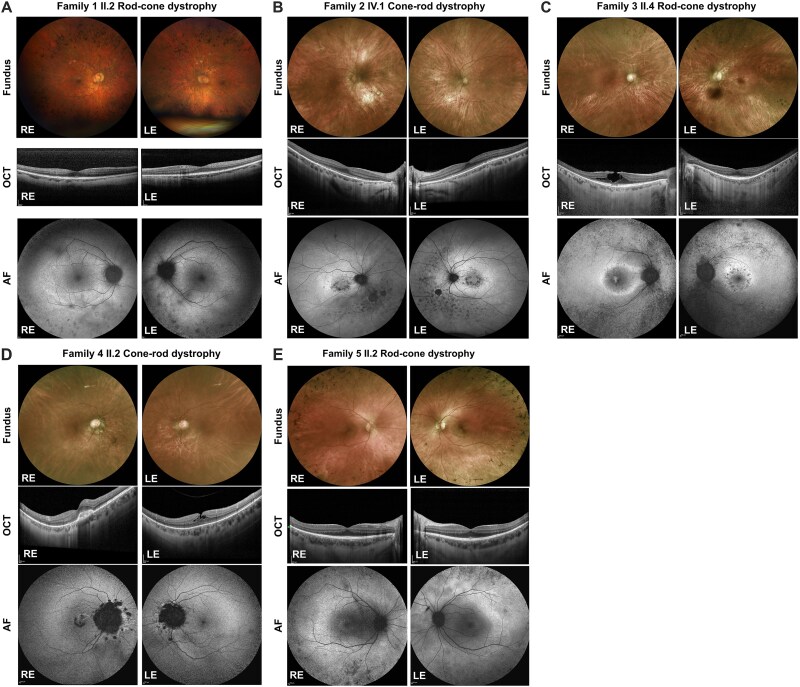
Inherited retinal dystrophies (IRDs) are characterized by their high clinical and genetic heterogeneity. Despite significant advances in the identification of genes associated with IRDs, many individuals and families still have not received a definite molecular diagnosis. Here, we performed clinical examinations and conducted genetic testing in five families with IRD. Whole exome sequencing in the five index cases revealed a heterozygous missense variant, c.209G > A, p.(Gly70Glu) in the ARL3 gene (NM_004311.4). A de novo occurrence was demonstrated in one affected individual and autosomal dominant inheritance in nine affected individuals from four families. Their phenotypes displayed variable expressivity, and ranged from rod-cone to cone-rod dystrophy with photophobia. Human induced pluripotent stem cells (hiPSCs) were generated from dermal fibroblasts from the individual with the de novo ARL3 variant and were differentiated to retinal pigment epithelium cells (RPE) and retinal organoids. Immunofluorescence analyses in these models showed decreased INPP5E localization within the cilia of RPE and connecting cilia of retinal organoids, as well as reduced PDE6⍺ in the organoid outer segments, suggesting that the p.(Gly70Glu) variant causes IRD by defective lipidated protein transport in photoreceptors and/or RPE. This is the first study of ARL3 dysfunction in human retinal cells, highlighting its importance for retinal homeostasis, as well as a variability in the clinical presentation of ARL3-associated IRD.
在人视网膜干细胞模型中,一种新的复发性ARL3变体c.209G > A p.(Gly70Glu)引起可变的非综合征显性视网膜营养不良,伴脂质蛋白转运缺陷。
遗传性视网膜营养不良(IRDs)具有较高的临床和遗传异质性。尽管在鉴定与ird相关的基因方面取得了重大进展,但许多个人和家庭仍然没有得到明确的分子诊断。在这里,我们对5个患有IRD的家庭进行了临床检查和基因检测。5个指标病例的全外显子组测序结果显示,ARL3基因(NM_004311.4)存在杂合错义变异c.209G > a, p.(Gly70Glu)。在4个家族的9个患者中发现常染色体显性遗传。它们的表型表现出不同的表达性,从杆状-锥状到锥状-杆状营养不良伴畏光。人类诱导多能干细胞(hiPSCs)是由ARL3突变个体的真皮成纤维细胞生成的,并分化为视网膜色素上皮细胞(RPE)和视网膜类器官。这些模型的免疫荧光分析显示,INPP5E在RPE纤毛和视网膜类器官连接纤毛内的定位减少,以及类器官外段PDE6的减少,表明p.(Gly70Glu)变体通过光感受器和/或RPE中脂化蛋白运输缺陷导致IRD。这是人类视网膜细胞中ARL3功能障碍的第一个研究,强调了它对视网膜稳态的重要性,以及ARL3相关IRD临床表现的变异性。
期刊介绍:
Human Molecular Genetics concentrates on full-length research papers covering a wide range of topics in all aspects of human molecular genetics. These include:
the molecular basis of human genetic disease
developmental genetics
cancer genetics
neurogenetics
chromosome and genome structure and function
therapy of genetic disease
stem cells in human genetic disease and therapy, including the application of iPS cells
genome-wide association studies
mouse and other models of human diseases
functional genomics
computational genomics
In addition, the journal also publishes research on other model systems for the analysis of genes, especially when there is an obvious relevance to human genetics.




 京公网安备 11010802042870号
京ICP备2023020795号-1
京公网安备 11010802042870号
京ICP备2023020795号-1

 分享
分享
 求助内容:
求助内容: 应助结果提醒方式:
 扫码关注我们
