{"title":"Decouple-and-Couple Learning in Multi-Modal Brain Tumor Segmentation.","authors":"Fuan Xiao, Chaojie Ji, Zheng Zhang, Ruxin Wang","doi":"10.1109/JBHI.2025.3542394","DOIUrl":null,"url":null,"abstract":"<p><p>Exploiting multi-modal magnetic resonance imaging complementary information for brain tumor segmentation is still a challenging task. Existing methods are usually inclined to learn the joint representation of all tumor regions indiscriminately, thus salient sub-region or healthy tissue would be dominant during the training procedure, which leads to a biased and limited representation performance. In this study, a novel transformer-based multi-modal brain tumor segmentation approach is developed by decoupling and coupling strategy. First, Anatomy-induced Region Decoupler decouples the representation of the tumor scattered in different semantic sub-regions following anatomical view, which forces the model to fully learn intra-region representation separately with multiple modalities context. Additionally, we introduce the collaborative decoupling of the corresponding sub-region edge to serve auxiliary cues. We then design the Edge-supported Intra-region Coupler to separately couple edge and object learning within each anatomical sub-region structure. Lastly, the Mutual Cross-region Coupler is further applied to implement mutual improvement by coupling complementary gains among the above decoupled sub-regions. Extensive experiments clearly demonstrate that our method outperforms current state-of-the-arts for brain tumor segmentation on BRATS2018, BRATS2020, MSD, and BRATS2021 benchmarks while retaining high efficiency in the learning procedure.</p>","PeriodicalId":13073,"journal":{"name":"IEEE Journal of Biomedical and Health Informatics","volume":"PP ","pages":""},"PeriodicalIF":6.8000,"publicationDate":"2025-02-17","publicationTypes":"Journal Article","fieldsOfStudy":null,"isOpenAccess":false,"openAccessPdf":"","citationCount":"0","resultStr":null,"platform":"Semanticscholar","paperid":null,"PeriodicalName":"IEEE Journal of Biomedical and Health Informatics","FirstCategoryId":"5","ListUrlMain":"https://doi.org/10.1109/JBHI.2025.3542394","RegionNum":2,"RegionCategory":"医学","ArticlePicture":[],"TitleCN":null,"AbstractTextCN":null,"PMCID":null,"EPubDate":"","PubModel":"","JCR":"Q1","JCRName":"COMPUTER SCIENCE, INFORMATION SYSTEMS","Score":null,"Total":0}
引用次数: 0
Abstract
Exploiting multi-modal magnetic resonance imaging complementary information for brain tumor segmentation is still a challenging task. Existing methods are usually inclined to learn the joint representation of all tumor regions indiscriminately, thus salient sub-region or healthy tissue would be dominant during the training procedure, which leads to a biased and limited representation performance. In this study, a novel transformer-based multi-modal brain tumor segmentation approach is developed by decoupling and coupling strategy. First, Anatomy-induced Region Decoupler decouples the representation of the tumor scattered in different semantic sub-regions following anatomical view, which forces the model to fully learn intra-region representation separately with multiple modalities context. Additionally, we introduce the collaborative decoupling of the corresponding sub-region edge to serve auxiliary cues. We then design the Edge-supported Intra-region Coupler to separately couple edge and object learning within each anatomical sub-region structure. Lastly, the Mutual Cross-region Coupler is further applied to implement mutual improvement by coupling complementary gains among the above decoupled sub-regions. Extensive experiments clearly demonstrate that our method outperforms current state-of-the-arts for brain tumor segmentation on BRATS2018, BRATS2020, MSD, and BRATS2021 benchmarks while retaining high efficiency in the learning procedure.
期刊介绍:
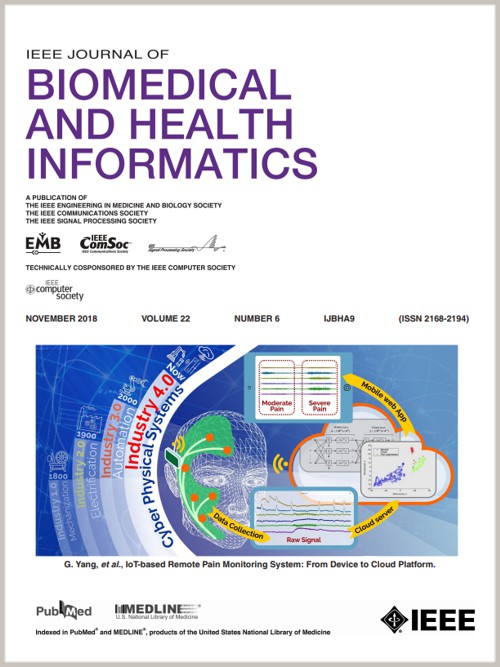
IEEE Journal of Biomedical and Health Informatics publishes original papers presenting recent advances where information and communication technologies intersect with health, healthcare, life sciences, and biomedicine. Topics include acquisition, transmission, storage, retrieval, management, and analysis of biomedical and health information. The journal covers applications of information technologies in healthcare, patient monitoring, preventive care, early disease diagnosis, therapy discovery, and personalized treatment protocols. It explores electronic medical and health records, clinical information systems, decision support systems, medical and biological imaging informatics, wearable systems, body area/sensor networks, and more. Integration-related topics like interoperability, evidence-based medicine, and secure patient data are also addressed.



 京公网安备 11010802042870号
京ICP备2023020795号-1
京公网安备 11010802042870号
京ICP备2023020795号-1

 分享
分享
 求助内容:
求助内容: 应助结果提醒方式:
 扫码关注我们
