Adriano Losso, Feng Feng, Barbara Beikircher, Stefan Mayr
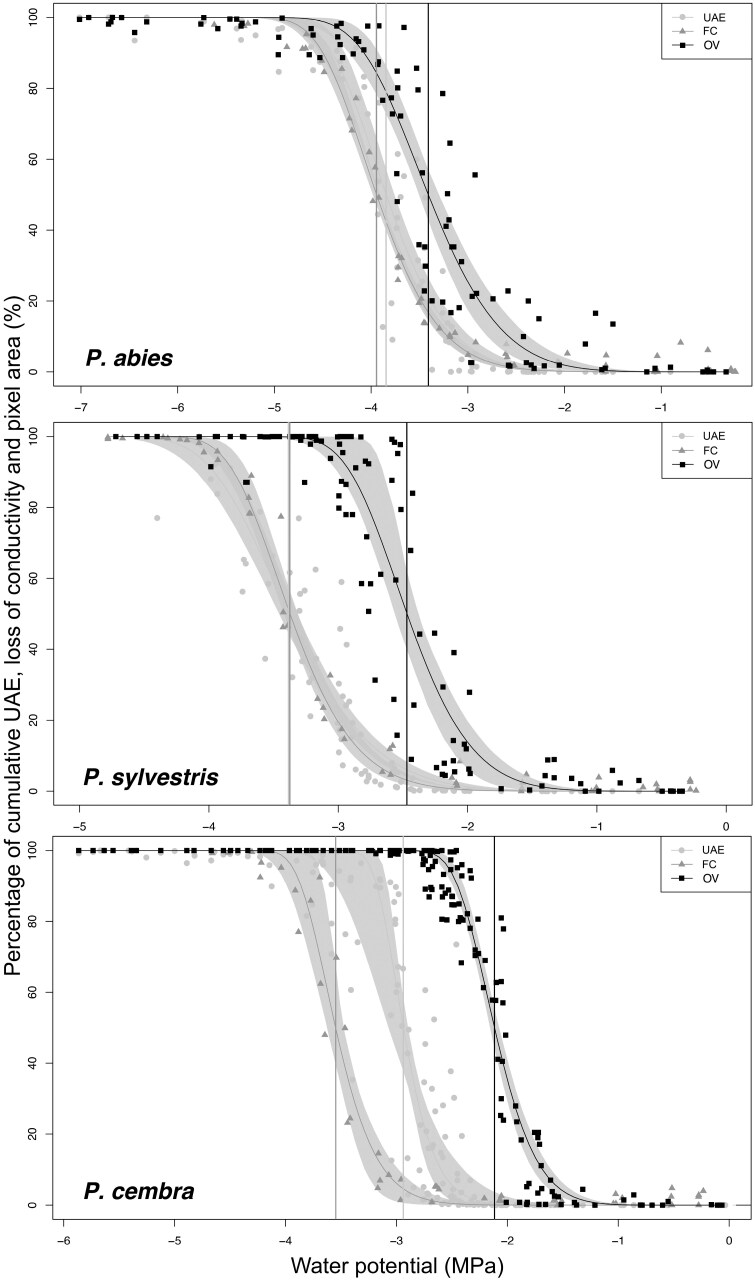
{"title":"Optical observations of embolism in three conifers overestimate the vulnerability of stem xylem to hydraulic dysfunction.","authors":"Adriano Losso, Feng Feng, Barbara Beikircher, Stefan Mayr","doi":"10.1093/jxb/eraf075","DOIUrl":null,"url":null,"abstract":"<p><p>Hydraulic failure due to drought stress is a major cause of forest decline. Many techniques have been developed to test the vulnerability of trees to drought-induced xylem embolism, each with advantages and limitations. We quantified drought vulnerability using optical vulnerability and ultrasonic acoustic emission (UAE) techniques by performing simultaneous measurements on branches of three conifers (Picea abies, Pinus sylvestris, and Pinus cembra). Results were compared with vulnerability curves obtained using the flow-centrifuge (FC) technique. With respect to the optical vulnerability method, the light transmission properties of the samples were analyzed to determine the xylem fraction observed. Optical vulnerability thresholds were 0.3-1.4 MPa higher than those obtained with UAE and FC techniques, which were similar overall. Xylem depths observed by optical vulnerability were limited to the peripheral 0.15-0.20 mm, as no light transmission was detected at greater depth. Light transmission was higher in saturated xylem than in dry. The results indicatet that xylem embolism detection by optical vulnerability is limited to thin, peripheral xylem layers, and that vulnerability thresholds may differ from those of thicker samples (>0.4 mm) measured with UAE and FC techniques. Therefore, optical vulnerability may not accurately reflect the general vulnerability of thick branches, as only peripheral xylem layers are analyzed. Changes in light transmission during dehydration must be considered.</p>","PeriodicalId":15820,"journal":{"name":"Journal of Experimental Botany","volume":" ","pages":"2864-2873"},"PeriodicalIF":5.7000,"publicationDate":"2025-07-02","publicationTypes":"Journal Article","fieldsOfStudy":null,"isOpenAccess":false,"openAccessPdf":"https://www.ncbi.nlm.nih.gov/pmc/articles/PMC12223502/pdf/","citationCount":"0","resultStr":null,"platform":"Semanticscholar","paperid":null,"PeriodicalName":"Journal of Experimental Botany","FirstCategoryId":"99","ListUrlMain":"https://doi.org/10.1093/jxb/eraf075","RegionNum":2,"RegionCategory":"生物学","ArticlePicture":[],"TitleCN":null,"AbstractTextCN":null,"PMCID":null,"EPubDate":"","PubModel":"","JCR":"Q1","JCRName":"PLANT SCIENCES","Score":null,"Total":0}
引用次数: 0
Abstract
Hydraulic failure due to drought stress is a major cause of forest decline. Many techniques have been developed to test the vulnerability of trees to drought-induced xylem embolism, each with advantages and limitations. We quantified drought vulnerability using optical vulnerability and ultrasonic acoustic emission (UAE) techniques by performing simultaneous measurements on branches of three conifers (Picea abies, Pinus sylvestris, and Pinus cembra). Results were compared with vulnerability curves obtained using the flow-centrifuge (FC) technique. With respect to the optical vulnerability method, the light transmission properties of the samples were analyzed to determine the xylem fraction observed. Optical vulnerability thresholds were 0.3-1.4 MPa higher than those obtained with UAE and FC techniques, which were similar overall. Xylem depths observed by optical vulnerability were limited to the peripheral 0.15-0.20 mm, as no light transmission was detected at greater depth. Light transmission was higher in saturated xylem than in dry. The results indicatet that xylem embolism detection by optical vulnerability is limited to thin, peripheral xylem layers, and that vulnerability thresholds may differ from those of thicker samples (>0.4 mm) measured with UAE and FC techniques. Therefore, optical vulnerability may not accurately reflect the general vulnerability of thick branches, as only peripheral xylem layers are analyzed. Changes in light transmission during dehydration must be considered.
期刊介绍:
The Journal of Experimental Botany publishes high-quality primary research and review papers in the plant sciences. These papers cover a range of disciplines from molecular and cellular physiology and biochemistry through whole plant physiology to community physiology.
Full-length primary papers should contribute to our understanding of how plants develop and function, and should provide new insights into biological processes. The journal will not publish purely descriptive papers or papers that report a well-known process in a species in which the process has not been identified previously. Articles should be concise and generally limited to 10 printed pages.





 京公网安备 11010802042870号
京ICP备2023020795号-1
京公网安备 11010802042870号
京ICP备2023020795号-1

 分享
分享
 求助内容:
求助内容: 应助结果提醒方式:
 扫码关注我们
