Effect of a Gamified Family-Based Exercise Intervention on Adherence to 24-Hour Movement Behavior Recommendations in Preschool Children: Single-Center Pragmatic Trial.
Gaizka Legarra-Gorgoñon, Yesenia García-Alonso, Robinson Ramírez-Vélez, Loreto Alonso-Martínez, Mikel Izquierdo, Alicia M Alonso-Martínez
{"title":"Effect of a Gamified Family-Based Exercise Intervention on Adherence to 24-Hour Movement Behavior Recommendations in Preschool Children: Single-Center Pragmatic Trial.","authors":"Gaizka Legarra-Gorgoñon, Yesenia García-Alonso, Robinson Ramírez-Vélez, Loreto Alonso-Martínez, Mikel Izquierdo, Alicia M Alonso-Martínez","doi":"10.2196/60185","DOIUrl":null,"url":null,"abstract":"<p><strong>Background: </strong>Adherence to 24-hour movement behavior recommendations, including physical activity (PA), sedentary time, and sleep, is essential for the healthy development of preschool children. Gamified family-based interventions have shown the potential to improve adherence to these guidelines, but evidence of their effectiveness among children is limited.</p><p><strong>Objective: </strong>This study aimed to evaluate the effectiveness of a gamified family-based exercise intervention in promoting adherence to 24-hour movement behavior recommendations among preschool-aged children.</p><p><strong>Methods: </strong>This 12-week study is a single-center, pragmatic randomized controlled trial that included 80 preschool children (56% boys) and their families, who were randomly assigned to either the gamification group (n=40) or the control group (n=40). The \"3, 2, 1 Move on Study\" incorporates family-oriented physical activities and gamification techniques to increase PA domains, reduce sedentary behavior, and improve sleep patterns. The primary outcome was to increase moderate to vigorous PA (MVPA) by 5 minutes/day, as measured by accelerometer at follow-up. Accelerometer-determined daily time spent (PA domains, sedentary behavior, and sleep), physical fitness (cardiorespiratory, speed-agility, muscular, physical fitness z-score), basic motor competencies (self-movement and object movement), and executive function (memory, cognitive flexibility, and inhibitory control) were also included as secondary outcomes.</p><p><strong>Results: </strong>The 71 participants included in the per-protocol analyses (32 girls, 45%; 39 boys, 55%) had a mean (SD) age of 5.0 (0.5) years. Change in MVPA per day after the intervention (12 weeks) increased in both groups by +25.3 (SD 24.6) minutes/day in the gamification group and +10.0 (SD 31.4) minutes/day in the routine care group, but no significant between-group differences were observed (8.62, 95% CI -5.72 to 22.95 minutes/day, ηp2=.025; P=.23). The analysis of secondary outcomes showed significant between-group mean differences in the change in physical behaviors derived from the accelerometers from baseline to follow-up of 26.44 (95% CI 8.93 to 43.94) minutes/day in favor of light PA (ηp2=.138; P=.01) and 30.88 (95% CI 4.36 to 57.41) minutes/day in favor of total PA, which corresponds to a large effect size (ηp2=.087; P=.02). Likewise, the gamification group substantially increased their score in standing long jump and physical fitness z-score from baseline (P<.05).</p><p><strong>Conclusions: </strong>In the \"3, 2, 1 Move on Study,\" a gamified intervention showed a modest but relevant increase in MVPA and other domains of 24-hour movement behavior among preschool-aged children. Therefore, gamified family-based interventions may provide a viable alternative to improve adherence to 24-hour movement behavior recommendations.</p>","PeriodicalId":14795,"journal":{"name":"JMIR Serious Games","volume":"13 ","pages":"e60185"},"PeriodicalIF":4.1000,"publicationDate":"2025-03-04","publicationTypes":"Journal Article","fieldsOfStudy":null,"isOpenAccess":false,"openAccessPdf":"https://www.ncbi.nlm.nih.gov/pmc/articles/PMC11896562/pdf/","citationCount":"0","resultStr":null,"platform":"Semanticscholar","paperid":null,"PeriodicalName":"JMIR Serious Games","FirstCategoryId":"3","ListUrlMain":"https://doi.org/10.2196/60185","RegionNum":2,"RegionCategory":"医学","ArticlePicture":[],"TitleCN":null,"AbstractTextCN":null,"PMCID":null,"EPubDate":"","PubModel":"","JCR":"Q1","JCRName":"HEALTH CARE SCIENCES & SERVICES","Score":null,"Total":0}
引用次数: 0
Abstract
Background: Adherence to 24-hour movement behavior recommendations, including physical activity (PA), sedentary time, and sleep, is essential for the healthy development of preschool children. Gamified family-based interventions have shown the potential to improve adherence to these guidelines, but evidence of their effectiveness among children is limited.
Objective: This study aimed to evaluate the effectiveness of a gamified family-based exercise intervention in promoting adherence to 24-hour movement behavior recommendations among preschool-aged children.
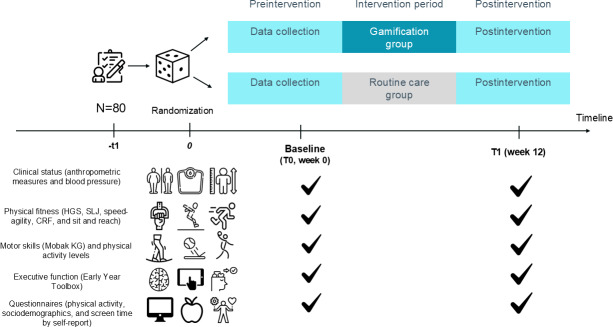
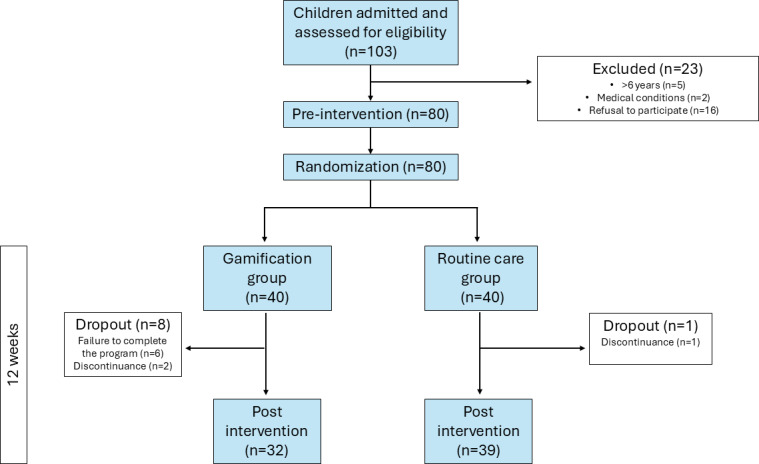
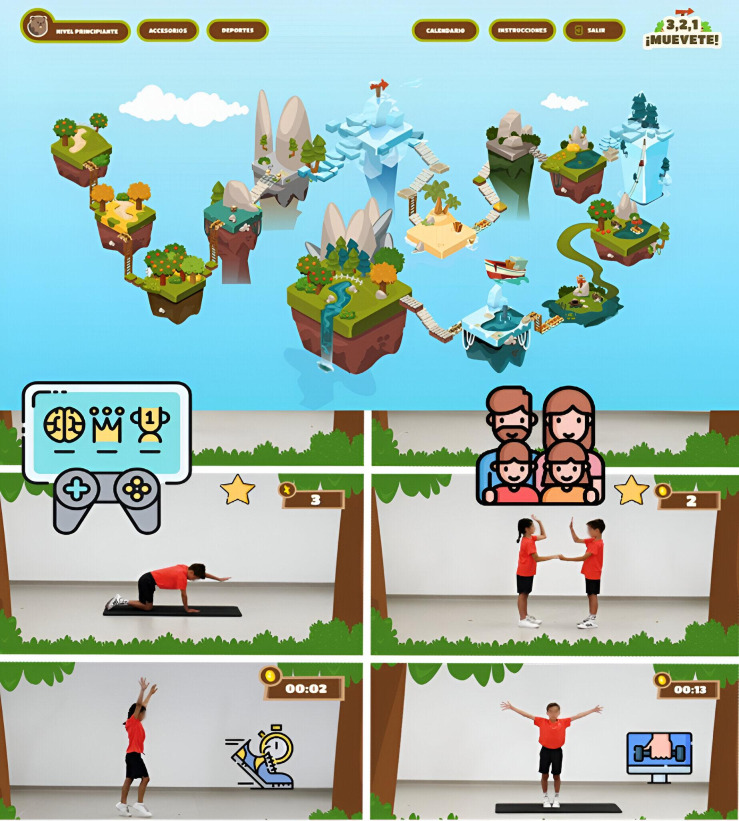
Methods: This 12-week study is a single-center, pragmatic randomized controlled trial that included 80 preschool children (56% boys) and their families, who were randomly assigned to either the gamification group (n=40) or the control group (n=40). The "3, 2, 1 Move on Study" incorporates family-oriented physical activities and gamification techniques to increase PA domains, reduce sedentary behavior, and improve sleep patterns. The primary outcome was to increase moderate to vigorous PA (MVPA) by 5 minutes/day, as measured by accelerometer at follow-up. Accelerometer-determined daily time spent (PA domains, sedentary behavior, and sleep), physical fitness (cardiorespiratory, speed-agility, muscular, physical fitness z-score), basic motor competencies (self-movement and object movement), and executive function (memory, cognitive flexibility, and inhibitory control) were also included as secondary outcomes.
Results: The 71 participants included in the per-protocol analyses (32 girls, 45%; 39 boys, 55%) had a mean (SD) age of 5.0 (0.5) years. Change in MVPA per day after the intervention (12 weeks) increased in both groups by +25.3 (SD 24.6) minutes/day in the gamification group and +10.0 (SD 31.4) minutes/day in the routine care group, but no significant between-group differences were observed (8.62, 95% CI -5.72 to 22.95 minutes/day, ηp2=.025; P=.23). The analysis of secondary outcomes showed significant between-group mean differences in the change in physical behaviors derived from the accelerometers from baseline to follow-up of 26.44 (95% CI 8.93 to 43.94) minutes/day in favor of light PA (ηp2=.138; P=.01) and 30.88 (95% CI 4.36 to 57.41) minutes/day in favor of total PA, which corresponds to a large effect size (ηp2=.087; P=.02). Likewise, the gamification group substantially increased their score in standing long jump and physical fitness z-score from baseline (P<.05).
Conclusions: In the "3, 2, 1 Move on Study," a gamified intervention showed a modest but relevant increase in MVPA and other domains of 24-hour movement behavior among preschool-aged children. Therefore, gamified family-based interventions may provide a viable alternative to improve adherence to 24-hour movement behavior recommendations.
期刊介绍:
JMIR Serious Games (JSG, ISSN 2291-9279) is a sister journal of the Journal of Medical Internet Research (JMIR), one of the most cited journals in health informatics (Impact Factor 2016: 5.175). JSG has a projected impact factor (2016) of 3.32. JSG is a multidisciplinary journal devoted to computer/web/mobile applications that incorporate elements of gaming to solve serious problems such as health education/promotion, teaching and education, or social change.The journal also considers commentary and research in the fields of video games violence and video games addiction.




 京公网安备 11010802042870号
京ICP备2023020795号-1
京公网安备 11010802042870号
京ICP备2023020795号-1

 分享
分享
 求助内容:
求助内容: 应助结果提醒方式:
 扫码关注我们
