Andressa M Venturini, Júlia B Gontijo, Louis Berrios, Jorge L Mazza Rodrigues, Kabir G Peay, Siu M Tsai
{"title":"Linking soil microbial genomic features to forest-to-pasture conversion in the Amazon.","authors":"Andressa M Venturini, Júlia B Gontijo, Louis Berrios, Jorge L Mazza Rodrigues, Kabir G Peay, Siu M Tsai","doi":"10.1128/spectrum.01561-24","DOIUrl":null,"url":null,"abstract":"<p><p>Amazonian soil microbial communities are known to be altered by land-use change. However, attempts to understand these impacts have focused on broader community alterations or the response of specific microbial groups. Here, we recovered and characterized 69 soil bacterial and archaeal metagenome-assembled genomes (MAGs) from three forests and three pastures of the Eastern Brazilian Amazon and evaluated the impacts of land conversion on their genomic features. Pasture MAGs had significantly higher GC content (64.9% vs 60.2%), genome size (4.0 vs 3.1 Mbp), and number of coding sequences (4,058 vs 3,306) compared to forest genomes. Taxonomically, MAGs belonged to eight phyla; however, most (90%) had low similarity to previously known species, indicating potentially novel taxa at multiple levels. We also observed that the functional profiles associated with biogeochemical cycling and carbohydrate-active enzyme genes were impacted by forest conversion, with pasture MAGs exhibiting a notably higher number of both gene groups. Together, these data constitute the largest single-sourced genomic data set from upland soils of the Brazilian Amazon to date and increase the known MAG richness in these soils by 78%. Our data, therefore, not only add to a neglected yet emerging field but, importantly, highlight that land-use change has drastic impacts on the genomic characteristics and functional traits of dominant soil microbes.IMPORTANCEThe Brazilian Amazon is facing unprecedented threats, including increasing deforestation and degradation, which together impact half of the original forest area. Soil microorganisms are sensitive indicators of land-use change, linked to a rise in microbial methane emissions and antibiotic-resistance genes in the Amazon. However, most Amazonian soil microbes remain unknown, and little attention has been given to their genomes. Using sequencing and bioinformatics, we recovered and characterized 69 soil bacterial and archaeal genomes (metagenome-assembled genomes). These abundant members of the microbial communities diverged across forests and pastures in terms of taxonomic and functional traits. Forest conversion favors organisms with specific genomic features - increased GC content, genome size, and gene number - selecting for microorganisms that can thrive under altered conditions. Our paper helps us understand the intricate relationships between microbes and the environment, which are crucial pieces of information for comprehensive soil health assessments and future policy formulation.</p>","PeriodicalId":18670,"journal":{"name":"Microbiology spectrum","volume":" ","pages":"e0156124"},"PeriodicalIF":3.8000,"publicationDate":"2025-04-01","publicationTypes":"Journal Article","fieldsOfStudy":null,"isOpenAccess":false,"openAccessPdf":"https://www.ncbi.nlm.nih.gov/pmc/articles/PMC11960080/pdf/","citationCount":"0","resultStr":null,"platform":"Semanticscholar","paperid":null,"PeriodicalName":"Microbiology spectrum","FirstCategoryId":"99","ListUrlMain":"https://doi.org/10.1128/spectrum.01561-24","RegionNum":2,"RegionCategory":"生物学","ArticlePicture":[],"TitleCN":null,"AbstractTextCN":null,"PMCID":null,"EPubDate":"2025/3/5 0:00:00","PubModel":"Epub","JCR":"Q2","JCRName":"MICROBIOLOGY","Score":null,"Total":0}
引用次数: 0
Abstract
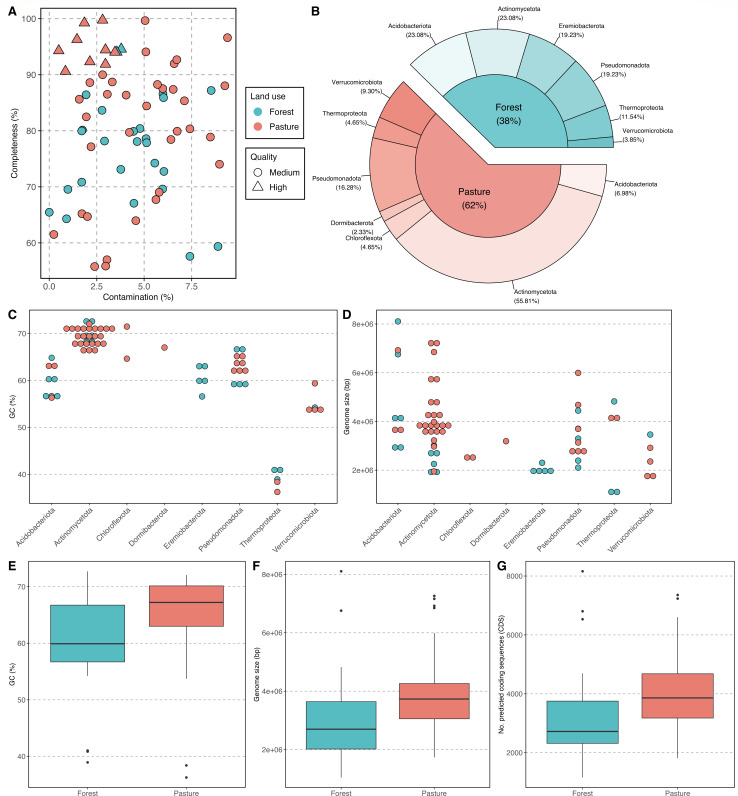
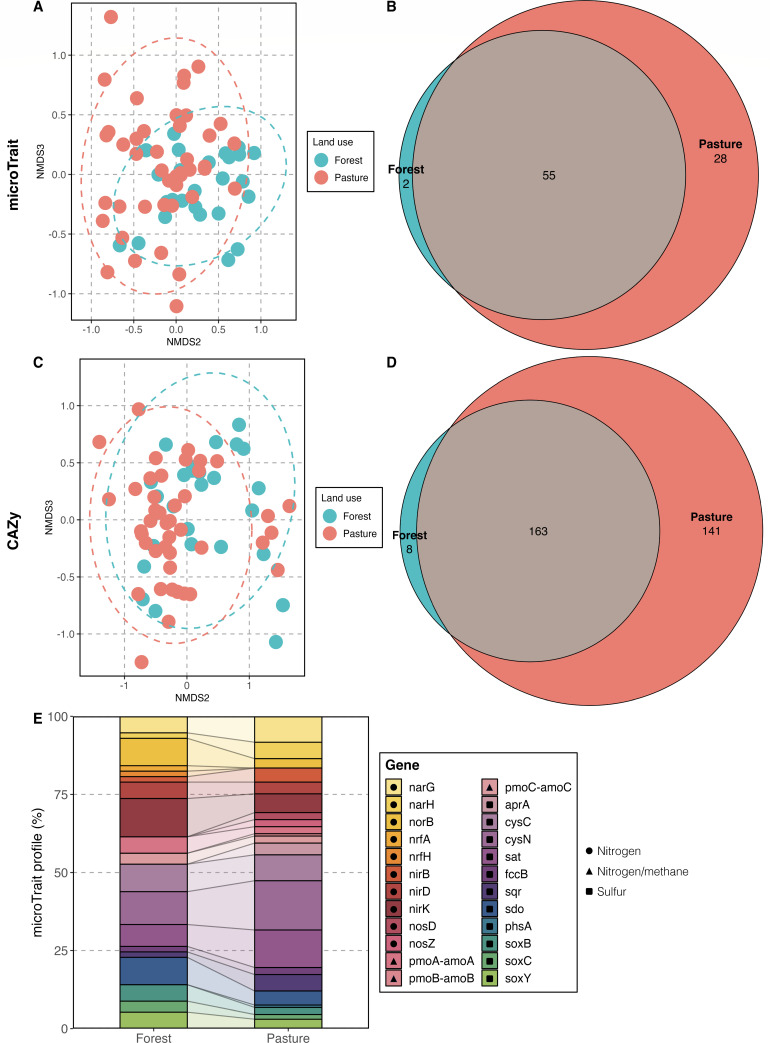
Amazonian soil microbial communities are known to be altered by land-use change. However, attempts to understand these impacts have focused on broader community alterations or the response of specific microbial groups. Here, we recovered and characterized 69 soil bacterial and archaeal metagenome-assembled genomes (MAGs) from three forests and three pastures of the Eastern Brazilian Amazon and evaluated the impacts of land conversion on their genomic features. Pasture MAGs had significantly higher GC content (64.9% vs 60.2%), genome size (4.0 vs 3.1 Mbp), and number of coding sequences (4,058 vs 3,306) compared to forest genomes. Taxonomically, MAGs belonged to eight phyla; however, most (90%) had low similarity to previously known species, indicating potentially novel taxa at multiple levels. We also observed that the functional profiles associated with biogeochemical cycling and carbohydrate-active enzyme genes were impacted by forest conversion, with pasture MAGs exhibiting a notably higher number of both gene groups. Together, these data constitute the largest single-sourced genomic data set from upland soils of the Brazilian Amazon to date and increase the known MAG richness in these soils by 78%. Our data, therefore, not only add to a neglected yet emerging field but, importantly, highlight that land-use change has drastic impacts on the genomic characteristics and functional traits of dominant soil microbes.IMPORTANCEThe Brazilian Amazon is facing unprecedented threats, including increasing deforestation and degradation, which together impact half of the original forest area. Soil microorganisms are sensitive indicators of land-use change, linked to a rise in microbial methane emissions and antibiotic-resistance genes in the Amazon. However, most Amazonian soil microbes remain unknown, and little attention has been given to their genomes. Using sequencing and bioinformatics, we recovered and characterized 69 soil bacterial and archaeal genomes (metagenome-assembled genomes). These abundant members of the microbial communities diverged across forests and pastures in terms of taxonomic and functional traits. Forest conversion favors organisms with specific genomic features - increased GC content, genome size, and gene number - selecting for microorganisms that can thrive under altered conditions. Our paper helps us understand the intricate relationships between microbes and the environment, which are crucial pieces of information for comprehensive soil health assessments and future policy formulation.
众所周知,亚马逊土壤微生物群落会因土地利用变化而改变。然而,了解这些影响的尝试集中在更广泛的群落变化或特定微生物群的反应上。在此,我们从巴西东部亚马逊地区的3个森林和3个牧场中恢复并鉴定了69个土壤细菌和古细菌宏基因组组装基因组(MAGs),并评估了土地转换对其基因组特征的影响。与森林基因组相比,牧场基因组的GC含量(64.9% vs 60.2%)、基因组大小(4.0 vs 3.1 Mbp)和编码序列数量(4,058 vs 3,306)显著高于森林基因组。在分类学上,MAGs分属8门;然而,大多数(90%)与已知物种的相似性较低,表明可能在多个水平上形成新的分类群。我们还观察到,与生物地球化学循环和碳水化合物活性酶基因相关的功能谱受到森林转换的影响,牧场MAGs中这两个基因群的数量显著增加。这些数据构成了迄今为止巴西亚马逊高地土壤中最大的单一来源基因组数据集,并使这些土壤中已知的MAG丰富度增加了78%。因此,我们的数据不仅增加了一个被忽视但新兴的领域,而且重要的是,强调了土地利用变化对优势土壤微生物的基因组特征和功能特征的巨大影响。巴西亚马逊正面临着前所未有的威胁,包括日益严重的森林砍伐和退化,它们共同影响了一半的原始森林面积。土壤微生物是土地利用变化的敏感指标,与亚马逊地区微生物甲烷排放和抗生素抗性基因的增加有关。然而,大多数亚马逊土壤微生物仍然是未知的,很少有人关注它们的基因组。利用测序和生物信息学技术,我们对69个土壤细菌和古细菌基因组(宏基因组组装基因组)进行了恢复和表征。这些丰富的微生物群落成员在森林和牧场的分类和功能特征方面存在分歧。森林转化有利于具有特定基因组特征的生物-增加GC含量,基因组大小和基因数量-选择可以在改变条件下茁壮成长的微生物。我们的论文帮助我们理解微生物与环境之间复杂的关系,这是综合土壤健康评估和未来政策制定的关键信息。
期刊介绍:
Microbiology Spectrum publishes commissioned review articles on topics in microbiology representing ten content areas: Archaea; Food Microbiology; Bacterial Genetics, Cell Biology, and Physiology; Clinical Microbiology; Environmental Microbiology and Ecology; Eukaryotic Microbes; Genomics, Computational, and Synthetic Microbiology; Immunology; Pathogenesis; and Virology. Reviews are interrelated, with each review linking to other related content. A large board of Microbiology Spectrum editors aids in the development of topics for potential reviews and in the identification of an editor, or editors, who shepherd each collection.




 京公网安备 11010802042870号
京ICP备2023020795号-1
京公网安备 11010802042870号
京ICP备2023020795号-1

 分享
分享
 求助内容:
求助内容: 应助结果提醒方式:
 扫码关注我们
