Pop-off mechanisms in fetal megacystis: extravasation, umbilical cord cyst, ureterocele and megaureter.

IF 6.3 1区 医学 Q1 ACOUSTICS Ultrasound in Obstetrics & Gynecology Pub Date : 2025-04-01 Epub Date: 2025-03-04 DOI:10.1002/uog.29200
L A M Brinkman, L K Duin, P N Adama van Scheltema, T E Cohen-Overbeek, E Pajkrt, M N Bekker, C Willekes, E J T Verweij, C Bilardo, F Fontanella
{"title":"Pop-off mechanisms in fetal megacystis: extravasation, umbilical cord cyst, ureterocele and megaureter.","authors":"L A M Brinkman, L K Duin, P N Adama van Scheltema, T E Cohen-Overbeek, E Pajkrt, M N Bekker, C Willekes, E J T Verweij, C Bilardo, F Fontanella","doi":"10.1002/uog.29200","DOIUrl":null,"url":null,"abstract":"<p><strong>Objective: </strong>To analyze comprehensively the incidence, antenatal ultrasound characteristics and prognostic implications of antenatal pop-off mechanisms of the fetal urinary system in pregnancies with suspected fetal megacystis.</p><p><strong>Methods: </strong>This was a retrospective multicenter study of pregnancies with suspected fetal megacystis conducted across all academic hospitals in The Netherlands. Three antenatal pop-off mechanisms were identified: presence of an umbilical cord cyst (UCC), extravasation of urine into the intraperitoneal space (ascites) or perirenal subcapsular (urinoma), and megaureter/ureterocele. Cases that exhibited two different pop-off mechanisms, underwent vesicoamniotic shunt placement or had unclear information regarding shunt placement were excluded. We compared the antenatal ultrasound characteristics and outcomes among pregnancies with UCC, those with extravasation, those with megaureter/ureterocele and those without a pop-off mechanism. Logistic regression analysis was used to evaluate the association of pop-off mechanisms with antenatal characteristics and postnatal outcomes.</p><p><strong>Results: </strong>Among 543 fetuses with suspected megacystis, 76% exhibited no pop-off mechanism, 7% presented with UCC only, 9% presented with extravasation only, 7% presented with a megaureter/ureterocele only and 1% presented with two pop-off mechanisms. Following exclusions, 511 cases were included in the analysis. The identification of UCC (n = 39) was associated with early-onset megacystis (odds ratio (OR), 4.2 (95% CI, 1.9-9.1); P < 0.001), severe megacystis (OR 2.3 (95% CI, 1.1-5.0); P = 0.033), normal amniotic fluid index (AFI) (OR, 3.3 (95% CI, 1.3-8.2); P = 0.011) and additional associated anomaly (OR, 3.3 (95% CI, 1.7-6.4); P < 0.001), and thus with the highest prevalence of complex diagnosis (66%), primarily represented by anorectal malformation. Extravasation (n = 42) was associated with severe megacystis (OR, 2.4 (95% CI, 1.1-5.4); P = 0.030), abnormal AFI (OR, 2.8 (95% CI, 1.2-6.8); P = 0.022), the keyhole sign (OR, 2.5 (95% CI, 1.1-5.8); P = 0.033) and additional associated anomaly (OR, 2.1 (95% CI, 1.1-4.1); P = 0.026). Megaureter/ureterocele (n = 36) was associated with late-onset megacystis (OR, 4.0 (95% CI, 1.6-9.7); P = 0.003), a thickened bladder wall during pregnancy (OR, 6.6 (95% CI, 1.9-23.1); P = 0.003) and the lowest prevalence of additional associated anomaly (22%). Intrauterine fetal demise was most prevalent in fetuses with UCC (15%), while termination of pregnancy and non-survivors were most common in cases with extravasation (50% and 17%, respectively). The majority of fetuses with megacystis associated with megaureter/ureterocele were still alive during follow-up (72%) and the odds of survival were the highest for this group (OR, 2.7 (95% CI, 1.3-5.7); P = 0.010).</p><p><strong>Conclusions: </strong>Antenatal pop-off mechanisms may alleviate high intraluminal pressure within the fetal urinary tract. Each mechanism leads to a different antenatal clinical picture and outcome, which may explain partially the heterogeneity of outcomes in fetuses with megacystis. Therefore, understanding the implications of these mechanisms and their antenatal characteristics could guide antenatal counseling and management of fetal megacystis. © 2025 The Author(s). Ultrasound in Obstetrics & Gynecology published by John Wiley & Sons Ltd on behalf of International Society of Ultrasound in Obstetrics and Gynecology.</p>","PeriodicalId":23454,"journal":{"name":"Ultrasound in Obstetrics & Gynecology","volume":" ","pages":"487-494"},"PeriodicalIF":6.3000,"publicationDate":"2025-04-01","publicationTypes":"Journal Article","fieldsOfStudy":null,"isOpenAccess":false,"openAccessPdf":"https://www.ncbi.nlm.nih.gov/pmc/articles/PMC11961101/pdf/","citationCount":"0","resultStr":null,"platform":"Semanticscholar","paperid":null,"PeriodicalName":"Ultrasound in Obstetrics & Gynecology","FirstCategoryId":"3","ListUrlMain":"https://doi.org/10.1002/uog.29200","RegionNum":1,"RegionCategory":"医学","ArticlePicture":[],"TitleCN":null,"AbstractTextCN":null,"PMCID":null,"EPubDate":"2025/3/4 0:00:00","PubModel":"Epub","JCR":"Q1","JCRName":"ACOUSTICS","Score":null,"Total":0}
引用次数: 0

Abstract

Objective: To analyze comprehensively the incidence, antenatal ultrasound characteristics and prognostic implications of antenatal pop-off mechanisms of the fetal urinary system in pregnancies with suspected fetal megacystis.

Methods: This was a retrospective multicenter study of pregnancies with suspected fetal megacystis conducted across all academic hospitals in The Netherlands. Three antenatal pop-off mechanisms were identified: presence of an umbilical cord cyst (UCC), extravasation of urine into the intraperitoneal space (ascites) or perirenal subcapsular (urinoma), and megaureter/ureterocele. Cases that exhibited two different pop-off mechanisms, underwent vesicoamniotic shunt placement or had unclear information regarding shunt placement were excluded. We compared the antenatal ultrasound characteristics and outcomes among pregnancies with UCC, those with extravasation, those with megaureter/ureterocele and those without a pop-off mechanism. Logistic regression analysis was used to evaluate the association of pop-off mechanisms with antenatal characteristics and postnatal outcomes.

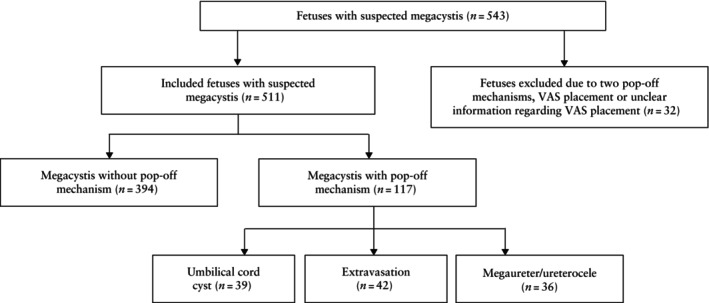
Results: Among 543 fetuses with suspected megacystis, 76% exhibited no pop-off mechanism, 7% presented with UCC only, 9% presented with extravasation only, 7% presented with a megaureter/ureterocele only and 1% presented with two pop-off mechanisms. Following exclusions, 511 cases were included in the analysis. The identification of UCC (n = 39) was associated with early-onset megacystis (odds ratio (OR), 4.2 (95% CI, 1.9-9.1); P < 0.001), severe megacystis (OR 2.3 (95% CI, 1.1-5.0); P = 0.033), normal amniotic fluid index (AFI) (OR, 3.3 (95% CI, 1.3-8.2); P = 0.011) and additional associated anomaly (OR, 3.3 (95% CI, 1.7-6.4); P < 0.001), and thus with the highest prevalence of complex diagnosis (66%), primarily represented by anorectal malformation. Extravasation (n = 42) was associated with severe megacystis (OR, 2.4 (95% CI, 1.1-5.4); P = 0.030), abnormal AFI (OR, 2.8 (95% CI, 1.2-6.8); P = 0.022), the keyhole sign (OR, 2.5 (95% CI, 1.1-5.8); P = 0.033) and additional associated anomaly (OR, 2.1 (95% CI, 1.1-4.1); P = 0.026). Megaureter/ureterocele (n = 36) was associated with late-onset megacystis (OR, 4.0 (95% CI, 1.6-9.7); P = 0.003), a thickened bladder wall during pregnancy (OR, 6.6 (95% CI, 1.9-23.1); P = 0.003) and the lowest prevalence of additional associated anomaly (22%). Intrauterine fetal demise was most prevalent in fetuses with UCC (15%), while termination of pregnancy and non-survivors were most common in cases with extravasation (50% and 17%, respectively). The majority of fetuses with megacystis associated with megaureter/ureterocele were still alive during follow-up (72%) and the odds of survival were the highest for this group (OR, 2.7 (95% CI, 1.3-5.7); P = 0.010).

Conclusions: Antenatal pop-off mechanisms may alleviate high intraluminal pressure within the fetal urinary tract. Each mechanism leads to a different antenatal clinical picture and outcome, which may explain partially the heterogeneity of outcomes in fetuses with megacystis. Therefore, understanding the implications of these mechanisms and their antenatal characteristics could guide antenatal counseling and management of fetal megacystis. © 2025 The Author(s). Ultrasound in Obstetrics & Gynecology published by John Wiley & Sons Ltd on behalf of International Society of Ultrasound in Obstetrics and Gynecology.

Abstract Image

Abstract Image

查看原文
分享 分享
微信好友 朋友圈 QQ好友 复制链接
本刊更多论文
胎儿巨囊炎的弹出机制:外渗、脐带囊肿、输尿管膨出和体表。
目的:综合分析疑似胎儿巨囊炎孕妇胎儿泌尿系统弹出机制的发生率、产前超声特征及预后意义。方法:这是一项在荷兰所有学术医院进行的怀疑胎儿巨囊炎的妊娠的回顾性多中心研究。确定了三种产前弹出机制:脐带囊肿(UCC),尿液外渗到腹膜内间隙(腹水)或肾周包膜下(尿瘤),以及输尿管/输尿管囊肿。排除了表现出两种不同弹出机制的病例,接受了膀胱-羊膜分流术放置或关于分流术放置信息不明确的病例。我们比较了UCC妊娠、外渗妊娠、输尿管/输尿管膨出妊娠和无弹出机制妊娠的产前超声特征和结局。采用Logistic回归分析来评估弹出机制与产前特征和产后结局的关系。结果:543例疑似巨囊炎胎儿中,76%无弹出机制,7%仅表现为UCC, 9%仅表现为外渗,7%仅表现为输尿管/输尿管膨出,1%表现为两种弹出机制。排除后,511例病例纳入分析。鉴别UCC (n = 39)与早发性巨囊炎相关(优势比(OR), 4.2 (95% CI, 1.9-9.1);结论:产前弹出机制可能减轻胎儿尿路内的高腔内压力。每种机制导致不同的产前临床表现和结果,这可能部分解释了巨囊炎胎儿结局的异质性。因此,了解这些机制的含义及其产前特征可以指导胎儿巨囊炎的产前咨询和处理。©2025作者。妇产科学超声由John Wiley & Sons Ltd代表国际妇产科学超声学会出版。
本文章由计算机程序翻译,如有差异,请以英文原文为准。
求助全文
约1分钟内获得全文 去求助
来源期刊
CiteScore
12.30
自引率
14.10%
发文量
891
审稿时长
1 months
期刊介绍: Ultrasound in Obstetrics & Gynecology (UOG) is the official journal of the International Society of Ultrasound in Obstetrics and Gynecology (ISUOG) and is considered the foremost international peer-reviewed journal in the field. It publishes cutting-edge research that is highly relevant to clinical practice, which includes guidelines, expert commentaries, consensus statements, original articles, and systematic reviews. UOG is widely recognized and included in prominent abstract and indexing databases such as Index Medicus and Current Contents.
期刊最新文献
Mixed germ cell tumor presenting with mixed sonographic appearance and unique clinical presentation. Local injection of thrombin: a novel fertility-preserving approach for treatment of Cesarean scar ectopic pregnancy complicated by persistent uterine pseudoaneurysm. Right-sided posterior ductus arteriosus: unusual vascular ring in two fetuses with univentricular physiology. Three-dimensional ultrasound demonstration of boomerang vessel of Type-III vasa previa at 21 weeks' gestation. Fetal heart, brain and placenta: introducing a three-way (patho)physiological pairing.
×
引用
GB/T 7714-2015
复制
MLA
复制
APA
复制
导出至
BibTeX EndNote RefMan NoteFirst NoteExpress
×
×
提示
您的信息不完整,为了账户安全,请先补充。
现在去补充
×
提示
您因"违规操作"
具体请查看互助需知
我知道了
×
提示
现在去查看 取消
×
提示
确定
0
微信
客服QQ
Book学术公众号 扫码关注我们
反馈
×
意见反馈
请填写您的意见或建议
请填写您的手机或邮箱
已复制链接
已复制链接
快去分享给好友吧!
我知道了
×
扫码分享
扫码分享
Book学术官方微信
Book学术文献互助
Book学术文献互助群
群 号:604180095
Book学术
文献互助 智能选刊 最新文献 互助须知 联系我们:info@booksci.cn
Book学术提供免费学术资源搜索服务,方便国内外学者检索中英文文献。致力于提供最便捷和优质的服务体验。
Copyright © 2023 Book学术 All rights reserved.
ghs 京公网安备 11010802042870号 京ICP备2023020795号-1