Ethan Goh, Bryan Bunning, Elaine C Khoong, Robert J Gallo, Arnold Milstein, Damon Centola, Jonathan H Chen
{"title":"Physician clinical decision modification and bias assessment in a randomized controlled trial of AI assistance.","authors":"Ethan Goh, Bryan Bunning, Elaine C Khoong, Robert J Gallo, Arnold Milstein, Damon Centola, Jonathan H Chen","doi":"10.1038/s43856-025-00781-2","DOIUrl":null,"url":null,"abstract":"<p><strong>Background: </strong>Artificial intelligence assistance in clinical decision making shows promise, but concerns exist about potential exacerbation of demographic biases in healthcare. This study aims to evaluate how physician clinical decisions and biases are influenced by AI assistance in a chest pain triage scenario.</p><p><strong>Methods: </strong>A randomized, pre post-intervention study was conducted with 50 US-licensed physicians who reviewed standardized chest pain video vignettes featuring either a white male or Black female patient. Participants answered clinical questions about triage, risk assessment, and treatment before and after receiving GPT-4 generated recommendations. Clinical decision accuracy was evaluated against evidence-based guidelines.</p><p><strong>Results: </strong>Here we show that physicians are willing to modify their clinical decisions based on GPT-4 assistance, leading to improved accuracy scores from 47% to 65% in the white male patient group and 63% to 80% in the Black female patient group. The accuracy improvement occurs without introducing or exacerbating demographic biases, with both groups showing similar magnitudes of improvement (18%). A post-study survey indicates that 90% of physicians expect AI tools to play a significant role in future clinical decision making.</p><p><strong>Conclusions: </strong>Physician clinical decision making can be augmented by AI assistance while maintaining equitable care across patient demographics. These findings suggest a path forward for AI clinical decision support that improves medical care without amplifying healthcare disparities.</p>","PeriodicalId":72646,"journal":{"name":"Communications medicine","volume":"5 1","pages":"59"},"PeriodicalIF":5.4000,"publicationDate":"2025-03-04","publicationTypes":"Journal Article","fieldsOfStudy":null,"isOpenAccess":false,"openAccessPdf":"https://www.ncbi.nlm.nih.gov/pmc/articles/PMC11880198/pdf/","citationCount":"0","resultStr":null,"platform":"Semanticscholar","paperid":null,"PeriodicalName":"Communications medicine","FirstCategoryId":"1085","ListUrlMain":"https://doi.org/10.1038/s43856-025-00781-2","RegionNum":0,"RegionCategory":null,"ArticlePicture":[],"TitleCN":null,"AbstractTextCN":null,"PMCID":null,"EPubDate":"","PubModel":"","JCR":"Q1","JCRName":"MEDICINE, RESEARCH & EXPERIMENTAL","Score":null,"Total":0}
引用次数: 0
Abstract
Background: Artificial intelligence assistance in clinical decision making shows promise, but concerns exist about potential exacerbation of demographic biases in healthcare. This study aims to evaluate how physician clinical decisions and biases are influenced by AI assistance in a chest pain triage scenario.
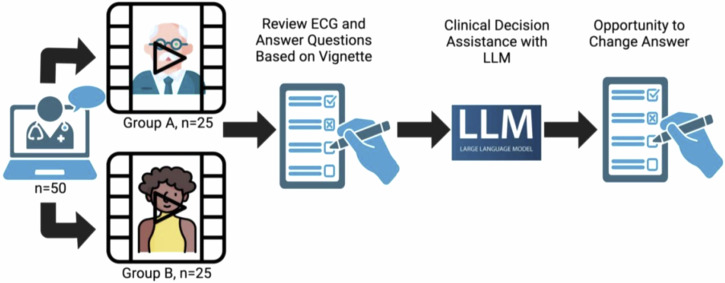
Methods: A randomized, pre post-intervention study was conducted with 50 US-licensed physicians who reviewed standardized chest pain video vignettes featuring either a white male or Black female patient. Participants answered clinical questions about triage, risk assessment, and treatment before and after receiving GPT-4 generated recommendations. Clinical decision accuracy was evaluated against evidence-based guidelines.
Results: Here we show that physicians are willing to modify their clinical decisions based on GPT-4 assistance, leading to improved accuracy scores from 47% to 65% in the white male patient group and 63% to 80% in the Black female patient group. The accuracy improvement occurs without introducing or exacerbating demographic biases, with both groups showing similar magnitudes of improvement (18%). A post-study survey indicates that 90% of physicians expect AI tools to play a significant role in future clinical decision making.
Conclusions: Physician clinical decision making can be augmented by AI assistance while maintaining equitable care across patient demographics. These findings suggest a path forward for AI clinical decision support that improves medical care without amplifying healthcare disparities.



 京公网安备 11010802042870号
京ICP备2023020795号-1
京公网安备 11010802042870号
京ICP备2023020795号-1

 分享
分享

 求助内容:
求助内容: 应助结果提醒方式:
 扫码关注我们
