Efrain Vizuete-Jaramillo , Agustin Robles-Morua , Francisco Robert Alexander Ziegler-Rivera
{"title":"Leaching dynamics of Zn2+, Pb2+ and Cu2+ in urban soils of a semi-arid region: A quantitative analysis","authors":"Efrain Vizuete-Jaramillo , Agustin Robles-Morua , Francisco Robert Alexander Ziegler-Rivera","doi":"10.1016/j.envpol.2025.125955","DOIUrl":null,"url":null,"abstract":"<div><div>In this study, we evaluate the leaching process and movement of PTEs once they reach the soil profile in urban soils in a semiarid city in northwest Mexico. Concentrations of Zn<sup>2+</sup>, Pb<sup>2+</sup> and Cu<sup>2+</sup> were quantified in an urban area using ion-exchange resin (IER) samplers. The IER is a passive method based on ion-exchange resins which allows sampling the transport of elements in macropores under unsaturated flow conditions. Samples were taken during three monitoring periods in a city influenced by the North American Monsoon (NAM). In the first monitoring period, the IER samplers showed leaching rates of 323.40 g Zn<sup>2+</sup> ha<sup>−1</sup> 15 wk<sup>−1</sup>, 361.90 g Pb<sup>2+</sup> ha<sup>-1</sup>15 wk<sup>−1</sup>, and 31.9 g Cu<sup>2+</sup> ha<sup>-1</sup>15 wk<sup>−1</sup>. The second period estimated 101.50 g Zn<sup>2+</sup> ha<sup>−1</sup> 37 wk<sup>−1</sup>, 58.20 g Pb<sup>2+</sup> ha<sup>−1</sup> 37 wk<sup>−1</sup>, and 20.00 g Cu<sup>2+</sup> ha<sup>−1</sup> 37 wk<sup>−1</sup>. Finally, in the third monitoring period concentrations of 141.90 g Zn<sup>2+</sup> ha<sup>-1</sup>17 wk<sup>−1</sup>, 32.10 g Pb<sup>2+</sup> ha<sup>−1</sup> 17 wk<sup>−1</sup> and 20.70 g Cu<sup>2+</sup> ha<sup>−1</sup> 17 wk<sup>−1</sup> were found. The highest leaching rate of PTEs was identified in the central area of the city and its surroundings, influenced mainly by flood areas and high surface runoff. The results of this study demonstrate the role that monsoon rains and runoff plays in the movement and distribution of PTEs in urban areas.</div></div>","PeriodicalId":311,"journal":{"name":"Environmental Pollution","volume":"372 ","pages":"Article 125955"},"PeriodicalIF":7.3000,"publicationDate":"2025-03-05","publicationTypes":"Journal Article","fieldsOfStudy":null,"isOpenAccess":false,"openAccessPdf":"","citationCount":"0","resultStr":null,"platform":"Semanticscholar","paperid":null,"PeriodicalName":"Environmental Pollution","FirstCategoryId":"93","ListUrlMain":"https://www.sciencedirect.com/science/article/pii/S0269749125003288","RegionNum":2,"RegionCategory":"环境科学与生态学","ArticlePicture":[],"TitleCN":null,"AbstractTextCN":null,"PMCID":null,"EPubDate":"","PubModel":"","JCR":"Q1","JCRName":"ENVIRONMENTAL SCIENCES","Score":null,"Total":0}
引用次数: 0
Abstract
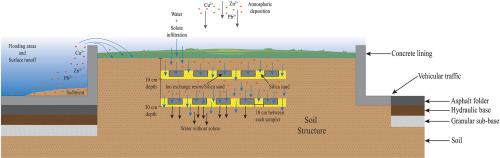
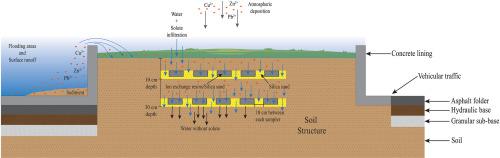
In this study, we evaluate the leaching process and movement of PTEs once they reach the soil profile in urban soils in a semiarid city in northwest Mexico. Concentrations of Zn2+, Pb2+ and Cu2+ were quantified in an urban area using ion-exchange resin (IER) samplers. The IER is a passive method based on ion-exchange resins which allows sampling the transport of elements in macropores under unsaturated flow conditions. Samples were taken during three monitoring periods in a city influenced by the North American Monsoon (NAM). In the first monitoring period, the IER samplers showed leaching rates of 323.40 g Zn2+ ha−1 15 wk−1, 361.90 g Pb2+ ha-115 wk−1, and 31.9 g Cu2+ ha-115 wk−1. The second period estimated 101.50 g Zn2+ ha−1 37 wk−1, 58.20 g Pb2+ ha−1 37 wk−1, and 20.00 g Cu2+ ha−1 37 wk−1. Finally, in the third monitoring period concentrations of 141.90 g Zn2+ ha-117 wk−1, 32.10 g Pb2+ ha−1 17 wk−1 and 20.70 g Cu2+ ha−1 17 wk−1 were found. The highest leaching rate of PTEs was identified in the central area of the city and its surroundings, influenced mainly by flood areas and high surface runoff. The results of this study demonstrate the role that monsoon rains and runoff plays in the movement and distribution of PTEs in urban areas.
期刊介绍:
Environmental Pollution is an international peer-reviewed journal that publishes high-quality research papers and review articles covering all aspects of environmental pollution and its impacts on ecosystems and human health.
Subject areas include, but are not limited to:
• Sources and occurrences of pollutants that are clearly defined and measured in environmental compartments, food and food-related items, and human bodies;
• Interlinks between contaminant exposure and biological, ecological, and human health effects, including those of climate change;
• Contaminants of emerging concerns (including but not limited to antibiotic resistant microorganisms or genes, microplastics/nanoplastics, electronic wastes, light, and noise) and/or their biological, ecological, or human health effects;
• Laboratory and field studies on the remediation/mitigation of environmental pollution via new techniques and with clear links to biological, ecological, or human health effects;
• Modeling of pollution processes, patterns, or trends that is of clear environmental and/or human health interest;
• New techniques that measure and examine environmental occurrences, transport, behavior, and effects of pollutants within the environment or the laboratory, provided that they can be clearly used to address problems within regional or global environmental compartments.



 京公网安备 11010802042870号
京ICP备2023020795号-1
京公网安备 11010802042870号
京ICP备2023020795号-1

 分享
分享
 求助内容:
求助内容: 应助结果提醒方式:
 扫码关注我们
