Mateusz Hajdel, Krzysztof Gołyga, Marcin Siekacz, Anna Feduniewicz-Żmuda, Czesław Skierbiszewski, Ulrich Theodor Schwarz, Grzegorz Muziol
{"title":"Distinctness of Electroluminescence and Optical Gain in Laser Diodes with Wide Polar Quantum Wells","authors":"Mateusz Hajdel, Krzysztof Gołyga, Marcin Siekacz, Anna Feduniewicz-Żmuda, Czesław Skierbiszewski, Ulrich Theodor Schwarz, Grzegorz Muziol","doi":"10.1021/acsphotonics.4c02193","DOIUrl":null,"url":null,"abstract":"Despite the ubiquity of semiconductor-based emitters in optoelectronic devices we use every day, obstacles still remain to unlock their full potential. One of these lies in long-wavelength GaN-based laser diodes (LDs). It is common knowledge that InGaN quantum wells (QWs) exhibit extremely large built-in polarization, which helps to obtain long-wavelength emission in light-emitting diodes, thanks to the large quantum-confined Stark effect. However, in this paper, it is shown that in order to achieve long-wavelength LDs, wide InGaN QWs might be preferential. The lasing wavelength for blue LDs can be even 20 nm longer in the case of wide QWs than in thin QWs for the same composition. The mechanisms behind these effects are explored by analyzing evolution of spontaneous emission, amplified spontaneous emission, optical gain, and quasi-Fermi level separation. It is shown that in wide QWs, the spontaneous emission originates from highly excited states. However, as the carrier density increases, quantum states with lower energy take over. Furthermore, population inversion, and thus lasing action, is obtained from the lowest excited states, resulting in long-wavelength lasing. The reported effects should also be observed in other polar materials with sufficiently thick QWs.","PeriodicalId":23,"journal":{"name":"ACS Photonics","volume":"11 1","pages":""},"PeriodicalIF":6.7000,"publicationDate":"2025-03-06","publicationTypes":"Journal Article","fieldsOfStudy":null,"isOpenAccess":false,"openAccessPdf":"","citationCount":"0","resultStr":null,"platform":"Semanticscholar","paperid":null,"PeriodicalName":"ACS Photonics","FirstCategoryId":"101","ListUrlMain":"https://doi.org/10.1021/acsphotonics.4c02193","RegionNum":1,"RegionCategory":"物理与天体物理","ArticlePicture":[],"TitleCN":null,"AbstractTextCN":null,"PMCID":null,"EPubDate":"","PubModel":"","JCR":"Q1","JCRName":"MATERIALS SCIENCE, MULTIDISCIPLINARY","Score":null,"Total":0}
引用次数: 0
Abstract
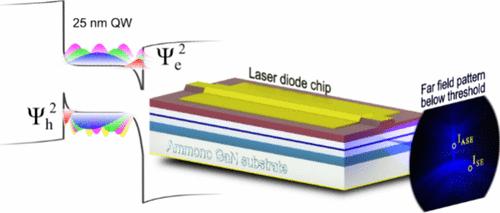
Despite the ubiquity of semiconductor-based emitters in optoelectronic devices we use every day, obstacles still remain to unlock their full potential. One of these lies in long-wavelength GaN-based laser diodes (LDs). It is common knowledge that InGaN quantum wells (QWs) exhibit extremely large built-in polarization, which helps to obtain long-wavelength emission in light-emitting diodes, thanks to the large quantum-confined Stark effect. However, in this paper, it is shown that in order to achieve long-wavelength LDs, wide InGaN QWs might be preferential. The lasing wavelength for blue LDs can be even 20 nm longer in the case of wide QWs than in thin QWs for the same composition. The mechanisms behind these effects are explored by analyzing evolution of spontaneous emission, amplified spontaneous emission, optical gain, and quasi-Fermi level separation. It is shown that in wide QWs, the spontaneous emission originates from highly excited states. However, as the carrier density increases, quantum states with lower energy take over. Furthermore, population inversion, and thus lasing action, is obtained from the lowest excited states, resulting in long-wavelength lasing. The reported effects should also be observed in other polar materials with sufficiently thick QWs.
期刊介绍:
Published as soon as accepted and summarized in monthly issues, ACS Photonics will publish Research Articles, Letters, Perspectives, and Reviews, to encompass the full scope of published research in this field.



 京公网安备 11010802042870号
京ICP备2023020795号-1
京公网安备 11010802042870号
京ICP备2023020795号-1

 分享
分享
 求助内容:
求助内容: 应助结果提醒方式:
 扫码关注我们
