{"title":"Degradation of Microplastics by Microbial in Combination with a Micromotor","authors":"Jiaoyu Ren, Yahao Meng, Zhuxin Wang, Guangyuan Xie","doi":"10.1021/acssuschemeng.4c09593","DOIUrl":null,"url":null,"abstract":"Microplastics, known for their high durability, are pervasive in the environment and pose potential risks to human health via the food chain. Traditional physical and chemical degradation methods often release harmful gases and cause secondary pollution. While biodegradation is a low-carbon, ecofriendly alternative, its slow degradation remains a challenge. Research demonstrates that integrating physicochemical treatments with biological methods can enhance the efficiency of microplastic degradation; yet, major improvements are still needed. Using industrial waste fly ash and g-C<sub>3</sub>N<sub>4</sub> as raw materials, we successfully fabricated MnO<sub>2</sub>/g-C<sub>3</sub>N<sub>4</sub>/fly ash (MCNF) micromotors with Fenton reaction and self-propulsion capabilities through calcination and multilayer self-assembly. Notably, these micromotors do not inhibit microbial growth. Pretreatment of polystyrene (PS) with MCNF micromotors achieved a biodegradation rate of 60% within 24 days, while direct addition of MCNF micromotors enabled polyethylene (PE) degradation to reach 66% within 50 days. Compared to biodegradation alone, this combined approach increased the degradation rates of PS and PE by 40 and 24%, respectively. These findings provide a foundation for effective microplastic degradation and highlight the potential of repurposing waste resources.","PeriodicalId":25,"journal":{"name":"ACS Sustainable Chemistry & Engineering","volume":"16 1","pages":""},"PeriodicalIF":7.3000,"publicationDate":"2025-03-06","publicationTypes":"Journal Article","fieldsOfStudy":null,"isOpenAccess":false,"openAccessPdf":"","citationCount":"0","resultStr":null,"platform":"Semanticscholar","paperid":null,"PeriodicalName":"ACS Sustainable Chemistry & Engineering","FirstCategoryId":"92","ListUrlMain":"https://doi.org/10.1021/acssuschemeng.4c09593","RegionNum":1,"RegionCategory":"化学","ArticlePicture":[],"TitleCN":null,"AbstractTextCN":null,"PMCID":null,"EPubDate":"","PubModel":"","JCR":"Q1","JCRName":"CHEMISTRY, MULTIDISCIPLINARY","Score":null,"Total":0}
引用次数: 0
Abstract
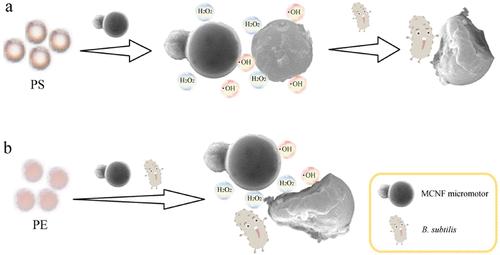
Microplastics, known for their high durability, are pervasive in the environment and pose potential risks to human health via the food chain. Traditional physical and chemical degradation methods often release harmful gases and cause secondary pollution. While biodegradation is a low-carbon, ecofriendly alternative, its slow degradation remains a challenge. Research demonstrates that integrating physicochemical treatments with biological methods can enhance the efficiency of microplastic degradation; yet, major improvements are still needed. Using industrial waste fly ash and g-C3N4 as raw materials, we successfully fabricated MnO2/g-C3N4/fly ash (MCNF) micromotors with Fenton reaction and self-propulsion capabilities through calcination and multilayer self-assembly. Notably, these micromotors do not inhibit microbial growth. Pretreatment of polystyrene (PS) with MCNF micromotors achieved a biodegradation rate of 60% within 24 days, while direct addition of MCNF micromotors enabled polyethylene (PE) degradation to reach 66% within 50 days. Compared to biodegradation alone, this combined approach increased the degradation rates of PS and PE by 40 and 24%, respectively. These findings provide a foundation for effective microplastic degradation and highlight the potential of repurposing waste resources.
期刊介绍:
ACS Sustainable Chemistry & Engineering is a prestigious weekly peer-reviewed scientific journal published by the American Chemical Society. Dedicated to advancing the principles of green chemistry and green engineering, it covers a wide array of research topics including green chemistry, green engineering, biomass, alternative energy, and life cycle assessment.
The journal welcomes submissions in various formats, including Letters, Articles, Features, and Perspectives (Reviews), that address the challenges of sustainability in the chemical enterprise and contribute to the advancement of sustainable practices. Join us in shaping the future of sustainable chemistry and engineering.



 京公网安备 11010802042870号
京ICP备2023020795号-1
京公网安备 11010802042870号
京ICP备2023020795号-1

 分享
分享
 求助内容:
求助内容: 应助结果提醒方式:
 扫码关注我们
