Yuling Lin, Kaihao Chen, Tianwen Bai, Jun Ling, Xufeng Ni
{"title":"Carbenium-Based Cationic Ring-Opening Polymerization of CO2-Based Disubstituted δ-Valerolactone","authors":"Yuling Lin, Kaihao Chen, Tianwen Bai, Jun Ling, Xufeng Ni","doi":"10.1021/acsmacrolett.5c00005","DOIUrl":null,"url":null,"abstract":"The challenging ring-opening homopolymerization of α-ethylidene-δ-vinyl-δ-valerolactone (EVL), derived from CO<sub>2</sub> and 1,3-butadiene, has aroused extensive attention in consideration of economic efficiency and functionalization potential. In the contribution, we achieve the first cationic ring-opening polymerization (CROP) of EVL through a carbenium-based mechanism, yielding well-defined cyclic polyester PEVL with a number-average molecular weight (<i>M</i><sub>n</sub>) up to 12.8 kg/mol and a low dispersity of 1.2. The carbenium-based CROP results in PEVL containing two kinds of structural units derived from EVL, evidenced by NMR, MALDI-ToF MS, and density functional theory (DFT) calculation. The fast intramolecular transfer reaction and slow initiation are responsible for the cyclic topology fidelity of PEVL. The <i>M</i><sub>n</sub> of PEVL is tunable from 6.5 to 12.8 kg/mol by decreasing the polymerization temperature from 10 to −30 °C. PEVL possessing a low glass transition temperature (<i>T</i><sub>g</sub>) of −33.6 °C is ready for postpolymerization functionalization, as showcased by modification with 1-octadecanethiol, which endows the polymer with a melting point (<i>T</i><sub>m</sub>) of 42.2 °C.","PeriodicalId":18,"journal":{"name":"ACS Macro Letters","volume":"86 1","pages":""},"PeriodicalIF":5.2000,"publicationDate":"2025-03-05","publicationTypes":"Journal Article","fieldsOfStudy":null,"isOpenAccess":false,"openAccessPdf":"","citationCount":"0","resultStr":null,"platform":"Semanticscholar","paperid":null,"PeriodicalName":"ACS Macro Letters","FirstCategoryId":"92","ListUrlMain":"https://doi.org/10.1021/acsmacrolett.5c00005","RegionNum":0,"RegionCategory":null,"ArticlePicture":[],"TitleCN":null,"AbstractTextCN":null,"PMCID":null,"EPubDate":"","PubModel":"","JCR":"Q1","JCRName":"POLYMER SCIENCE","Score":null,"Total":0}
引用次数: 0
Abstract
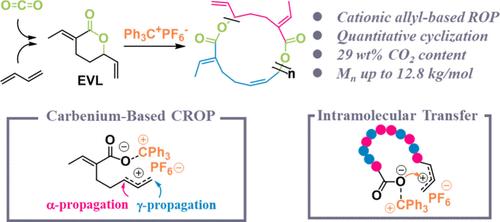
The challenging ring-opening homopolymerization of α-ethylidene-δ-vinyl-δ-valerolactone (EVL), derived from CO2 and 1,3-butadiene, has aroused extensive attention in consideration of economic efficiency and functionalization potential. In the contribution, we achieve the first cationic ring-opening polymerization (CROP) of EVL through a carbenium-based mechanism, yielding well-defined cyclic polyester PEVL with a number-average molecular weight (Mn) up to 12.8 kg/mol and a low dispersity of 1.2. The carbenium-based CROP results in PEVL containing two kinds of structural units derived from EVL, evidenced by NMR, MALDI-ToF MS, and density functional theory (DFT) calculation. The fast intramolecular transfer reaction and slow initiation are responsible for the cyclic topology fidelity of PEVL. The Mn of PEVL is tunable from 6.5 to 12.8 kg/mol by decreasing the polymerization temperature from 10 to −30 °C. PEVL possessing a low glass transition temperature (Tg) of −33.6 °C is ready for postpolymerization functionalization, as showcased by modification with 1-octadecanethiol, which endows the polymer with a melting point (Tm) of 42.2 °C.
期刊介绍:
ACS Macro Letters publishes research in all areas of contemporary soft matter science in which macromolecules play a key role, including nanotechnology, self-assembly, supramolecular chemistry, biomaterials, energy generation and storage, and renewable/sustainable materials. Submissions to ACS Macro Letters should justify clearly the rapid disclosure of the key elements of the study. The scope of the journal includes high-impact research of broad interest in all areas of polymer science and engineering, including cross-disciplinary research that interfaces with polymer science.
With the launch of ACS Macro Letters, all Communications that were formerly published in Macromolecules and Biomacromolecules will be published as Letters in ACS Macro Letters.



 京公网安备 11010802042870号
京ICP备2023020795号-1
京公网安备 11010802042870号
京ICP备2023020795号-1

 分享
分享
 求助内容:
求助内容: 应助结果提醒方式:
 扫码关注我们
