Claudia Steinbach, Alexander Schmid, Matthäus Siebenhofer, Andreas Nenning, Christoph Rameshan, Markus Kubicek, Juergen Fleig
{"title":"Space Charges at SrTiO3|Mixed Ionic and Electronic Conducting Oxide Heterojunctions and Their Relation to Defect Chemistry","authors":"Claudia Steinbach, Alexander Schmid, Matthäus Siebenhofer, Andreas Nenning, Christoph Rameshan, Markus Kubicek, Juergen Fleig","doi":"10.1021/acsami.4c21843","DOIUrl":null,"url":null,"abstract":"Mixed ionic and electronic conductors (MIECs) are a highly relevant material class in the field of solid-oxide cells and are, for example, promising candidates for electrodes with fast interfacial reaction kinetics. While there are many studies dealing with the bulk conductivities of such MIECs, models describing the interfaces between two mixed-conducting oxides have been far less developed. This study focuses on the investigation of space charges at the interfaces of the model perovskite SrTiO<sub>3</sub> with different MIECs. Impedance spectroscopic measurements at 500 °C revealed that the MIECs under investigation can be divided into materials leading to negligible (YBa<sub>2</sub>Cu<sub>3</sub>O<sub>7−δ</sub>), moderate [(La,Sr)FeO<sub>3−δ</sub>, (La,Sr)CoO<sub>3−δ</sub>], and large [(La,Sr)MnO<sub>3−δ</sub>, (La,Sr)CrO<sub>3−δ</sub>] space charge resistances in SrTiO<sub>3</sub> single crystals. The fundamental cause for these different space charge resistances is different space charge potentials, and we show that these can be determined by various methods with excellent agreement, ranging from X-ray photoelectron spectroscopy to impedance spectroscopy and photovoltage measurements. A model is introduced to correlate the ionic and electronic driving forces determining the space charges and to predict the space charge potentials from the electronic and ionic bulk properties of the corresponding mixed-conducting oxides. This model is also used to relate space charge potentials with reducibilities of MIECs, i.e., transition points from hole to vacancy compensation of an acceptor dopant in defect chemical Brouwer diagrams. The predicted trends are in good agreement with thermodynamic data on defect formation energies from the literature. Accordingly, the given model provides a widely applicable framework to predict and describe the space charge properties of a variety of MIEC heterojunctions.","PeriodicalId":5,"journal":{"name":"ACS Applied Materials & Interfaces","volume":"47 1","pages":""},"PeriodicalIF":8.2000,"publicationDate":"2025-03-05","publicationTypes":"Journal Article","fieldsOfStudy":null,"isOpenAccess":false,"openAccessPdf":"","citationCount":"0","resultStr":null,"platform":"Semanticscholar","paperid":null,"PeriodicalName":"ACS Applied Materials & Interfaces","FirstCategoryId":"88","ListUrlMain":"https://doi.org/10.1021/acsami.4c21843","RegionNum":2,"RegionCategory":"材料科学","ArticlePicture":[],"TitleCN":null,"AbstractTextCN":null,"PMCID":null,"EPubDate":"","PubModel":"","JCR":"Q1","JCRName":"MATERIALS SCIENCE, MULTIDISCIPLINARY","Score":null,"Total":0}
引用次数: 0
Abstract
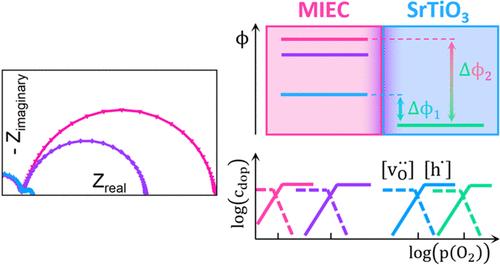
Mixed ionic and electronic conductors (MIECs) are a highly relevant material class in the field of solid-oxide cells and are, for example, promising candidates for electrodes with fast interfacial reaction kinetics. While there are many studies dealing with the bulk conductivities of such MIECs, models describing the interfaces between two mixed-conducting oxides have been far less developed. This study focuses on the investigation of space charges at the interfaces of the model perovskite SrTiO3 with different MIECs. Impedance spectroscopic measurements at 500 °C revealed that the MIECs under investigation can be divided into materials leading to negligible (YBa2Cu3O7−δ), moderate [(La,Sr)FeO3−δ, (La,Sr)CoO3−δ], and large [(La,Sr)MnO3−δ, (La,Sr)CrO3−δ] space charge resistances in SrTiO3 single crystals. The fundamental cause for these different space charge resistances is different space charge potentials, and we show that these can be determined by various methods with excellent agreement, ranging from X-ray photoelectron spectroscopy to impedance spectroscopy and photovoltage measurements. A model is introduced to correlate the ionic and electronic driving forces determining the space charges and to predict the space charge potentials from the electronic and ionic bulk properties of the corresponding mixed-conducting oxides. This model is also used to relate space charge potentials with reducibilities of MIECs, i.e., transition points from hole to vacancy compensation of an acceptor dopant in defect chemical Brouwer diagrams. The predicted trends are in good agreement with thermodynamic data on defect formation energies from the literature. Accordingly, the given model provides a widely applicable framework to predict and describe the space charge properties of a variety of MIEC heterojunctions.
期刊介绍:
ACS Applied Materials & Interfaces is a leading interdisciplinary journal that brings together chemists, engineers, physicists, and biologists to explore the development and utilization of newly-discovered materials and interfacial processes for specific applications. Our journal has experienced remarkable growth since its establishment in 2009, both in terms of the number of articles published and the impact of the research showcased. We are proud to foster a truly global community, with the majority of published articles originating from outside the United States, reflecting the rapid growth of applied research worldwide.



 京公网安备 11010802042870号
京ICP备2023020795号-1
京公网安备 11010802042870号
京ICP备2023020795号-1

 分享
分享
 求助内容:
求助内容: 应助结果提醒方式:
 扫码关注我们
