, Nouraiz Mushtaq, Abrar Ahmad, Javaria Khayaban E Erum, Lan Li, Jinjie Qian, Xusheng Wang, Junkuo Gao
{"title":"Shaping the future of solar-driven photocatalysis by reticular framework materials","authors":", Nouraiz Mushtaq, Abrar Ahmad, Javaria Khayaban E Erum, Lan Li, Jinjie Qian, Xusheng Wang, Junkuo Gao","doi":"10.1016/j.jmst.2025.02.009","DOIUrl":null,"url":null,"abstract":"Photocatalysis, harnessing abundant solar energy, presents a sustainable strategy to address the dual challenges of fossil fuel depletion and environmental degradation. Among the emerging materials for photocatalytic applications, reticular framework materials, including metal-organic frameworks (MOFs), covalent organic frameworks (COFs), and hydrogen-bonded organic frameworks (HOFs), have attracted significant attention due to their high surface area, tunable architectures, and versatile chemical compositions. These properties enable efficient light harvesting and charge separation, making them promising candidates for various photocatalytic processes. This review systematically explores recent advancements in the synthesis and structural properties of MOFs, COFs, and HOFs, elucidating the complex mechanisms governing solar-driven photocatalysis and comparing their performance with a particular focus on their applications in CO<sub>2</sub> reduction, H<sub>2</sub> generation, H<sub>2</sub>O<sub>2</sub> production, N<sub>2</sub> fixation, and pollutant degradation. Key strategies for enhancing photocatalytic performance, including structural modifications, bandgap engineering, defect engineering, hybridization, and heterojunction formation, are critically analyzed. A comparative evaluation of reticular framework materials against traditional semiconductors is provided, considering factors such as efficiency, cost, and long-term stability. Furthermore, this review highlights the challenges related to stability and scalability, along with key achievements and barriers to practical implementation. This work offers possible insights to overcome existing limitations and improve efficiency. Ultimately, this comprehensive assessment highlights the pivotal role of reticular frameworks in advancing sustainable energy solutions and provides a roadmap for future research and innovation in this rapidly evolving field.","PeriodicalId":16154,"journal":{"name":"Journal of Materials Science & Technology","volume":"14 1","pages":""},"PeriodicalIF":14.3000,"publicationDate":"2025-03-05","publicationTypes":"Journal Article","fieldsOfStudy":null,"isOpenAccess":false,"openAccessPdf":"","citationCount":"0","resultStr":null,"platform":"Semanticscholar","paperid":null,"PeriodicalName":"Journal of Materials Science & Technology","FirstCategoryId":"88","ListUrlMain":"https://doi.org/10.1016/j.jmst.2025.02.009","RegionNum":1,"RegionCategory":"材料科学","ArticlePicture":[],"TitleCN":null,"AbstractTextCN":null,"PMCID":null,"EPubDate":"","PubModel":"","JCR":"Q1","JCRName":"MATERIALS SCIENCE, MULTIDISCIPLINARY","Score":null,"Total":0}
引用次数: 0
Abstract
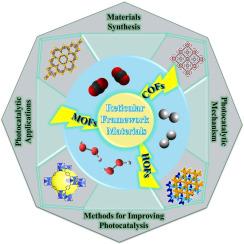
Photocatalysis, harnessing abundant solar energy, presents a sustainable strategy to address the dual challenges of fossil fuel depletion and environmental degradation. Among the emerging materials for photocatalytic applications, reticular framework materials, including metal-organic frameworks (MOFs), covalent organic frameworks (COFs), and hydrogen-bonded organic frameworks (HOFs), have attracted significant attention due to their high surface area, tunable architectures, and versatile chemical compositions. These properties enable efficient light harvesting and charge separation, making them promising candidates for various photocatalytic processes. This review systematically explores recent advancements in the synthesis and structural properties of MOFs, COFs, and HOFs, elucidating the complex mechanisms governing solar-driven photocatalysis and comparing their performance with a particular focus on their applications in CO2 reduction, H2 generation, H2O2 production, N2 fixation, and pollutant degradation. Key strategies for enhancing photocatalytic performance, including structural modifications, bandgap engineering, defect engineering, hybridization, and heterojunction formation, are critically analyzed. A comparative evaluation of reticular framework materials against traditional semiconductors is provided, considering factors such as efficiency, cost, and long-term stability. Furthermore, this review highlights the challenges related to stability and scalability, along with key achievements and barriers to practical implementation. This work offers possible insights to overcome existing limitations and improve efficiency. Ultimately, this comprehensive assessment highlights the pivotal role of reticular frameworks in advancing sustainable energy solutions and provides a roadmap for future research and innovation in this rapidly evolving field.
期刊介绍:
Journal of Materials Science & Technology strives to promote global collaboration in the field of materials science and technology. It primarily publishes original research papers, invited review articles, letters, research notes, and summaries of scientific achievements. The journal covers a wide range of materials science and technology topics, including metallic materials, inorganic nonmetallic materials, and composite materials.



 京公网安备 11010802042870号
京ICP备2023020795号-1
京公网安备 11010802042870号
京ICP备2023020795号-1

 分享
分享
 求助内容:
求助内容: 应助结果提醒方式:
 扫码关注我们
