Sichen Duan , Xin Bao , Jiawei Huang , Rongpei Shi , Linfeng Fei , Wenhua Xue , Honghao Yao , Xiaofang Li , Jian Wang , Xingjun Liu , Jun Mao , Feng Cao , Yumei Wang , Qian Zhang
{"title":"Spinodal decomposition promoting high thermoelectric performance in half-Heusler","authors":"Sichen Duan , Xin Bao , Jiawei Huang , Rongpei Shi , Linfeng Fei , Wenhua Xue , Honghao Yao , Xiaofang Li , Jian Wang , Xingjun Liu , Jun Mao , Feng Cao , Yumei Wang , Qian Zhang","doi":"10.1016/j.joule.2025.101854","DOIUrl":null,"url":null,"abstract":"<div><div>Spinodal decomposition typically manifests in partially miscible solid solutions in relevant phase diagrams as primarily dictated by the underlying thermodynamics, which is viewed as a powerful means for enhancing thermoelectric performance. Yet, the incomplete ternary phase diagrams of thermoelectric materials pose a challenge for microstructure design via spinodal decomposition. In addition, experimental investigation of microstructure evolution upon spinodal decomposition in thermoelectric alloys is rare, and its influence on electron and phonon transport remains largely unexplored. Herein, we constructed the (Ti, Zr, Hf)NiSn phase diagram experimentally, revealing a miscibility gap within 973–1,273 K. Spinodal decomposition with anisotropic composition modulation was observed in Ti<sub>0.5</sub>Zr<sub>0.25</sub>Hf<sub>0.25</sub>NiSn<sub>0.99</sub>Sb<sub>0.01</sub> by <em>in situ</em> transmission electron microscopy. The phase-field simulation further elucidates the microstructure evolution upon spinodal decomposition and provides insights into the generation of dislocations during further heat treatment. The annealing process not only induces dense dislocation arrays formed by spinodal evolution but also homogenizes the multiphase to facilitate electron transport. Consequently, a record-high average <em>zT</em> of ∼1.1 between 300 and 973 K has been realized in n-type Ti<sub>0.5</sub>Zr<sub>0.25</sub>Hf<sub>0.25</sub>NiSn<sub>0.99</sub>Sb<sub>0.01</sub>. Importantly, the half-Heusler module achieves a maximum conversion efficiency of ∼12% and an output power density of ∼3.7 W cm<sup>−2</sup> at a temperature difference of 653 K. This “double-high” result outperforms all of the current devices. Our results highlight spinodal decomposition as an effective avenue to advance materials for highly efficient thermoelectric power generation.</div></div>","PeriodicalId":343,"journal":{"name":"Joule","volume":"9 4","pages":"Article 101854"},"PeriodicalIF":35.4000,"publicationDate":"2025-04-16","publicationTypes":"Journal Article","fieldsOfStudy":null,"isOpenAccess":false,"openAccessPdf":"","citationCount":"0","resultStr":null,"platform":"Semanticscholar","paperid":null,"PeriodicalName":"Joule","FirstCategoryId":"88","ListUrlMain":"https://www.sciencedirect.com/science/article/pii/S2542435125000352","RegionNum":1,"RegionCategory":"材料科学","ArticlePicture":[],"TitleCN":null,"AbstractTextCN":null,"PMCID":null,"EPubDate":"","PubModel":"","JCR":"Q1","JCRName":"CHEMISTRY, PHYSICAL","Score":null,"Total":0}
引用次数: 0
Abstract
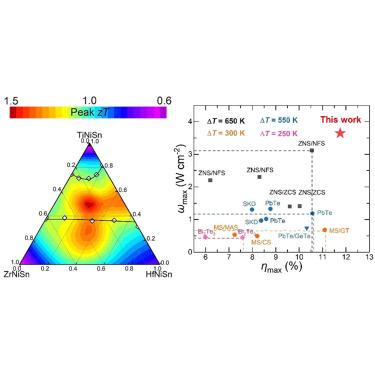
Spinodal decomposition typically manifests in partially miscible solid solutions in relevant phase diagrams as primarily dictated by the underlying thermodynamics, which is viewed as a powerful means for enhancing thermoelectric performance. Yet, the incomplete ternary phase diagrams of thermoelectric materials pose a challenge for microstructure design via spinodal decomposition. In addition, experimental investigation of microstructure evolution upon spinodal decomposition in thermoelectric alloys is rare, and its influence on electron and phonon transport remains largely unexplored. Herein, we constructed the (Ti, Zr, Hf)NiSn phase diagram experimentally, revealing a miscibility gap within 973–1,273 K. Spinodal decomposition with anisotropic composition modulation was observed in Ti0.5Zr0.25Hf0.25NiSn0.99Sb0.01 by in situ transmission electron microscopy. The phase-field simulation further elucidates the microstructure evolution upon spinodal decomposition and provides insights into the generation of dislocations during further heat treatment. The annealing process not only induces dense dislocation arrays formed by spinodal evolution but also homogenizes the multiphase to facilitate electron transport. Consequently, a record-high average zT of ∼1.1 between 300 and 973 K has been realized in n-type Ti0.5Zr0.25Hf0.25NiSn0.99Sb0.01. Importantly, the half-Heusler module achieves a maximum conversion efficiency of ∼12% and an output power density of ∼3.7 W cm−2 at a temperature difference of 653 K. This “double-high” result outperforms all of the current devices. Our results highlight spinodal decomposition as an effective avenue to advance materials for highly efficient thermoelectric power generation.
期刊介绍:
Joule is a sister journal to Cell that focuses on research, analysis, and ideas related to sustainable energy. It aims to address the global challenge of the need for more sustainable energy solutions. Joule is a forward-looking journal that bridges disciplines and scales of energy research. It connects researchers and analysts working on scientific, technical, economic, policy, and social challenges related to sustainable energy. The journal covers a wide range of energy research, from fundamental laboratory studies on energy conversion and storage to global-level analysis. Joule aims to highlight and amplify the implications, challenges, and opportunities of novel energy research for different groups in the field.




 京公网安备 11010802042870号
京ICP备2023020795号-1
京公网安备 11010802042870号
京ICP备2023020795号-1

 分享
分享
 求助内容:
求助内容: 应助结果提醒方式:
 扫码关注我们
