Xia Niu, Ge Chang, Ning Xu, Rui Li, Bingyu Niu, Rui Mao, Shan Wang, Guiling Li, Jiandong Jiang, Lulu Wang
{"title":"Vitamin A-Integrated Cinnamaldehyde Nanoemulsion: A Nanotherapeutic Approach To Counteract Liver Fibrosis via Gut–Liver Axis Modulation","authors":"Xia Niu, Ge Chang, Ning Xu, Rui Li, Bingyu Niu, Rui Mao, Shan Wang, Guiling Li, Jiandong Jiang, Lulu Wang","doi":"10.1021/acsnano.5c00136","DOIUrl":null,"url":null,"abstract":"Liver fibrosis, a complex process resulting from most chronic liver diseases, remains devoid of effective treatments. An increasing body of evidence links liver fibrosis to the “gut–liver axis”, with disruptions in the gut microbiota–host balance emerging as a critical contributor to its progression. Cinnamaldehyde (Cin), a natural compound with antioxidant, anti-inflammatory, and anticytotoxic properties, has shown potential in counteracting hepatic stellate cell (HSC) activation. Additionally, Cin has been shown to promote probiotics in the intestine, thereby restoring a healthy microbial community. These characteristics position Cin as a promising candidate for liver fibrosis treatment through modulation of the gut–liver axis. In this study, a Vitamin A (Va)-formulated Cin Nanoemulsion (Va-Cin@NM) was developed to enhance the physicochemical stability of Cin while preserving intestinal homeostasis and facilitating targeted liver deposition. In bile duct ligation (BDL)-induced liver fibrosis in rats, Va-Cin@NM intervention significantly reduced bile duct-like structure proliferation and collagen deposition in the liver. These effects are likely attributed to the restoration of gut microbiota, increased short-chain fatty acid (SCFA) concentrations, and improved intestinal integrity. Moreover, Va-Cin@NM treatment suppressed harmful bacterial populations in the liver, thus mitigating immune injury and inflammatory cell recruitment. Consequently, oxidative stress and HSC activation were attenuated. Overall, Va-Cin@NM demonstrates significant potential as a nanotherapeutic approach for liver fibrosis by modulating the gut–liver axis.","PeriodicalId":21,"journal":{"name":"ACS Nano","volume":"212 1","pages":""},"PeriodicalIF":16.0000,"publicationDate":"2025-03-06","publicationTypes":"Journal Article","fieldsOfStudy":null,"isOpenAccess":false,"openAccessPdf":"","citationCount":"0","resultStr":null,"platform":"Semanticscholar","paperid":null,"PeriodicalName":"ACS Nano","FirstCategoryId":"88","ListUrlMain":"https://doi.org/10.1021/acsnano.5c00136","RegionNum":1,"RegionCategory":"材料科学","ArticlePicture":[],"TitleCN":null,"AbstractTextCN":null,"PMCID":null,"EPubDate":"","PubModel":"","JCR":"Q1","JCRName":"CHEMISTRY, MULTIDISCIPLINARY","Score":null,"Total":0}
引用次数: 0
Abstract
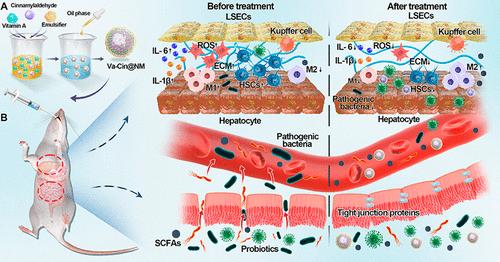
Liver fibrosis, a complex process resulting from most chronic liver diseases, remains devoid of effective treatments. An increasing body of evidence links liver fibrosis to the “gut–liver axis”, with disruptions in the gut microbiota–host balance emerging as a critical contributor to its progression. Cinnamaldehyde (Cin), a natural compound with antioxidant, anti-inflammatory, and anticytotoxic properties, has shown potential in counteracting hepatic stellate cell (HSC) activation. Additionally, Cin has been shown to promote probiotics in the intestine, thereby restoring a healthy microbial community. These characteristics position Cin as a promising candidate for liver fibrosis treatment through modulation of the gut–liver axis. In this study, a Vitamin A (Va)-formulated Cin Nanoemulsion (Va-Cin@NM) was developed to enhance the physicochemical stability of Cin while preserving intestinal homeostasis and facilitating targeted liver deposition. In bile duct ligation (BDL)-induced liver fibrosis in rats, Va-Cin@NM intervention significantly reduced bile duct-like structure proliferation and collagen deposition in the liver. These effects are likely attributed to the restoration of gut microbiota, increased short-chain fatty acid (SCFA) concentrations, and improved intestinal integrity. Moreover, Va-Cin@NM treatment suppressed harmful bacterial populations in the liver, thus mitigating immune injury and inflammatory cell recruitment. Consequently, oxidative stress and HSC activation were attenuated. Overall, Va-Cin@NM demonstrates significant potential as a nanotherapeutic approach for liver fibrosis by modulating the gut–liver axis.
期刊介绍:
ACS Nano, published monthly, serves as an international forum for comprehensive articles on nanoscience and nanotechnology research at the intersections of chemistry, biology, materials science, physics, and engineering. The journal fosters communication among scientists in these communities, facilitating collaboration, new research opportunities, and advancements through discoveries. ACS Nano covers synthesis, assembly, characterization, theory, and simulation of nanostructures, nanobiotechnology, nanofabrication, methods and tools for nanoscience and nanotechnology, and self- and directed-assembly. Alongside original research articles, it offers thorough reviews, perspectives on cutting-edge research, and discussions envisioning the future of nanoscience and nanotechnology.



 京公网安备 11010802042870号
京ICP备2023020795号-1
京公网安备 11010802042870号
京ICP备2023020795号-1

 分享
分享
 求助内容:
求助内容: 应助结果提醒方式:
 扫码关注我们
