Jianan Zhao, Xinyu Wang, Xinqi Xie and Hongmei Cao
{"title":"Binder-free V2O5-carbon nanotube composite films for high-performance aqueous manganese-ion batteries†","authors":"Jianan Zhao, Xinyu Wang, Xinqi Xie and Hongmei Cao","doi":"10.1039/D5NR00074B","DOIUrl":null,"url":null,"abstract":"<p >Aqueous manganese-ion batteries (MIBs) are considered a possible choice for energy storage systems as the Mn anode offers superior theoretical capacity and low redox potential. However, the capacities of the cathode materials are usually limited by the large radius of the solvated Mn<small><sup>2+</sup></small>. Herein, binder-free V<small><sub>2</sub></small>O<small><sub>5</sub></small>-carbon nanotube film (VO-CNT) cathodes were designed through a straightforward suction filtration method. In the films, V<small><sub>2</sub></small>O<small><sub>5</sub></small> with an open layered framework provided abundant ion transfer channels, and more importantly, the VO-CNT cathodes allowed the co-intercalation/extraction of Mn<small><sup>2+</sup></small> and H<small><sup>+</sup></small> ions. This charge storage mechanism significantly optimized the electrochemical performance of the batteries. In addition, the carbon nanotubes formed a continuous high-conductive scaffold in the film, which contributed to the overall good conductivity of the cathode. Leveraging the synergistic advantages of V<small><sub>2</sub></small>O<small><sub>5</sub></small> and carbon nanotubes, the binder-free VO-CNT cathodes displayed a high capacity, an exceptional rate capability, and robust cycling stability, retaining 96% capacity over 1000 cycles. This work provides a novel method in the design of high-performance cathodes for aqueous MIBs.</p>","PeriodicalId":92,"journal":{"name":"Nanoscale","volume":" 15","pages":" 9315-9322"},"PeriodicalIF":5.1000,"publicationDate":"2025-03-06","publicationTypes":"Journal Article","fieldsOfStudy":null,"isOpenAccess":false,"openAccessPdf":"","citationCount":"0","resultStr":null,"platform":"Semanticscholar","paperid":null,"PeriodicalName":"Nanoscale","FirstCategoryId":"88","ListUrlMain":"https://pubs.rsc.org/en/content/articlelanding/2025/nr/d5nr00074b","RegionNum":3,"RegionCategory":"材料科学","ArticlePicture":[],"TitleCN":null,"AbstractTextCN":null,"PMCID":null,"EPubDate":"","PubModel":"","JCR":"Q1","JCRName":"CHEMISTRY, MULTIDISCIPLINARY","Score":null,"Total":0}
引用次数: 0
Abstract
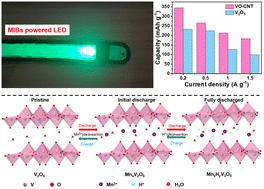
Aqueous manganese-ion batteries (MIBs) are considered a possible choice for energy storage systems as the Mn anode offers superior theoretical capacity and low redox potential. However, the capacities of the cathode materials are usually limited by the large radius of the solvated Mn2+. Herein, binder-free V2O5-carbon nanotube film (VO-CNT) cathodes were designed through a straightforward suction filtration method. In the films, V2O5 with an open layered framework provided abundant ion transfer channels, and more importantly, the VO-CNT cathodes allowed the co-intercalation/extraction of Mn2+ and H+ ions. This charge storage mechanism significantly optimized the electrochemical performance of the batteries. In addition, the carbon nanotubes formed a continuous high-conductive scaffold in the film, which contributed to the overall good conductivity of the cathode. Leveraging the synergistic advantages of V2O5 and carbon nanotubes, the binder-free VO-CNT cathodes displayed a high capacity, an exceptional rate capability, and robust cycling stability, retaining 96% capacity over 1000 cycles. This work provides a novel method in the design of high-performance cathodes for aqueous MIBs.
期刊介绍:
Nanoscale is a high-impact international journal, publishing high-quality research across nanoscience and nanotechnology. Nanoscale publishes a full mix of research articles on experimental and theoretical work, including reviews, communications, and full papers.Highly interdisciplinary, this journal appeals to scientists, researchers and professionals interested in nanoscience and nanotechnology, quantum materials and quantum technology, including the areas of physics, chemistry, biology, medicine, materials, energy/environment, information technology, detection science, healthcare and drug discovery, and electronics.



 京公网安备 11010802042870号
京ICP备2023020795号-1
京公网安备 11010802042870号
京ICP备2023020795号-1

 分享
分享
 求助内容:
求助内容: 应助结果提醒方式:
 扫码关注我们
