Huiping Chen, Zhifei Yang, Qing Yin, Wenjie Shangguan, Chong Cao, Qiliang Huang and Lidong Cao
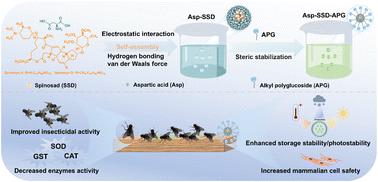
{"title":"An organic solvent-free self-assembly strategy for scalable preparation of nanobiopesticides with enhanced insecticidal activity against houseflies†","authors":"Huiping Chen, Zhifei Yang, Qing Yin, Wenjie Shangguan, Chong Cao, Qiliang Huang and Lidong Cao","doi":"10.1039/D4NR05141F","DOIUrl":null,"url":null,"abstract":"<p >The abuse of toxic organic solvents has caused great harm to human health and the environment. Therefore, developing an environmentally friendly nano-based pesticide formulation without using harmful solvents is urgent to improve the efficacy of pesticides and minimize environmental and health risks. Herein, by combining aspartic acid (Asp) with spinosad (SSD) as an attractive building unit, a self-assembly and carrier-minimized strategy was applied to construct a nanobiopesticide (Asp-SSD) simultaneously. To further improve the storage stability of the formulation, the biogenic surfactant alkyl polyglucoside (APG) was subsequently added to afford a more stable and smaller nano-delivery system (Asp-SSD-APG). Bioactivity assays showed that Asp-SSD-APG exhibited good quick-acting performance against <em>Musca domestica</em> in the spray assay, and the insecticidal activities of Asp-SSD and Asp-SSD-APG were better than that of the SSD nano-suspension concentrate (Nano-SC). Compared to CK, Asp-SSD-APG reduced the activity of GST, SOD, and CAT in <em>M. domestica</em>, which contributed to the enhanced insecticidal effect of SSD. The cell viability evaluation in 4T1 cells showed that Asp-SSD-APG posed a low risk to the mammalian cells. This study provides an alternative approach for developing environmentally benign nanobiopesticides with a self-assembly and carrier-minimized strategy, which has the potential to improve the efficacy and safety of pesticides in the public health field.</p>","PeriodicalId":92,"journal":{"name":"Nanoscale","volume":" 15","pages":" 9363-9373"},"PeriodicalIF":5.1000,"publicationDate":"2025-03-07","publicationTypes":"Journal Article","fieldsOfStudy":null,"isOpenAccess":false,"openAccessPdf":"https://pubs.rsc.org/en/content/articlepdf/2025/nr/d4nr05141f?page=search","citationCount":"0","resultStr":null,"platform":"Semanticscholar","paperid":null,"PeriodicalName":"Nanoscale","FirstCategoryId":"88","ListUrlMain":"https://pubs.rsc.org/en/content/articlelanding/2025/nr/d4nr05141f","RegionNum":3,"RegionCategory":"材料科学","ArticlePicture":[],"TitleCN":null,"AbstractTextCN":null,"PMCID":null,"EPubDate":"","PubModel":"","JCR":"Q1","JCRName":"CHEMISTRY, MULTIDISCIPLINARY","Score":null,"Total":0}
引用次数: 0
Abstract
The abuse of toxic organic solvents has caused great harm to human health and the environment. Therefore, developing an environmentally friendly nano-based pesticide formulation without using harmful solvents is urgent to improve the efficacy of pesticides and minimize environmental and health risks. Herein, by combining aspartic acid (Asp) with spinosad (SSD) as an attractive building unit, a self-assembly and carrier-minimized strategy was applied to construct a nanobiopesticide (Asp-SSD) simultaneously. To further improve the storage stability of the formulation, the biogenic surfactant alkyl polyglucoside (APG) was subsequently added to afford a more stable and smaller nano-delivery system (Asp-SSD-APG). Bioactivity assays showed that Asp-SSD-APG exhibited good quick-acting performance against Musca domestica in the spray assay, and the insecticidal activities of Asp-SSD and Asp-SSD-APG were better than that of the SSD nano-suspension concentrate (Nano-SC). Compared to CK, Asp-SSD-APG reduced the activity of GST, SOD, and CAT in M. domestica, which contributed to the enhanced insecticidal effect of SSD. The cell viability evaluation in 4T1 cells showed that Asp-SSD-APG posed a low risk to the mammalian cells. This study provides an alternative approach for developing environmentally benign nanobiopesticides with a self-assembly and carrier-minimized strategy, which has the potential to improve the efficacy and safety of pesticides in the public health field.
期刊介绍:
Nanoscale is a high-impact international journal, publishing high-quality research across nanoscience and nanotechnology. Nanoscale publishes a full mix of research articles on experimental and theoretical work, including reviews, communications, and full papers.Highly interdisciplinary, this journal appeals to scientists, researchers and professionals interested in nanoscience and nanotechnology, quantum materials and quantum technology, including the areas of physics, chemistry, biology, medicine, materials, energy/environment, information technology, detection science, healthcare and drug discovery, and electronics.



 京公网安备 11010802042870号
京ICP备2023020795号-1
京公网安备 11010802042870号
京ICP备2023020795号-1

 分享
分享
 求助内容:
求助内容: 应助结果提醒方式:
 扫码关注我们
