Tao Li, Xinji Dong, Hange Yang, Jianwei Zhang, Rong Huang, Zhuoran Lv, Yueyue Li, Shicong Zhang, Fuqiang Huang and Tianquan Lin
{"title":"Defective 1T-VS2 with fibonacci pattern unlocking high mass-loading and self-charging cathodes for aqueous zinc-ion batteries†","authors":"Tao Li, Xinji Dong, Hange Yang, Jianwei Zhang, Rong Huang, Zhuoran Lv, Yueyue Li, Shicong Zhang, Fuqiang Huang and Tianquan Lin","doi":"10.1039/D5EE00612K","DOIUrl":null,"url":null,"abstract":"<p >Cathode materials that exhibit high capacity, rapid charging, and long lifespan at high mass loading are crucial for the commercialization of aqueous zinc-ion batteries (AZIBs). However, challenges such as sluggish electrochemical kinetics and structural degradation during cycling often lead to low specific capacity and poor cycling stability, especially under high mass loading conditions, hindering their practical application. In this study, we introduce a novel defective 1T-VS<small><sub>2</sub></small> micro-rose material with a Fibonacci golden pattern structure, engineered to optimize the electrochemical performance of AZIBs. The unique rose-like morphology of the material promotes both a uniform and enriched electric field and concentration distribution, facilitating efficient ion and electron transport. This architecture, combined with abundant sulfur vacancies and vanadium intercalation, enhances structural stability, reduces cation migration barriers, and accelerates electrochemical kinetics. At high mass loading (up to 30 mg cm<small><sup>−2</sup></small>), the defective 1T-VS<small><sub>2</sub></small> cathode demonstrates excellent capacity retention (220 mA h g<small><sup>−1</sup></small>, 83% retention), remarkable cycling stability (80% retention over 400 cycles at 20 mA cm<small><sup>−2</sup></small>), and superior rate capability. Notably, the material also exhibits outstanding self-charging performance, with a high self-charging efficiency and an impressive self-charging rate, even at a high mass loading of 10 mg cm<small><sup>−2</sup></small>. This work not only underscores the exceptional electrochemical properties of the defective 1T-VS<small><sub>2</sub></small> cathode but also presents a design strategy that integrates macro-to-micro-scale structural optimization, offering a promising direction for the development of high-performance cathodes in energy storage applications.</p>","PeriodicalId":72,"journal":{"name":"Energy & Environmental Science","volume":" 7","pages":" 3169-3176"},"PeriodicalIF":30.8000,"publicationDate":"2025-03-05","publicationTypes":"Journal Article","fieldsOfStudy":null,"isOpenAccess":false,"openAccessPdf":"","citationCount":"0","resultStr":null,"platform":"Semanticscholar","paperid":null,"PeriodicalName":"Energy & Environmental Science","FirstCategoryId":"88","ListUrlMain":"https://pubs.rsc.org/en/content/articlelanding/2025/ee/d5ee00612k","RegionNum":1,"RegionCategory":"材料科学","ArticlePicture":[],"TitleCN":null,"AbstractTextCN":null,"PMCID":null,"EPubDate":"","PubModel":"","JCR":"Q1","JCRName":"CHEMISTRY, MULTIDISCIPLINARY","Score":null,"Total":0}
引用次数: 0
Abstract
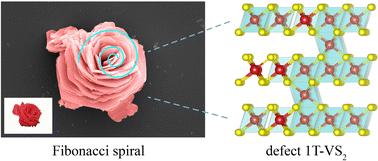
Cathode materials that exhibit high capacity, rapid charging, and long lifespan at high mass loading are crucial for the commercialization of aqueous zinc-ion batteries (AZIBs). However, challenges such as sluggish electrochemical kinetics and structural degradation during cycling often lead to low specific capacity and poor cycling stability, especially under high mass loading conditions, hindering their practical application. In this study, we introduce a novel defective 1T-VS2 micro-rose material with a Fibonacci golden pattern structure, engineered to optimize the electrochemical performance of AZIBs. The unique rose-like morphology of the material promotes both a uniform and enriched electric field and concentration distribution, facilitating efficient ion and electron transport. This architecture, combined with abundant sulfur vacancies and vanadium intercalation, enhances structural stability, reduces cation migration barriers, and accelerates electrochemical kinetics. At high mass loading (up to 30 mg cm−2), the defective 1T-VS2 cathode demonstrates excellent capacity retention (220 mA h g−1, 83% retention), remarkable cycling stability (80% retention over 400 cycles at 20 mA cm−2), and superior rate capability. Notably, the material also exhibits outstanding self-charging performance, with a high self-charging efficiency and an impressive self-charging rate, even at a high mass loading of 10 mg cm−2. This work not only underscores the exceptional electrochemical properties of the defective 1T-VS2 cathode but also presents a design strategy that integrates macro-to-micro-scale structural optimization, offering a promising direction for the development of high-performance cathodes in energy storage applications.
具有高容量、快速充电和高质量负载下长寿命的正极材料对于水性锌离子电池(azib)的商业化至关重要。然而,在循环过程中,电化学动力学缓慢和结构降解等挑战往往导致比容量低和循环稳定性差,特别是在高质量负载条件下,阻碍了其实际应用。在这项研究中,我们引入了一种具有斐波那契金图案结构的新型缺陷1T-VS2微玫瑰材料,用于优化AZIBs的电化学性能。材料独特的玫瑰状形态促进了均匀和丰富的电场和浓度分布,促进了高效的离子和电子传输。这种结构与丰富的硫空位和钒嵌入相结合,增强了结构稳定性,减少了阳离子迁移障碍,加速了电化学动力学。在高质量负载(高达30 mg cm-2)下,有缺陷的1T-VS2阴极表现出优异的容量保持率(220 mAh g-1,保持率83%),卓越的循环稳定性(在20 mA cm-2下循环400次,保持率80%)和优越的倍率能力。值得注意的是,该材料还表现出出色的自充电性能,即使在10 mg cm-2的高质量负载下,也具有很高的自充电效率和令人印象深刻的自充电率。这项工作不仅强调了缺陷1T-VS2阴极的优异电化学性能,而且提出了一种集成宏观到微观尺度结构优化的设计策略,为高性能阴极在储能应用中的发展提供了一个有前途的方向。
期刊介绍:
Energy & Environmental Science, a peer-reviewed scientific journal, publishes original research and review articles covering interdisciplinary topics in the (bio)chemical and (bio)physical sciences, as well as chemical engineering disciplines. Published monthly by the Royal Society of Chemistry (RSC), a not-for-profit publisher, Energy & Environmental Science is recognized as a leading journal. It boasts an impressive impact factor of 8.500 as of 2009, ranking 8th among 140 journals in the category "Chemistry, Multidisciplinary," second among 71 journals in "Energy & Fuels," second among 128 journals in "Engineering, Chemical," and first among 181 scientific journals in "Environmental Sciences."
Energy & Environmental Science publishes various types of articles, including Research Papers (original scientific work), Review Articles, Perspectives, and Minireviews (feature review-type articles of broad interest), Communications (original scientific work of an urgent nature), Opinions (personal, often speculative viewpoints or hypotheses on current topics), and Analysis Articles (in-depth examination of energy-related issues).




 京公网安备 11010802042870号
京ICP备2023020795号-1
京公网安备 11010802042870号
京ICP备2023020795号-1

 分享
分享
 求助内容:
求助内容: 应助结果提醒方式:
 扫码关注我们
