Teng Wang, Xiaohui Sun, Yidi Zhang, Qingyan Wang, Wenhui Cheng, Yuhui Gao, Xin’e Shi, Jianjun Jin
{"title":"Baicalin Promotes Skeletal Muscle Fiber Remodeling by Activating the p38MAPK/PGC-1α Signaling Pathway","authors":"Teng Wang, Xiaohui Sun, Yidi Zhang, Qingyan Wang, Wenhui Cheng, Yuhui Gao, Xin’e Shi, Jianjun Jin","doi":"10.1021/acs.jafc.5c00300","DOIUrl":null,"url":null,"abstract":"Skeletal muscle is the major tissue for metabolic activity in the body and performs a variety of physiological functions. Among these, muscle fiber types are decisive in muscle function and meat quality. Numerous studies have shown that natural products can affect the development of skeletal muscle, regulate the formation of muscle fibers, and impact muscle function under physiological or pathological conditions. Baicalin, a natural flavonoid compound mainly derived from the dried roots of <i>Scutellaria baicalensis</i>, has been reported to affect glucose metabolism and insulin resistance in skeletal muscle. However, the role of baicalin in the conversion of skeletal muscle fiber types and its underlying mechanisms remain unclear. This study aimed to explore the effects of baicalin on skeletal muscle fiber conversion in vitro and in vivo. The in vitro experiment used C2C12 cells as a model, with a baicalin treatment concentration of 125 μM; the in vivo experiment used C57BL/6J mice and weaned piglets as the models. The results showed that baicalin could participate in the remodeling of skeletal muscle fibers, promoting the conversion from glycolytic fibers to oxidative fibers in mice and pigs. This was evidenced by increased protein and mRNA expression levels of genes related to oxidative fibers, upregulated SDH enzyme activity, and mitochondrial complex expression in vivo and in vitro, while the protein and mRNA expression levels of genes related to glycolytic fibers were decreased, and LDH enzyme activity was downregulated. Mechanistic studies revealed that baicalin, as a small molecule, could target and bind to the p38 MAPK protein, increase its expression and phosphorylation levels, and activate the p38 MAPK/PGC-1α signaling pathway. Collectively, these data showed that baicalin induced a shift in skeletal muscle fiber composition from glycolytic to oxidative myofibers by activating the p38 MAPK/PGC-1α signaling pathway, thereby affecting the meat quality.","PeriodicalId":41,"journal":{"name":"Journal of Agricultural and Food Chemistry","volume":"16 1","pages":""},"PeriodicalIF":6.2000,"publicationDate":"2025-03-06","publicationTypes":"Journal Article","fieldsOfStudy":null,"isOpenAccess":false,"openAccessPdf":"","citationCount":"0","resultStr":null,"platform":"Semanticscholar","paperid":null,"PeriodicalName":"Journal of Agricultural and Food Chemistry","FirstCategoryId":"97","ListUrlMain":"https://doi.org/10.1021/acs.jafc.5c00300","RegionNum":1,"RegionCategory":"农林科学","ArticlePicture":[],"TitleCN":null,"AbstractTextCN":null,"PMCID":null,"EPubDate":"","PubModel":"","JCR":"Q1","JCRName":"AGRICULTURE, MULTIDISCIPLINARY","Score":null,"Total":0}
引用次数: 0
Abstract
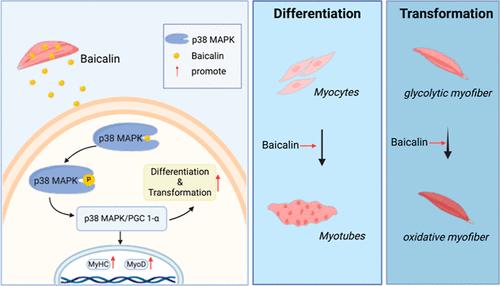
Skeletal muscle is the major tissue for metabolic activity in the body and performs a variety of physiological functions. Among these, muscle fiber types are decisive in muscle function and meat quality. Numerous studies have shown that natural products can affect the development of skeletal muscle, regulate the formation of muscle fibers, and impact muscle function under physiological or pathological conditions. Baicalin, a natural flavonoid compound mainly derived from the dried roots of Scutellaria baicalensis, has been reported to affect glucose metabolism and insulin resistance in skeletal muscle. However, the role of baicalin in the conversion of skeletal muscle fiber types and its underlying mechanisms remain unclear. This study aimed to explore the effects of baicalin on skeletal muscle fiber conversion in vitro and in vivo. The in vitro experiment used C2C12 cells as a model, with a baicalin treatment concentration of 125 μM; the in vivo experiment used C57BL/6J mice and weaned piglets as the models. The results showed that baicalin could participate in the remodeling of skeletal muscle fibers, promoting the conversion from glycolytic fibers to oxidative fibers in mice and pigs. This was evidenced by increased protein and mRNA expression levels of genes related to oxidative fibers, upregulated SDH enzyme activity, and mitochondrial complex expression in vivo and in vitro, while the protein and mRNA expression levels of genes related to glycolytic fibers were decreased, and LDH enzyme activity was downregulated. Mechanistic studies revealed that baicalin, as a small molecule, could target and bind to the p38 MAPK protein, increase its expression and phosphorylation levels, and activate the p38 MAPK/PGC-1α signaling pathway. Collectively, these data showed that baicalin induced a shift in skeletal muscle fiber composition from glycolytic to oxidative myofibers by activating the p38 MAPK/PGC-1α signaling pathway, thereby affecting the meat quality.
期刊介绍:
The Journal of Agricultural and Food Chemistry publishes high-quality, cutting edge original research representing complete studies and research advances dealing with the chemistry and biochemistry of agriculture and food. The Journal also encourages papers with chemistry and/or biochemistry as a major component combined with biological/sensory/nutritional/toxicological evaluation related to agriculture and/or food.



 京公网安备 11010802042870号
京ICP备2023020795号-1
京公网安备 11010802042870号
京ICP备2023020795号-1

 分享
分享
 求助内容:
求助内容: 应助结果提醒方式:
 扫码关注我们
