Targeted Degradation of Bromodomain-Containing Protein 4 Enabled by Reactive Oxygen Species–Activatable NanoPROTACs as an Efficient Strategy to Reverse Liver Fibrosis in Chronic Liver Injury
Tao Bi, Pan Liang, Qixin Zhao, Jiao Wu, Yanan Zhou, Yunke Xu, Xuehui Fan, Guoqiang Yang, Qin Sun, Wei Ren, Yingcheng Yang, Zengjin Liu
{"title":"Targeted Degradation of Bromodomain-Containing Protein 4 Enabled by Reactive Oxygen Species–Activatable NanoPROTACs as an Efficient Strategy to Reverse Liver Fibrosis in Chronic Liver Injury","authors":"Tao Bi, Pan Liang, Qixin Zhao, Jiao Wu, Yanan Zhou, Yunke Xu, Xuehui Fan, Guoqiang Yang, Qin Sun, Wei Ren, Yingcheng Yang, Zengjin Liu","doi":"10.1021/acs.jmedchem.4c02658","DOIUrl":null,"url":null,"abstract":"Liver fibrosis is an inadequate response to tissue stress, with reactive oxygen species (ROS) overproduction in activated hepatic stellate cells (aHSCs). Bromodomain-containing protein 4 (BRD4) was found to be upregulated in aHSCs and has been identified as an effective target for the treatment of liver fibrosis. However, inhibition of BRD4 with traditional kinase inhibitors achieved only limited success because of its low therapeutic efficiency. Furthermore, the exact mechanism by which BRD4 regulates liver fibrosis remains unclear and needs to be elucidated. In this work, we proposed an efficiency strategy, i.e., targeted degradation of BRD4 by ROS-activatable NanoPROTACs, for the treatment of liver fibrosis, both <i>in vitro</i> and <i>in vivo</i>. More importantly, we clarified the mechanism by which BRD4 regulates liver fibrosis. Thus, this strategy may represent an alternative to previously reported strategies and may be extensively applied to the design of ROS-activatable proteolysis-targeting chimeras for the treatment of other organ fibrosis.","PeriodicalId":46,"journal":{"name":"Journal of Medicinal Chemistry","volume":"11 1","pages":""},"PeriodicalIF":6.8000,"publicationDate":"2025-03-05","publicationTypes":"Journal Article","fieldsOfStudy":null,"isOpenAccess":false,"openAccessPdf":"","citationCount":"0","resultStr":null,"platform":"Semanticscholar","paperid":null,"PeriodicalName":"Journal of Medicinal Chemistry","FirstCategoryId":"3","ListUrlMain":"https://doi.org/10.1021/acs.jmedchem.4c02658","RegionNum":1,"RegionCategory":"医学","ArticlePicture":[],"TitleCN":null,"AbstractTextCN":null,"PMCID":null,"EPubDate":"","PubModel":"","JCR":"Q1","JCRName":"CHEMISTRY, MEDICINAL","Score":null,"Total":0}
引用次数: 0
Abstract
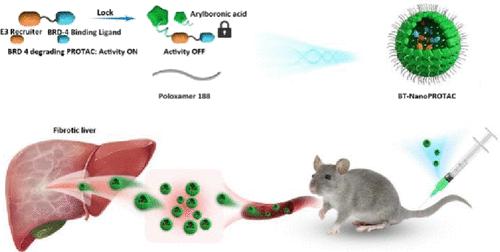
Liver fibrosis is an inadequate response to tissue stress, with reactive oxygen species (ROS) overproduction in activated hepatic stellate cells (aHSCs). Bromodomain-containing protein 4 (BRD4) was found to be upregulated in aHSCs and has been identified as an effective target for the treatment of liver fibrosis. However, inhibition of BRD4 with traditional kinase inhibitors achieved only limited success because of its low therapeutic efficiency. Furthermore, the exact mechanism by which BRD4 regulates liver fibrosis remains unclear and needs to be elucidated. In this work, we proposed an efficiency strategy, i.e., targeted degradation of BRD4 by ROS-activatable NanoPROTACs, for the treatment of liver fibrosis, both in vitro and in vivo. More importantly, we clarified the mechanism by which BRD4 regulates liver fibrosis. Thus, this strategy may represent an alternative to previously reported strategies and may be extensively applied to the design of ROS-activatable proteolysis-targeting chimeras for the treatment of other organ fibrosis.
期刊介绍:
The Journal of Medicinal Chemistry is a prestigious biweekly peer-reviewed publication that focuses on the multifaceted field of medicinal chemistry. Since its inception in 1959 as the Journal of Medicinal and Pharmaceutical Chemistry, it has evolved to become a cornerstone in the dissemination of research findings related to the design, synthesis, and development of therapeutic agents.
The Journal of Medicinal Chemistry is recognized for its significant impact in the scientific community, as evidenced by its 2022 impact factor of 7.3. This metric reflects the journal's influence and the importance of its content in shaping the future of drug discovery and development. The journal serves as a vital resource for chemists, pharmacologists, and other researchers interested in the molecular mechanisms of drug action and the optimization of therapeutic compounds.



 京公网安备 11010802042870号
京ICP备2023020795号-1
京公网安备 11010802042870号
京ICP备2023020795号-1

 分享
分享
 求助内容:
求助内容: 应助结果提醒方式:
 扫码关注我们
