Excitation wavelength-dependent room temperature phosphorescence based on dual confinement of an organic–inorganic matrix for dynamic information encryption†
Xianglong Zhao, Shaoyue Shuai, Runze Wang, Feifei Peng, Xianggui Kong and Wenying Shi
{"title":"Excitation wavelength-dependent room temperature phosphorescence based on dual confinement of an organic–inorganic matrix for dynamic information encryption†","authors":"Xianglong Zhao, Shaoyue Shuai, Runze Wang, Feifei Peng, Xianggui Kong and Wenying Shi","doi":"10.1039/D5DT00123D","DOIUrl":null,"url":null,"abstract":"<p >In the digital age of today, the importance of information encryption is increasingly recognized globally. Emerging room temperature phosphorescence (RTP) materials have stood out in the information encryption field. However, the majority of RTP materials have complicated synthesis processes, high costs, environmental problems, and potential bio-toxicity, which limit their wide application. Here, carbon dots (CDs) prepared from simple molecular chromophores, with the dual synergy of layered double hydroxides (LDHs) and polyvinyl alcohol (PVA), not only acquired RTP properties but also exhibited excitation wavelength-dependent characteristics. The mechanism shows that the two-dimensional template of inorganic LDHs can orderly arrange CDs. The organic PVA with abundant hydroxyl groups can be closely connected to guest molecules through hydrogen bonds. The resulting CDs–LDHs@PVA composite film demonstrates a RTP lifetime of 205 ms and a RTP quantum yield of 5.04%, and has broad application prospects in the field of optical anti-counterfeiting.</p>","PeriodicalId":71,"journal":{"name":"Dalton Transactions","volume":" 14","pages":" 5880-5887"},"PeriodicalIF":3.3000,"publicationDate":"2025-03-06","publicationTypes":"Journal Article","fieldsOfStudy":null,"isOpenAccess":false,"openAccessPdf":"","citationCount":"0","resultStr":null,"platform":"Semanticscholar","paperid":null,"PeriodicalName":"Dalton Transactions","FirstCategoryId":"92","ListUrlMain":"https://pubs.rsc.org/en/content/articlelanding/2025/dt/d5dt00123d","RegionNum":3,"RegionCategory":"化学","ArticlePicture":[],"TitleCN":null,"AbstractTextCN":null,"PMCID":null,"EPubDate":"","PubModel":"","JCR":"Q2","JCRName":"CHEMISTRY, INORGANIC & NUCLEAR","Score":null,"Total":0}
引用次数: 0
Abstract
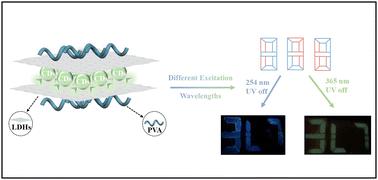
In the digital age of today, the importance of information encryption is increasingly recognized globally. Emerging room temperature phosphorescence (RTP) materials have stood out in the information encryption field. However, the majority of RTP materials have complicated synthesis processes, high costs, environmental problems, and potential bio-toxicity, which limit their wide application. Here, carbon dots (CDs) prepared from simple molecular chromophores, with the dual synergy of layered double hydroxides (LDHs) and polyvinyl alcohol (PVA), not only acquired RTP properties but also exhibited excitation wavelength-dependent characteristics. The mechanism shows that the two-dimensional template of inorganic LDHs can orderly arrange CDs. The organic PVA with abundant hydroxyl groups can be closely connected to guest molecules through hydrogen bonds. The resulting CDs–LDHs@PVA composite film demonstrates a RTP lifetime of 205 ms and a RTP quantum yield of 5.04%, and has broad application prospects in the field of optical anti-counterfeiting.
期刊介绍:
Dalton Transactions is a journal for all areas of inorganic chemistry, which encompasses the organometallic, bioinorganic and materials chemistry of the elements, with applications including synthesis, catalysis, energy conversion/storage, electrical devices and medicine. Dalton Transactions welcomes high-quality, original submissions in all of these areas and more, where the advancement of knowledge in inorganic chemistry is significant.




 京公网安备 11010802042870号
京ICP备2023020795号-1
京公网安备 11010802042870号
京ICP备2023020795号-1

 分享
分享
 求助内容:
求助内容: 应助结果提醒方式:
 扫码关注我们
