Zewei Wei, Du Yuan, Xuedi Yuan, Yalin Zhang, Jianmin Ma, Suojiang Zhang and Haitao Zhang
{"title":"Formulation principles and synergistic effects of high-voltage electrolytes","authors":"Zewei Wei, Du Yuan, Xuedi Yuan, Yalin Zhang, Jianmin Ma, Suojiang Zhang and Haitao Zhang","doi":"10.1039/D4CS00826J","DOIUrl":null,"url":null,"abstract":"<p >The energy density of lithium-ion batteries (LIBs) is primarily determined by the working potential of devices and the specific capacity of cathode compounds. Carbonate-based electrolytes have received considerable attention due to their significance for advancing current cell-assembly process. However, the commercially available liquid LiPF<small><sub>6</sub></small> based electrolytes cannot withstand the harsh high-voltage environment and the effects of cathode, due to issues such as the undesired oxidative decomposition of ethylene carbonate (EC), the catalytic influence of dissolved transition metal ions (TMs), and the poor performance of interphases with unstable morphologies and components. Furthermore, the complex working mechanisms of high-voltage electrolytes (HVEs) are not fully understood. This review presents a comprehensive summary of the HVEs, including their physical properties, solvation structures, and interface chemistry. Specifically, chemical environment of high-voltage cathode compounds and failure mechanisms of commercial electrolytes are investigated, followed by a discussion of expected functions of HVEs. Then, screening criteria for single-component electrolytes, considering their oxidation resistance and decomposition mechanism, and screening mechanism of interphase species are explored based on their energy level positions. Next, a cross-scale evolution framework is proposed, from the solvation structure to interphase characteristics, aimed at uncovering the formulation principles and synergistic effects of HVEs. Operational mechanisms are systematically scrutinized, starting from the conventional tuning of solvation structure to the incorporation of multiple components and further to the role of entropy-driven effects, all of which will favor the understanding of formulation principles and synergistic effects. Finally, integration of advanced computational methods and mature experimental techniques is expected to foster the development of novel perspectives and promising electrolyte candidates.</p>","PeriodicalId":68,"journal":{"name":"Chemical Society Reviews","volume":" 8","pages":" 3775-3818"},"PeriodicalIF":39.0000,"publicationDate":"2025-03-06","publicationTypes":"Journal Article","fieldsOfStudy":null,"isOpenAccess":false,"openAccessPdf":"","citationCount":"0","resultStr":null,"platform":"Semanticscholar","paperid":null,"PeriodicalName":"Chemical Society Reviews","FirstCategoryId":"92","ListUrlMain":"https://pubs.rsc.org/en/content/articlelanding/2025/cs/d4cs00826j","RegionNum":1,"RegionCategory":"化学","ArticlePicture":[],"TitleCN":null,"AbstractTextCN":null,"PMCID":null,"EPubDate":"","PubModel":"","JCR":"Q1","JCRName":"CHEMISTRY, MULTIDISCIPLINARY","Score":null,"Total":0}
引用次数: 0
Abstract
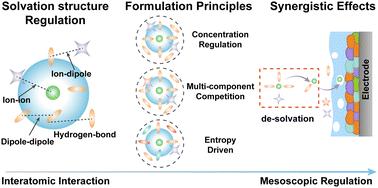
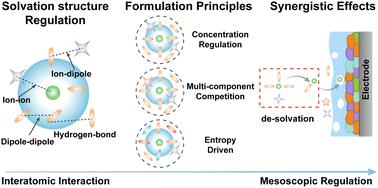
The energy density of lithium-ion batteries (LIBs) is primarily determined by the working potential of devices and the specific capacity of cathode compounds. Carbonate-based electrolytes have received considerable attention due to their significance for advancing current cell-assembly process. However, the commercially available liquid LiPF6 based electrolytes cannot withstand the harsh high-voltage environment and the effects of cathode, due to issues such as the undesired oxidative decomposition of ethylene carbonate (EC), the catalytic influence of dissolved transition metal ions (TMs), and the poor performance of interphases with unstable morphologies and components. Furthermore, the complex working mechanisms of high-voltage electrolytes (HVEs) are not fully understood. This review presents a comprehensive summary of the HVEs, including their physical properties, solvation structures, and interface chemistry. Specifically, chemical environment of high-voltage cathode compounds and failure mechanisms of commercial electrolytes are investigated, followed by a discussion of expected functions of HVEs. Then, screening criteria for single-component electrolytes, considering their oxidation resistance and decomposition mechanism, and screening mechanism of interphase species are explored based on their energy level positions. Next, a cross-scale evolution framework is proposed, from the solvation structure to interphase characteristics, aimed at uncovering the formulation principles and synergistic effects of HVEs. Operational mechanisms are systematically scrutinized, starting from the conventional tuning of solvation structure to the incorporation of multiple components and further to the role of entropy-driven effects, all of which will favor the understanding of formulation principles and synergistic effects. Finally, integration of advanced computational methods and mature experimental techniques is expected to foster the development of novel perspectives and promising electrolyte candidates.
期刊介绍:
Chemical Society Reviews is published by: Royal Society of Chemistry.
Focus: Review articles on topics of current interest in chemistry;
Predecessors: Quarterly Reviews, Chemical Society (1947–1971);
Current title: Since 1971;
Impact factor: 60.615 (2021);
Themed issues: Occasional themed issues on new and emerging areas of research in the chemical sciences



 京公网安备 11010802042870号
京ICP备2023020795号-1
京公网安备 11010802042870号
京ICP备2023020795号-1

 分享
分享
 求助内容:
求助内容: 应助结果提醒方式:
 扫码关注我们
