S. Janani , Ankit Choraria , KV Ashok Raj , S. Rajeswari , R. Sivasubramanian , A. Michael , R. Selvakumar
{"title":"Gold nanoparticle-based electrochemical immunosensor for the detection of Russell’s viper venom using IgY antibodies","authors":"S. Janani , Ankit Choraria , KV Ashok Raj , S. Rajeswari , R. Sivasubramanian , A. Michael , R. Selvakumar","doi":"10.1016/j.microc.2025.113247","DOIUrl":null,"url":null,"abstract":"<div><div>In this study, we have developed for the first time a sensitive electrochemical immunosensor by electrostatically immobilizing IgY antibodies onto the citrate capped gold nanoparticle (ctAuNP) functionalized glassy carbon electrode (GCE) for the detection of Russell’s Viper (RV) venom in human blood and serum. Initially, the ctAuNP was prepared by a simple citrate reduction method. Simultaneously a novel approach of preparing RV IgY antibodies was raised in immunized chicken for this study. The ctAuNP-IgY modified electrode was characterized using cyclic voltammetry (CV) and the sensing was carried out using electrochemical impedance spectroscopy (EIS). The Nyquist plot was recorded for different concentrations of RV venom using signals produced during antigen–antibody interactions. The presence of ctAuNP helps in the adsorption of antibodies and also enhances the conductivity of the sensor. The limit of detection (LOD) was estimated to be 0.74 µg/mL with a linear range from 3.34 to 6.68 µg/mL of RV venom. The sensor was tested in both human serum and blood samples which showed a satisfactory recovery percentage ranging from 87.3 % to 110.4 % and 84.6 % to 108.5 % respectively. Stability studies showed that the surface-modified electrode retained 87 % of the initial sensitivity after storage at 4 °C for one week.</div></div>","PeriodicalId":391,"journal":{"name":"Microchemical Journal","volume":"212 ","pages":"Article 113247"},"PeriodicalIF":4.9000,"publicationDate":"2025-05-01","publicationTypes":"Journal Article","fieldsOfStudy":null,"isOpenAccess":false,"openAccessPdf":"","citationCount":"0","resultStr":null,"platform":"Semanticscholar","paperid":null,"PeriodicalName":"Microchemical Journal","FirstCategoryId":"92","ListUrlMain":"https://www.sciencedirect.com/science/article/pii/S0026265X25006010","RegionNum":2,"RegionCategory":"化学","ArticlePicture":[],"TitleCN":null,"AbstractTextCN":null,"PMCID":null,"EPubDate":"2025/3/4 0:00:00","PubModel":"Epub","JCR":"Q1","JCRName":"CHEMISTRY, ANALYTICAL","Score":null,"Total":0}
引用次数: 0
Abstract
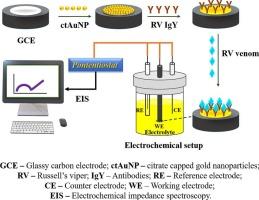
In this study, we have developed for the first time a sensitive electrochemical immunosensor by electrostatically immobilizing IgY antibodies onto the citrate capped gold nanoparticle (ctAuNP) functionalized glassy carbon electrode (GCE) for the detection of Russell’s Viper (RV) venom in human blood and serum. Initially, the ctAuNP was prepared by a simple citrate reduction method. Simultaneously a novel approach of preparing RV IgY antibodies was raised in immunized chicken for this study. The ctAuNP-IgY modified electrode was characterized using cyclic voltammetry (CV) and the sensing was carried out using electrochemical impedance spectroscopy (EIS). The Nyquist plot was recorded for different concentrations of RV venom using signals produced during antigen–antibody interactions. The presence of ctAuNP helps in the adsorption of antibodies and also enhances the conductivity of the sensor. The limit of detection (LOD) was estimated to be 0.74 µg/mL with a linear range from 3.34 to 6.68 µg/mL of RV venom. The sensor was tested in both human serum and blood samples which showed a satisfactory recovery percentage ranging from 87.3 % to 110.4 % and 84.6 % to 108.5 % respectively. Stability studies showed that the surface-modified electrode retained 87 % of the initial sensitivity after storage at 4 °C for one week.
期刊介绍:
The Microchemical Journal is a peer reviewed journal devoted to all aspects and phases of analytical chemistry and chemical analysis. The Microchemical Journal publishes articles which are at the forefront of modern analytical chemistry and cover innovations in the techniques to the finest possible limits. This includes fundamental aspects, instrumentation, new developments, innovative and novel methods and applications including environmental and clinical field.
Traditional classical analytical methods such as spectrophotometry and titrimetry as well as established instrumentation methods such as flame and graphite furnace atomic absorption spectrometry, gas chromatography, and modified glassy or carbon electrode electrochemical methods will be considered, provided they show significant improvements and novelty compared to the established methods.



 京公网安备 11010802042870号
京ICP备2023020795号-1
京公网安备 11010802042870号
京ICP备2023020795号-1

 分享
分享
 求助内容:
求助内容: 应助结果提醒方式:
 扫码关注我们
