Monolithic capillary columns based on methacryl-substituted polyhedral oligomeric silsesquioxane and sulfobetaine methacrylates synthesized in the wide-bore capillary: Evaluation and application in liquid chromatography
Dana Moravcová, Josef Planeta, Zuzana Gogaľová, Jozef Šesták, Matej Ščepán, Pavel Karásek, Michal Roth
{"title":"Monolithic capillary columns based on methacryl-substituted polyhedral oligomeric silsesquioxane and sulfobetaine methacrylates synthesized in the wide-bore capillary: Evaluation and application in liquid chromatography","authors":"Dana Moravcová, Josef Planeta, Zuzana Gogaľová, Jozef Šesták, Matej Ščepán, Pavel Karásek, Michal Roth","doi":"10.1016/j.microc.2025.113239","DOIUrl":null,"url":null,"abstract":"<div><div>The protocol for preparation of methacryl-substituted polyhedral oligomeric silsesquioxane-based monolithic stationary phases containing zwitterionic sulfobetaine monomers in 450 µm i.d. fused silica capillaries is presented. The monolithic columns were evaluated by scanning electron microscopy, inverse size-exclusion chromatography, and isocratic HPLC separation of model compounds. Nature of zwitterionic sulfobetaine monomers has distinct impact on the structure of the final monolithic material as well as on its polarity and separation ability. The columns are suitable for multimodal chromatography as confirmed by their capability to separate compounds over a wide range of polarities (alkylbenzenes, phenolics, aromatic carboxylic acids, a mixture of purine-, pyrimidine-bases, nucleosides, and 2-deoxynucleosides). The critical mobile phase composition for the transition from hydrophilic interaction liquid chromatography to reversed-phase mode is around 84 % of acetonitrile which confirms the prevailing non-polar nature of formed monoliths. The proposed preparation protocol allowed preparation of stable columns whose efficiency reached the minimal height of the theoretical plate 6–10 µm which decreased by less than 12 % during the two months of<!--> <!-->everyday use.</div></div>","PeriodicalId":391,"journal":{"name":"Microchemical Journal","volume":"212 ","pages":"Article 113239"},"PeriodicalIF":4.9000,"publicationDate":"2025-05-01","publicationTypes":"Journal Article","fieldsOfStudy":null,"isOpenAccess":false,"openAccessPdf":"","citationCount":"0","resultStr":null,"platform":"Semanticscholar","paperid":null,"PeriodicalName":"Microchemical Journal","FirstCategoryId":"92","ListUrlMain":"https://www.sciencedirect.com/science/article/pii/S0026265X25005934","RegionNum":2,"RegionCategory":"化学","ArticlePicture":[],"TitleCN":null,"AbstractTextCN":null,"PMCID":null,"EPubDate":"2025/3/4 0:00:00","PubModel":"Epub","JCR":"Q1","JCRName":"CHEMISTRY, ANALYTICAL","Score":null,"Total":0}
引用次数: 0
Abstract
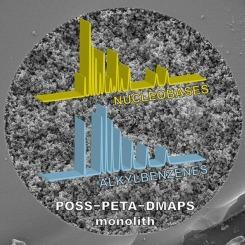
The protocol for preparation of methacryl-substituted polyhedral oligomeric silsesquioxane-based monolithic stationary phases containing zwitterionic sulfobetaine monomers in 450 µm i.d. fused silica capillaries is presented. The monolithic columns were evaluated by scanning electron microscopy, inverse size-exclusion chromatography, and isocratic HPLC separation of model compounds. Nature of zwitterionic sulfobetaine monomers has distinct impact on the structure of the final monolithic material as well as on its polarity and separation ability. The columns are suitable for multimodal chromatography as confirmed by their capability to separate compounds over a wide range of polarities (alkylbenzenes, phenolics, aromatic carboxylic acids, a mixture of purine-, pyrimidine-bases, nucleosides, and 2-deoxynucleosides). The critical mobile phase composition for the transition from hydrophilic interaction liquid chromatography to reversed-phase mode is around 84 % of acetonitrile which confirms the prevailing non-polar nature of formed monoliths. The proposed preparation protocol allowed preparation of stable columns whose efficiency reached the minimal height of the theoretical plate 6–10 µm which decreased by less than 12 % during the two months of everyday use.
期刊介绍:
The Microchemical Journal is a peer reviewed journal devoted to all aspects and phases of analytical chemistry and chemical analysis. The Microchemical Journal publishes articles which are at the forefront of modern analytical chemistry and cover innovations in the techniques to the finest possible limits. This includes fundamental aspects, instrumentation, new developments, innovative and novel methods and applications including environmental and clinical field.
Traditional classical analytical methods such as spectrophotometry and titrimetry as well as established instrumentation methods such as flame and graphite furnace atomic absorption spectrometry, gas chromatography, and modified glassy or carbon electrode electrochemical methods will be considered, provided they show significant improvements and novelty compared to the established methods.



 京公网安备 11010802042870号
京ICP备2023020795号-1
京公网安备 11010802042870号
京ICP备2023020795号-1

 分享
分享
 求助内容:
求助内容: 应助结果提醒方式:
 扫码关注我们
