{"title":"Driving martensitic transformation through pre-cold deformation: Unveiling the mechanism of microstructural evolution in martensite bearing steel","authors":"Decheng Jia , Chunsheng Zhang , Runzhou Dong , Haida Zhang , Xinliang Gao , Xiaoyong Feng , Zhinan Yang , Fucheng Zhang","doi":"10.1016/j.matdes.2025.113788","DOIUrl":null,"url":null,"abstract":"<div><div>Bearing steel is used to produce bearing components through preforming processes, such as cold heading and cold rolling, prior to heat treatment. Cold rolling is a key developmental direction for manufacturing high-performance bearing. This research comprehensively examines how pre-cold deformation affects the microstructural evolution and mechanical characteristics of martensitic bearing steel. The findings suggest that pre-cold deformation reduces the original austenite grain size decreases by half, and the cementite particles become more uniformly distributed. Simultaneously, pre-cold deformation treatment considerably increases the bearing steel hardness from 715HV to 768HV whilst maintaining its toughness. The homogenisation of cementite size and the increase in hardness enhance the wear resistance of the samples by 34%. Furthermore, we explores the microstructural evolution mechanisms during subsequent phase transformations: the bearing steel in the process of martensitic transformation, the pre-cold deformation treatment leads to a strong variant selection, which increases the intrinsic nucleation rate and reduces the autocatalytic nucleation rate of martensite. The change of nucleation positions causes the great differences in the crystallography of the samples. The martensite twins transforming into twinned variants that adhere to the Kurdjumov-Sachs orientation relationship. In this study, we have established a relationship linking crystallography, phase transitions, and mechanical properties.</div></div>","PeriodicalId":383,"journal":{"name":"Materials & Design","volume":"252 ","pages":"Article 113788"},"PeriodicalIF":7.9000,"publicationDate":"2025-03-01","publicationTypes":"Journal Article","fieldsOfStudy":null,"isOpenAccess":false,"openAccessPdf":"","citationCount":"0","resultStr":null,"platform":"Semanticscholar","paperid":null,"PeriodicalName":"Materials & Design","FirstCategoryId":"88","ListUrlMain":"https://www.sciencedirect.com/science/article/pii/S0264127525002084","RegionNum":2,"RegionCategory":"材料科学","ArticlePicture":[],"TitleCN":null,"AbstractTextCN":null,"PMCID":null,"EPubDate":"","PubModel":"","JCR":"Q1","JCRName":"MATERIALS SCIENCE, MULTIDISCIPLINARY","Score":null,"Total":0}
引用次数: 0
Abstract
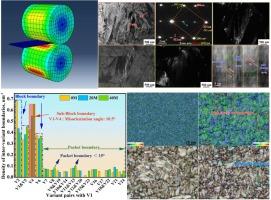
Bearing steel is used to produce bearing components through preforming processes, such as cold heading and cold rolling, prior to heat treatment. Cold rolling is a key developmental direction for manufacturing high-performance bearing. This research comprehensively examines how pre-cold deformation affects the microstructural evolution and mechanical characteristics of martensitic bearing steel. The findings suggest that pre-cold deformation reduces the original austenite grain size decreases by half, and the cementite particles become more uniformly distributed. Simultaneously, pre-cold deformation treatment considerably increases the bearing steel hardness from 715HV to 768HV whilst maintaining its toughness. The homogenisation of cementite size and the increase in hardness enhance the wear resistance of the samples by 34%. Furthermore, we explores the microstructural evolution mechanisms during subsequent phase transformations: the bearing steel in the process of martensitic transformation, the pre-cold deformation treatment leads to a strong variant selection, which increases the intrinsic nucleation rate and reduces the autocatalytic nucleation rate of martensite. The change of nucleation positions causes the great differences in the crystallography of the samples. The martensite twins transforming into twinned variants that adhere to the Kurdjumov-Sachs orientation relationship. In this study, we have established a relationship linking crystallography, phase transitions, and mechanical properties.
期刊介绍:
Materials and Design is a multi-disciplinary journal that publishes original research reports, review articles, and express communications. The journal focuses on studying the structure and properties of inorganic and organic materials, advancements in synthesis, processing, characterization, and testing, the design of materials and engineering systems, and their applications in technology. It aims to bring together various aspects of materials science, engineering, physics, and chemistry.
The journal explores themes ranging from materials to design and aims to reveal the connections between natural and artificial materials, as well as experiment and modeling. Manuscripts submitted to Materials and Design should contain elements of discovery and surprise, as they often contribute new insights into the architecture and function of matter.



 京公网安备 11010802042870号
京ICP备2023020795号-1
京公网安备 11010802042870号
京ICP备2023020795号-1

 分享
分享
 求助内容:
求助内容: 应助结果提醒方式:
 扫码关注我们
