Controls on metal distributions of the Fengzishan Zn–Pb deposit at the giant Jinding ore field in western Yunnan Province, SW China: Insights from field mapping and 3D geological modeling
JingKun Liu , ChuanDong Xue , Wei Wang , LiPeng Xue , Rehana Ghazi
{"title":"Controls on metal distributions of the Fengzishan Zn–Pb deposit at the giant Jinding ore field in western Yunnan Province, SW China: Insights from field mapping and 3D geological modeling","authors":"JingKun Liu , ChuanDong Xue , Wei Wang , LiPeng Xue , Rehana Ghazi","doi":"10.1016/j.oregeorev.2025.106509","DOIUrl":null,"url":null,"abstract":"<div><div>The world class Jinding Zn–Pb ore field, located in the Meso–Cenozoic Lanping Basin in western Yunnan Province, SW China, contains significant deposits that are primarily controlled by stratigraphy and structure. However, the migration pathways and driving mechanisms of ore-forming fluids are poorly understood, which limit the minerals exploration. Based on typical orebodies in the Fengzishan Zn–Pb deposit, this study used field mapping and three-dimensional (3D) geological modeling to depict the metal distribution and identify key ore-controlling structures. The results show that lead, zinc, and other base metals are concentrated in the hosting sandstones and breccia limestones of the Upper Triassic Sanhedong Formation. These rocks are located beneath the unconformity with the Miocene Jinding Group and within the hanging walls of NS-trending thrust faults and EW-trending tear faults. Oxidized metal-rich brines from the Jinding Group and reduced H<sub>2</sub>S-rich fluids from the Sanhedong Formation migrate along the thrust and tear faults. Elevated Pb, Zn, Cd, and Ag concentrations and low Zn/Pb ratios were observed, suggesting multiple ore-forming fluid recharge events. We propose the following key suggestions: the spatial distributions of metals are controlled by the Jinding Group, the Sanhedong Formation, the unconformity between them, and the thrust and tear faults; the two-source fluids exhibit lateral and vertical flow through fault zones; and this migration is primarily driven by regional EW-trending compressive stresses. Based on regional geological data, the depths and adjacent areas of the Fengzishan and Nanchang deposits were identified as potential exploration targets for mineralization. These insights provide valuable perspectives for understanding the ore-forming processes of Jinding Zn–Pb ore field and similar regions.</div></div>","PeriodicalId":19644,"journal":{"name":"Ore Geology Reviews","volume":"179 ","pages":"Article 106509"},"PeriodicalIF":3.6000,"publicationDate":"2025-02-18","publicationTypes":"Journal Article","fieldsOfStudy":null,"isOpenAccess":false,"openAccessPdf":"","citationCount":"0","resultStr":null,"platform":"Semanticscholar","paperid":null,"PeriodicalName":"Ore Geology Reviews","FirstCategoryId":"89","ListUrlMain":"https://www.sciencedirect.com/science/article/pii/S0169136825000691","RegionNum":2,"RegionCategory":"地球科学","ArticlePicture":[],"TitleCN":null,"AbstractTextCN":null,"PMCID":null,"EPubDate":"","PubModel":"","JCR":"Q1","JCRName":"GEOLOGY","Score":null,"Total":0}
引用次数: 0
Abstract
The world class Jinding Zn–Pb ore field, located in the Meso–Cenozoic Lanping Basin in western Yunnan Province, SW China, contains significant deposits that are primarily controlled by stratigraphy and structure. However, the migration pathways and driving mechanisms of ore-forming fluids are poorly understood, which limit the minerals exploration. Based on typical orebodies in the Fengzishan Zn–Pb deposit, this study used field mapping and three-dimensional (3D) geological modeling to depict the metal distribution and identify key ore-controlling structures. The results show that lead, zinc, and other base metals are concentrated in the hosting sandstones and breccia limestones of the Upper Triassic Sanhedong Formation. These rocks are located beneath the unconformity with the Miocene Jinding Group and within the hanging walls of NS-trending thrust faults and EW-trending tear faults. Oxidized metal-rich brines from the Jinding Group and reduced H2S-rich fluids from the Sanhedong Formation migrate along the thrust and tear faults. Elevated Pb, Zn, Cd, and Ag concentrations and low Zn/Pb ratios were observed, suggesting multiple ore-forming fluid recharge events. We propose the following key suggestions: the spatial distributions of metals are controlled by the Jinding Group, the Sanhedong Formation, the unconformity between them, and the thrust and tear faults; the two-source fluids exhibit lateral and vertical flow through fault zones; and this migration is primarily driven by regional EW-trending compressive stresses. Based on regional geological data, the depths and adjacent areas of the Fengzishan and Nanchang deposits were identified as potential exploration targets for mineralization. These insights provide valuable perspectives for understanding the ore-forming processes of Jinding Zn–Pb ore field and similar regions.
期刊介绍:
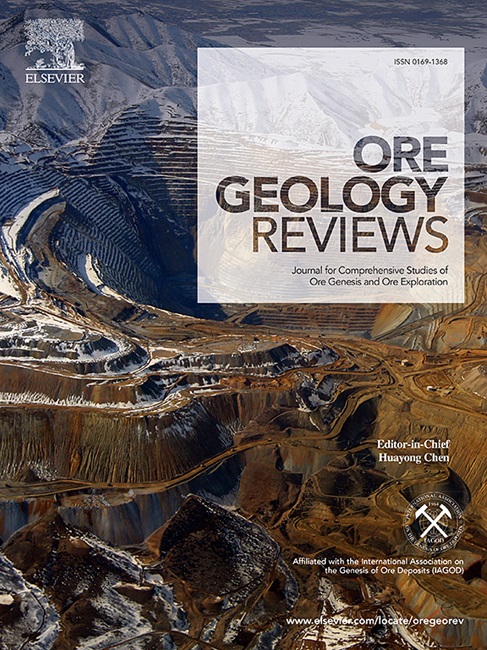
Ore Geology Reviews aims to familiarize all earth scientists with recent advances in a number of interconnected disciplines related to the study of, and search for, ore deposits. The reviews range from brief to longer contributions, but the journal preferentially publishes manuscripts that fill the niche between the commonly shorter journal articles and the comprehensive book coverages, and thus has a special appeal to many authors and readers.




 京公网安备 11010802042870号
京ICP备2023020795号-1
京公网安备 11010802042870号
京ICP备2023020795号-1

 分享
分享
 求助内容:
求助内容: 应助结果提醒方式:
 扫码关注我们
