Yan Sun, Daniele Silvestro, Gregor H. Mathes, Marcel G. A. van der Heijden, Heinz Müller-Schärer
{"title":"Eco-Evolutionary Dynamics of Plant–Soil Feedbacks Explain the Spread Potential of a Plant Invader Under Climate Warming and Biocontrol Herbivory","authors":"Yan Sun, Daniele Silvestro, Gregor H. Mathes, Marcel G. A. van der Heijden, Heinz Müller-Schärer","doi":"10.1111/gcb.70110","DOIUrl":null,"url":null,"abstract":"<div>\n \n <p>Plant–soil feedbacks (PSFs) can contribute to the success of invasive plants. Despite strong evidence that plant genetic traits influence soil microbial communities and vice versa, empirical evidence exploring these feedbacks over evolutionary timescales, especially under climate change, remains limited. We conducted a 5-year field study of the annual invasive plant, <i>Ambrosia artemisiifolia</i> L., to examine how selection under climate warming and biocontrol insect herbivory shapes plant population genetics, soil properties, and microbial communities. After four generations under warming and herbivory, we collected seeds of the F<sub>4</sub> plant populations together with their conditioned soil for a common garden PSF experiment to explore how resulting PSFs patterns are influencing the performance and spread potential of <i>Ambrosia</i> under changing environmental conditions. This is especially relevant because our recent predictions point to a northward spread of <i>Ambrosia</i> in Europe and Asia under climate change, outpacing the spread of its insect biocontrol agent. We discovered that warming and herbivory significantly but differentially altered plant genetic composition and its soil microbial communities, with less pronounced effects on soil physicochemical properties. Our results indicate that both herbivory and warming generated negative PSFs. These negative PSFs favored plant growth of the seeds from the persistent soil seed bank growing in the conditioned soil under insect herbivory, and by this maintaining the <i>Ambrosia</i> population genetic diversity. They also enhanced the spread potential of warming-selected plant offspring, especially from warmer (southern) to colder (northern) climates. This can be explained by the observed decrease in soil pathogens occurrence under insect herbivory and by the especially strong genetic changes in plant populations under climate warming. Our findings provide insights into how climate warming and biocontrol management affect eco-evolutionary interactions between invasive plant populations and their soil environments, which are critical for predicting invasion dynamics in the context of global change.</p>\n </div>","PeriodicalId":175,"journal":{"name":"Global Change Biology","volume":"31 3","pages":""},"PeriodicalIF":12.0000,"publicationDate":"2025-03-07","publicationTypes":"Journal Article","fieldsOfStudy":null,"isOpenAccess":false,"openAccessPdf":"","citationCount":"0","resultStr":null,"platform":"Semanticscholar","paperid":null,"PeriodicalName":"Global Change Biology","FirstCategoryId":"93","ListUrlMain":"https://onlinelibrary.wiley.com/doi/10.1111/gcb.70110","RegionNum":1,"RegionCategory":"环境科学与生态学","ArticlePicture":[],"TitleCN":null,"AbstractTextCN":null,"PMCID":null,"EPubDate":"","PubModel":"","JCR":"Q1","JCRName":"BIODIVERSITY CONSERVATION","Score":null,"Total":0}
引用次数: 0
Abstract
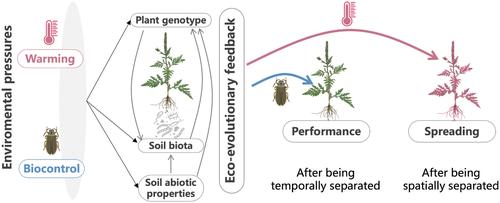
Plant–soil feedbacks (PSFs) can contribute to the success of invasive plants. Despite strong evidence that plant genetic traits influence soil microbial communities and vice versa, empirical evidence exploring these feedbacks over evolutionary timescales, especially under climate change, remains limited. We conducted a 5-year field study of the annual invasive plant, Ambrosia artemisiifolia L., to examine how selection under climate warming and biocontrol insect herbivory shapes plant population genetics, soil properties, and microbial communities. After four generations under warming and herbivory, we collected seeds of the F4 plant populations together with their conditioned soil for a common garden PSF experiment to explore how resulting PSFs patterns are influencing the performance and spread potential of Ambrosia under changing environmental conditions. This is especially relevant because our recent predictions point to a northward spread of Ambrosia in Europe and Asia under climate change, outpacing the spread of its insect biocontrol agent. We discovered that warming and herbivory significantly but differentially altered plant genetic composition and its soil microbial communities, with less pronounced effects on soil physicochemical properties. Our results indicate that both herbivory and warming generated negative PSFs. These negative PSFs favored plant growth of the seeds from the persistent soil seed bank growing in the conditioned soil under insect herbivory, and by this maintaining the Ambrosia population genetic diversity. They also enhanced the spread potential of warming-selected plant offspring, especially from warmer (southern) to colder (northern) climates. This can be explained by the observed decrease in soil pathogens occurrence under insect herbivory and by the especially strong genetic changes in plant populations under climate warming. Our findings provide insights into how climate warming and biocontrol management affect eco-evolutionary interactions between invasive plant populations and their soil environments, which are critical for predicting invasion dynamics in the context of global change.
期刊介绍:
Global Change Biology is an environmental change journal committed to shaping the future and addressing the world's most pressing challenges, including sustainability, climate change, environmental protection, food and water safety, and global health.
Dedicated to fostering a profound understanding of the impacts of global change on biological systems and offering innovative solutions, the journal publishes a diverse range of content, including primary research articles, technical advances, research reviews, reports, opinions, perspectives, commentaries, and letters. Starting with the 2024 volume, Global Change Biology will transition to an online-only format, enhancing accessibility and contributing to the evolution of scholarly communication.



 京公网安备 11010802042870号
京ICP备2023020795号-1
京公网安备 11010802042870号
京ICP备2023020795号-1

 分享
分享
 求助内容:
求助内容: 应助结果提醒方式:
 扫码关注我们
