Andana Barrios, Nicolas Gaggion, Natanael Mansilla, Thomas Blein, Céline Sorin, Leandro Lucero, Enzo Ferrante, Martin Crespi, Federico Ariel
{"title":"The transcription factor NF-YA10 determines the area explored by Arabidopsis thaliana roots and directly regulates LAZY genes","authors":"Andana Barrios, Nicolas Gaggion, Natanael Mansilla, Thomas Blein, Céline Sorin, Leandro Lucero, Enzo Ferrante, Martin Crespi, Federico Ariel","doi":"10.1111/tpj.70016","DOIUrl":null,"url":null,"abstract":"<p>Root developmental plasticity relies on transcriptional reprogramming, which largely depends on the activity of transcription factors (TFs). NF-YA2 and NF-YA10 (nuclear factor A2 and A10) are downregulated by the specific miRNA isoform miR169defg. Here, we analyzed the role of the <i>Arabidopsis thaliana</i> TF NF-YA10 in the regulation of lateral root (LR) development. Plants expressing a version of <i>NF-YA10</i> resistant to miR169 cleavage showed a perturbation in the LR gravitropic response. By extracting several features of root architecture using an improved version of the ChronoRoot deep-learning-based phenotyping system, we uncovered that these plants showed a differential angle of LRs over time when compared to Col-0. Detailed phenotyping of root growth dynamics revealed that NF-YA10 misregulation modulates the area explored by Arabidopsis roots. Furthermore, we found that NF-YA10 directly regulates <i>LAZY</i> genes, which were previously linked to gravitropism, by targeting their promoter regions. Hence, the TF NF-YA10 is a new element in the control of LR bending and root system architecture.</p>","PeriodicalId":233,"journal":{"name":"The Plant Journal","volume":"121 5","pages":""},"PeriodicalIF":5.7000,"publicationDate":"2025-03-06","publicationTypes":"Journal Article","fieldsOfStudy":null,"isOpenAccess":false,"openAccessPdf":"https://onlinelibrary.wiley.com/doi/epdf/10.1111/tpj.70016","citationCount":"0","resultStr":null,"platform":"Semanticscholar","paperid":null,"PeriodicalName":"The Plant Journal","FirstCategoryId":"2","ListUrlMain":"https://onlinelibrary.wiley.com/doi/10.1111/tpj.70016","RegionNum":1,"RegionCategory":"生物学","ArticlePicture":[],"TitleCN":null,"AbstractTextCN":null,"PMCID":null,"EPubDate":"","PubModel":"","JCR":"Q1","JCRName":"PLANT SCIENCES","Score":null,"Total":0}
引用次数: 0
Abstract
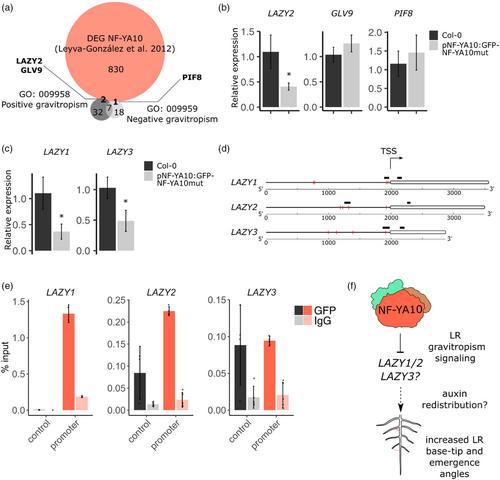
Root developmental plasticity relies on transcriptional reprogramming, which largely depends on the activity of transcription factors (TFs). NF-YA2 and NF-YA10 (nuclear factor A2 and A10) are downregulated by the specific miRNA isoform miR169defg. Here, we analyzed the role of the Arabidopsis thaliana TF NF-YA10 in the regulation of lateral root (LR) development. Plants expressing a version of NF-YA10 resistant to miR169 cleavage showed a perturbation in the LR gravitropic response. By extracting several features of root architecture using an improved version of the ChronoRoot deep-learning-based phenotyping system, we uncovered that these plants showed a differential angle of LRs over time when compared to Col-0. Detailed phenotyping of root growth dynamics revealed that NF-YA10 misregulation modulates the area explored by Arabidopsis roots. Furthermore, we found that NF-YA10 directly regulates LAZY genes, which were previously linked to gravitropism, by targeting their promoter regions. Hence, the TF NF-YA10 is a new element in the control of LR bending and root system architecture.
期刊介绍:
Publishing the best original research papers in all key areas of modern plant biology from the world"s leading laboratories, The Plant Journal provides a dynamic forum for this ever growing international research community.
Plant science research is now at the forefront of research in the biological sciences, with breakthroughs in our understanding of fundamental processes in plants matching those in other organisms. The impact of molecular genetics and the availability of model and crop species can be seen in all aspects of plant biology. For publication in The Plant Journal the research must provide a highly significant new contribution to our understanding of plants and be of general interest to the plant science community.



 京公网安备 11010802042870号
京ICP备2023020795号-1
京公网安备 11010802042870号
京ICP备2023020795号-1

 分享
分享
 求助内容:
求助内容: 应助结果提醒方式:
 扫码关注我们
