Dr. Tobias Kull, Johannes Dahlhues, Andrea Wilmsen, Dr. Heiko Lohmann, Dr. Barbara Zeidler-Fandrich, Prof. Dr. Ulf-Peter Apfel
{"title":"Chromite–Zeolite Catalysts for Syngas Conversion to Hydrocarbons: Insights into Oxide–Zeolite Interactions","authors":"Dr. Tobias Kull, Johannes Dahlhues, Andrea Wilmsen, Dr. Heiko Lohmann, Dr. Barbara Zeidler-Fandrich, Prof. Dr. Ulf-Peter Apfel","doi":"10.1002/cctc.202401810","DOIUrl":null,"url":null,"abstract":"<p>A key challenge in modern society is developing the sustainable processes for producing vital chemicals, such as hydrocarbons, from renewable raw materials. The OX-ZEO process, which uses bifunctional catalysts to convert syngas into hydrocarbons, offers a potential alternative to the nonsustainable cracking process. Combining oxide materials with zeolites enables the direct synthesis of various hydrocarbon products with high selectivity. However, challenges remain, particularly regarding carbon monoxide (CO) conversion and unwanted carbon dioxide (CO<sub>2</sub>) generation. This study explores the impact of bimetallic chromites combined with H-MOR zeolite on the reaction outcome. Comparative experiments using only the oxide versus the bifunctional catalyst revealed a clear link between the methanol synthesis activity of the oxide and the overall activity in the OX-ZEO process. Furthermore, catalytic tests with monometallic oxides paired with H-MOR highlighted the role of the oxide's crystal structure in syngas conversion. These findings offer insights into the oxide–zeolite interactions, enabling the development of improved catalyst combinations that enhance the CO conversion, reduce CO<sub>2</sub> formation, and maintain high product selectivity.</p>","PeriodicalId":141,"journal":{"name":"ChemCatChem","volume":"17 5","pages":""},"PeriodicalIF":3.9000,"publicationDate":"2024-12-23","publicationTypes":"Journal Article","fieldsOfStudy":null,"isOpenAccess":false,"openAccessPdf":"https://onlinelibrary.wiley.com/doi/epdf/10.1002/cctc.202401810","citationCount":"0","resultStr":null,"platform":"Semanticscholar","paperid":null,"PeriodicalName":"ChemCatChem","FirstCategoryId":"92","ListUrlMain":"https://chemistry-europe.onlinelibrary.wiley.com/doi/10.1002/cctc.202401810","RegionNum":3,"RegionCategory":"化学","ArticlePicture":[],"TitleCN":null,"AbstractTextCN":null,"PMCID":null,"EPubDate":"","PubModel":"","JCR":"Q2","JCRName":"CHEMISTRY, PHYSICAL","Score":null,"Total":0}
引用次数: 0
Abstract
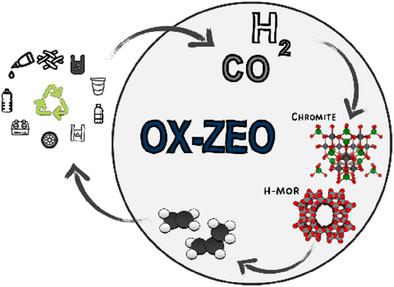
A key challenge in modern society is developing the sustainable processes for producing vital chemicals, such as hydrocarbons, from renewable raw materials. The OX-ZEO process, which uses bifunctional catalysts to convert syngas into hydrocarbons, offers a potential alternative to the nonsustainable cracking process. Combining oxide materials with zeolites enables the direct synthesis of various hydrocarbon products with high selectivity. However, challenges remain, particularly regarding carbon monoxide (CO) conversion and unwanted carbon dioxide (CO2) generation. This study explores the impact of bimetallic chromites combined with H-MOR zeolite on the reaction outcome. Comparative experiments using only the oxide versus the bifunctional catalyst revealed a clear link between the methanol synthesis activity of the oxide and the overall activity in the OX-ZEO process. Furthermore, catalytic tests with monometallic oxides paired with H-MOR highlighted the role of the oxide's crystal structure in syngas conversion. These findings offer insights into the oxide–zeolite interactions, enabling the development of improved catalyst combinations that enhance the CO conversion, reduce CO2 formation, and maintain high product selectivity.
期刊介绍:
With an impact factor of 4.495 (2018), ChemCatChem is one of the premier journals in the field of catalysis. The journal provides primary research papers and critical secondary information on heterogeneous, homogeneous and bio- and nanocatalysis. The journal is well placed to strengthen cross-communication within between these communities. Its authors and readers come from academia, the chemical industry, and government laboratories across the world. It is published on behalf of Chemistry Europe, an association of 16 European chemical societies, and is supported by the German Catalysis Society.





 京公网安备 11010802042870号
京ICP备2023020795号-1
京公网安备 11010802042870号
京ICP备2023020795号-1

 分享
分享
 求助内容:
求助内容: 应助结果提醒方式:
 扫码关注我们
