Dr. Hushan Chand, Nicolò Allasia, Dr. Luis A. Cipriano, Dr. Giovanni Di Liberto, Prof.Dr. Ik Seon Kwon, Prof.Dr. Min Zhang, Prof.Dr. Gianfranco Pacchioni, Prof.Dr. Venkata Krishnan, Prof.Dr. Gianvito Vilé
{"title":"Synergistic Effects in a Nitrogen-Coordinated Zinc Single-Atom Catalyst for Efficient CO2 Cycloaddition","authors":"Dr. Hushan Chand, Nicolò Allasia, Dr. Luis A. Cipriano, Dr. Giovanni Di Liberto, Prof.Dr. Ik Seon Kwon, Prof.Dr. Min Zhang, Prof.Dr. Gianfranco Pacchioni, Prof.Dr. Venkata Krishnan, Prof.Dr. Gianvito Vilé","doi":"10.1002/cctc.202401768","DOIUrl":null,"url":null,"abstract":"<p>The valorization of CO<sub>2</sub> into organic carbonates through its cycloaddition to epoxides has garnered significant attention in catalysis. However, the reaction is often hindered by low selectivity, and a key challenge is the development of catalysts capable of effectively activating both CO<sub>2</sub> and epoxides simultaneously. In this study, we prepared and characterized a catalyst comprising isolated zinc single atoms dispersed on carbon nitride for the selective CO<sub>2</sub> conversion to cyclic carbonates. The monoatomic nature and homogeneous distribution of the zinc species were confirmed utilizing advanced characterization methods, including X-ray absorption spectroscopy and aberration-corrected scanning transmission electron microscopy. The catalyst activity and recyclability were validated through catalytic tests with epichlorohydrin as a model epoxydic compound, and the study scope was subsequently extended to include a wide range of functionalized epoxides. Density functional theory calculations were performed to elucidate the reaction mechanism, revealing that both CO<sub>2</sub> and epichlorohydrin interact with the same zinc atom in the cycloaddition process, highlighting the key role of zinc single atoms in promoting the reaction. Overall, the present study provides new insights into the design and optimization of heterogeneous catalysts for CO<sub>2</sub> cycloadditions, paving the way for more effective strategies in CO<sub>2</sub> valorization and conversion for producing valuable fine chemicals.</p>","PeriodicalId":141,"journal":{"name":"ChemCatChem","volume":"17 5","pages":""},"PeriodicalIF":3.9000,"publicationDate":"2024-12-23","publicationTypes":"Journal Article","fieldsOfStudy":null,"isOpenAccess":false,"openAccessPdf":"https://onlinelibrary.wiley.com/doi/epdf/10.1002/cctc.202401768","citationCount":"0","resultStr":null,"platform":"Semanticscholar","paperid":null,"PeriodicalName":"ChemCatChem","FirstCategoryId":"92","ListUrlMain":"https://chemistry-europe.onlinelibrary.wiley.com/doi/10.1002/cctc.202401768","RegionNum":3,"RegionCategory":"化学","ArticlePicture":[],"TitleCN":null,"AbstractTextCN":null,"PMCID":null,"EPubDate":"","PubModel":"","JCR":"Q2","JCRName":"CHEMISTRY, PHYSICAL","Score":null,"Total":0}
引用次数: 0
Abstract
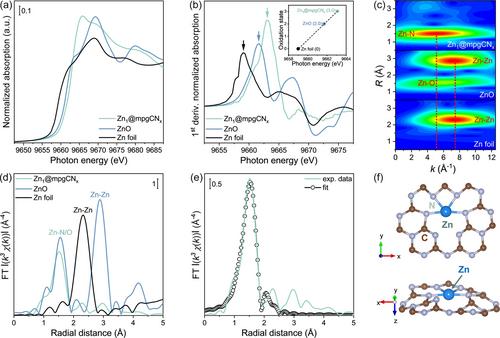
The valorization of CO2 into organic carbonates through its cycloaddition to epoxides has garnered significant attention in catalysis. However, the reaction is often hindered by low selectivity, and a key challenge is the development of catalysts capable of effectively activating both CO2 and epoxides simultaneously. In this study, we prepared and characterized a catalyst comprising isolated zinc single atoms dispersed on carbon nitride for the selective CO2 conversion to cyclic carbonates. The monoatomic nature and homogeneous distribution of the zinc species were confirmed utilizing advanced characterization methods, including X-ray absorption spectroscopy and aberration-corrected scanning transmission electron microscopy. The catalyst activity and recyclability were validated through catalytic tests with epichlorohydrin as a model epoxydic compound, and the study scope was subsequently extended to include a wide range of functionalized epoxides. Density functional theory calculations were performed to elucidate the reaction mechanism, revealing that both CO2 and epichlorohydrin interact with the same zinc atom in the cycloaddition process, highlighting the key role of zinc single atoms in promoting the reaction. Overall, the present study provides new insights into the design and optimization of heterogeneous catalysts for CO2 cycloadditions, paving the way for more effective strategies in CO2 valorization and conversion for producing valuable fine chemicals.
期刊介绍:
With an impact factor of 4.495 (2018), ChemCatChem is one of the premier journals in the field of catalysis. The journal provides primary research papers and critical secondary information on heterogeneous, homogeneous and bio- and nanocatalysis. The journal is well placed to strengthen cross-communication within between these communities. Its authors and readers come from academia, the chemical industry, and government laboratories across the world. It is published on behalf of Chemistry Europe, an association of 16 European chemical societies, and is supported by the German Catalysis Society.





 京公网安备 11010802042870号
京ICP备2023020795号-1
京公网安备 11010802042870号
京ICP备2023020795号-1

 分享
分享
 求助内容:
求助内容: 应助结果提醒方式:
 扫码关注我们
