Tobias Rios-Studer, Zhengfan Chen, Christean Nickel, Fan Feng, Kevin Sowa, Dr. Ekemena O. Oseghe, Dr. Sina Sadigh Akbari, Sarra Rahali, Leon Prädel, Dr. Ingo Lieberwirth, Guangjin Zhang, Dr. Dandan Gao, Dr. Rongji Liu, Dr. Carsten Streb
{"title":"Ruthenium-Doped Copper Nanowires for Nitrite/Nitrate to Ammonia Conversion and Their Integration in Zinc–Nitrite Batteries","authors":"Tobias Rios-Studer, Zhengfan Chen, Christean Nickel, Fan Feng, Kevin Sowa, Dr. Ekemena O. Oseghe, Dr. Sina Sadigh Akbari, Sarra Rahali, Leon Prädel, Dr. Ingo Lieberwirth, Guangjin Zhang, Dr. Dandan Gao, Dr. Rongji Liu, Dr. Carsten Streb","doi":"10.1002/cctc.202401690","DOIUrl":null,"url":null,"abstract":"<p>The electrochemical reduction of nitrite (NO<sub>2</sub><sup>−</sup>) and nitrate (NO<sub>3</sub><sup>−</sup>) not only enables sustainable, circular routes to produce ammonia (NH<sub>3</sub>), but also eliminates pollutants in groundwater. In this article, we report a facile synthesis of Ru-doped Cu nanowires on Cu foam electrodes with low Ru (0.48 wt.%) loading. The composite electrode shows high-performance in the NO<sub>2</sub><sup>−</sup>/NO<sub>3</sub><sup>−</sup> to NH<sub>3</sub> electroreduction, giving NH<sub>3</sub> Faradaic efficiency of up to 100% and NH<sub>3</sub> yield rates up to 33.2 mg h<sup>−1</sup> cm<sup>−2</sup> at −0.2 V versus RHE in NO<sub>2</sub><sup>−</sup> reduction. For the nitrate-to-ammonia reduction, the electrode also shows high activity with Faradaic efficiency of 88.4% (at −0.6 V versus RHE) and a yield rate of 62.5 mg h<sup>−1</sup> cm<sup>−2</sup> (at −1.0 V versus RHE). We show that the electrode can easily be integrated into a Zn–nitrite battery, giving a power density of 9.1 mW cm<sup>−2</sup>, a NH<sub>3</sub> yield rate of 1.88 mg h<sup>−1</sup> cm<sup>−2</sup> and a nitrite-to-ammonia Faradaic efficiency of 88.9% at a current density of 20 mA cm<sup>−2</sup>. The system combines three productive outputs, that is removal of NO<sub>x</sub><sup>−</sup> pollutants, synthesis of valuable NH<sub>3</sub> and generation of “green” electricity.</p>","PeriodicalId":141,"journal":{"name":"ChemCatChem","volume":"17 5","pages":""},"PeriodicalIF":3.9000,"publicationDate":"2024-12-23","publicationTypes":"Journal Article","fieldsOfStudy":null,"isOpenAccess":false,"openAccessPdf":"https://onlinelibrary.wiley.com/doi/epdf/10.1002/cctc.202401690","citationCount":"0","resultStr":null,"platform":"Semanticscholar","paperid":null,"PeriodicalName":"ChemCatChem","FirstCategoryId":"92","ListUrlMain":"https://chemistry-europe.onlinelibrary.wiley.com/doi/10.1002/cctc.202401690","RegionNum":3,"RegionCategory":"化学","ArticlePicture":[],"TitleCN":null,"AbstractTextCN":null,"PMCID":null,"EPubDate":"","PubModel":"","JCR":"Q2","JCRName":"CHEMISTRY, PHYSICAL","Score":null,"Total":0}
引用次数: 0
Abstract
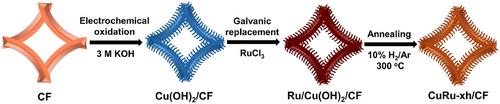
The electrochemical reduction of nitrite (NO2−) and nitrate (NO3−) not only enables sustainable, circular routes to produce ammonia (NH3), but also eliminates pollutants in groundwater. In this article, we report a facile synthesis of Ru-doped Cu nanowires on Cu foam electrodes with low Ru (0.48 wt.%) loading. The composite electrode shows high-performance in the NO2−/NO3− to NH3 electroreduction, giving NH3 Faradaic efficiency of up to 100% and NH3 yield rates up to 33.2 mg h−1 cm−2 at −0.2 V versus RHE in NO2− reduction. For the nitrate-to-ammonia reduction, the electrode also shows high activity with Faradaic efficiency of 88.4% (at −0.6 V versus RHE) and a yield rate of 62.5 mg h−1 cm−2 (at −1.0 V versus RHE). We show that the electrode can easily be integrated into a Zn–nitrite battery, giving a power density of 9.1 mW cm−2, a NH3 yield rate of 1.88 mg h−1 cm−2 and a nitrite-to-ammonia Faradaic efficiency of 88.9% at a current density of 20 mA cm−2. The system combines three productive outputs, that is removal of NOx− pollutants, synthesis of valuable NH3 and generation of “green” electricity.
期刊介绍:
With an impact factor of 4.495 (2018), ChemCatChem is one of the premier journals in the field of catalysis. The journal provides primary research papers and critical secondary information on heterogeneous, homogeneous and bio- and nanocatalysis. The journal is well placed to strengthen cross-communication within between these communities. Its authors and readers come from academia, the chemical industry, and government laboratories across the world. It is published on behalf of Chemistry Europe, an association of 16 European chemical societies, and is supported by the German Catalysis Society.





 京公网安备 11010802042870号
京ICP备2023020795号-1
京公网安备 11010802042870号
京ICP备2023020795号-1

 分享
分享
 求助内容:
求助内容: 应助结果提醒方式:
 扫码关注我们
