{"title":"Improving CO2 Fixation with Epoxides by Replacing Zirconium by Hafnium in UiO66 MOFs","authors":"Seyedeh Molood Masoom Nataj, Kaylee Ouellet, Serge Kaliaguine, Frédéric-Georges Fontaine","doi":"10.1002/cctc.202401630","DOIUrl":null,"url":null,"abstract":"<p>The impact of replacing Zr<sup>4+</sup> with Hf⁴⁺ as the metal site on CO₂ adsorption and catalytic activity in CO₂ fixation reaction with epoxide under mild conditions was investigated in <b>UiO66-NH₂</b> grafted with carbodiimides <i>N,N</i>′-dicyclohexylcarbodiimide (DCC) and <i>N,N</i>′-diisopropylcarbodiimide (DIC) (<b>UiO66(M)-DCCBr</b> and <b>UiO66(M)-DICBr</b>; M = Zr and Hf). Leveraging on Hf⁴⁺’s greater oxophilicity and stronger M—O bonds, Hf-based <b>UiO66-NH<sub>2</sub></b> materials exhibited increased CO₂ adsorption capacity, influencing the catalytic performance in CO₂ fixation with epoxides. The materials were characterized by multiple techniques such as PXRD, FTIR, TGA, SEM, elemental analysis, as well as N₂ and CO₂ adsorption equilibrium measurements. <b>UiO66(Hf)-DCCBr</b> and <b>UiO66(Hf)-DICBr</b> demonstrated superior activity compared to their Zr-based counterparts with high yield and TOF (14.6 and 11.9 h⁻¹, respectively) under milder conditions (0.1 MPa, 90 °C, 16 h, co-catalyst-free and solvent-free). These findings underscore the pivotal role of unsaturated metal sites in enhancing the catalytic efficacy of guanidinium ionic <b>UiO66-NH₂</b> materials. Moreover, these catalysts exhibit excellent thermal stability and can be recycled and reused at least five times without a noticeable reduction in their catalytic efficiency.</p>","PeriodicalId":141,"journal":{"name":"ChemCatChem","volume":"17 5","pages":""},"PeriodicalIF":3.9000,"publicationDate":"2024-12-24","publicationTypes":"Journal Article","fieldsOfStudy":null,"isOpenAccess":false,"openAccessPdf":"https://onlinelibrary.wiley.com/doi/epdf/10.1002/cctc.202401630","citationCount":"0","resultStr":null,"platform":"Semanticscholar","paperid":null,"PeriodicalName":"ChemCatChem","FirstCategoryId":"92","ListUrlMain":"https://chemistry-europe.onlinelibrary.wiley.com/doi/10.1002/cctc.202401630","RegionNum":3,"RegionCategory":"化学","ArticlePicture":[],"TitleCN":null,"AbstractTextCN":null,"PMCID":null,"EPubDate":"","PubModel":"","JCR":"Q2","JCRName":"CHEMISTRY, PHYSICAL","Score":null,"Total":0}
引用次数: 0
Abstract
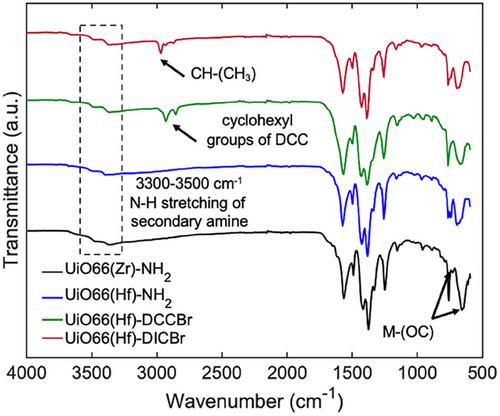
The impact of replacing Zr4+ with Hf⁴⁺ as the metal site on CO₂ adsorption and catalytic activity in CO₂ fixation reaction with epoxide under mild conditions was investigated in UiO66-NH₂ grafted with carbodiimides N,N′-dicyclohexylcarbodiimide (DCC) and N,N′-diisopropylcarbodiimide (DIC) (UiO66(M)-DCCBr and UiO66(M)-DICBr; M = Zr and Hf). Leveraging on Hf⁴⁺’s greater oxophilicity and stronger M—O bonds, Hf-based UiO66-NH2 materials exhibited increased CO₂ adsorption capacity, influencing the catalytic performance in CO₂ fixation with epoxides. The materials were characterized by multiple techniques such as PXRD, FTIR, TGA, SEM, elemental analysis, as well as N₂ and CO₂ adsorption equilibrium measurements. UiO66(Hf)-DCCBr and UiO66(Hf)-DICBr demonstrated superior activity compared to their Zr-based counterparts with high yield and TOF (14.6 and 11.9 h⁻¹, respectively) under milder conditions (0.1 MPa, 90 °C, 16 h, co-catalyst-free and solvent-free). These findings underscore the pivotal role of unsaturated metal sites in enhancing the catalytic efficacy of guanidinium ionic UiO66-NH₂ materials. Moreover, these catalysts exhibit excellent thermal stability and can be recycled and reused at least five times without a noticeable reduction in their catalytic efficiency.
期刊介绍:
With an impact factor of 4.495 (2018), ChemCatChem is one of the premier journals in the field of catalysis. The journal provides primary research papers and critical secondary information on heterogeneous, homogeneous and bio- and nanocatalysis. The journal is well placed to strengthen cross-communication within between these communities. Its authors and readers come from academia, the chemical industry, and government laboratories across the world. It is published on behalf of Chemistry Europe, an association of 16 European chemical societies, and is supported by the German Catalysis Society.






 京公网安备 11010802042870号
京ICP备2023020795号-1
京公网安备 11010802042870号
京ICP备2023020795号-1

 分享
分享
 求助内容:
求助内容: 应助结果提醒方式:
 扫码关注我们
