{"title":"Unveiling the Critical Role of High-/Low-Index Facets in Nanostructured Energy Materials for Enhancing the Photoelectrochemical Water Splitting","authors":"Suhaib Alam, Hiromi Yamashita, Priyanka Verma","doi":"10.1002/cctc.202401672","DOIUrl":null,"url":null,"abstract":"<p>The surface properties of nanostructured materials, especially the role of facets, have emerged as a central focus in improving photoelectrochemical (PEC) performance. High-/low-index facets in semiconductor nanostructures feature unique atomic structures, chemical reactivity, and electronic characteristics, critically influencing light absorption, charge separation, and catalytic activity, significantly enhancing the PEC efficiency. High-index facets, distinguished by distinct atomic structures, generally demonstrate enhanced catalytic activity owing to their higher surface energy and increased density of reactive sites. However, they tend to be less stable compared to low-index facets. In contrast, low-index facets offer better thermodynamic stability but may have reduced catalytic activity. Achieving the balance between these properties is critical for designing materials that maximize performance and durability in PEC water-splitting applications. Recent developments in synthetic techniques, including hydrothermal/solvothermal procedures and epitaxial growth, have facilitated precise control over the exposure of specific facets, allowing for the customization of nanostructured materials to optimize efficiency. This review paper comprehensively analyzes the faceted materials and their diverse methodologies for synthesis (ex situ and in situ), modification, and transformation of geometrical arrangements into facets of various semiconductor materials. A deeper understanding of crystal-facet engineering in crystals with tailored configurations has revealed substantial potential for the systematic design and synthesis of advanced micro-/nanostructures.</p>","PeriodicalId":141,"journal":{"name":"ChemCatChem","volume":"17 5","pages":""},"PeriodicalIF":3.9000,"publicationDate":"2024-12-25","publicationTypes":"Journal Article","fieldsOfStudy":null,"isOpenAccess":false,"openAccessPdf":"","citationCount":"0","resultStr":null,"platform":"Semanticscholar","paperid":null,"PeriodicalName":"ChemCatChem","FirstCategoryId":"92","ListUrlMain":"https://chemistry-europe.onlinelibrary.wiley.com/doi/10.1002/cctc.202401672","RegionNum":3,"RegionCategory":"化学","ArticlePicture":[],"TitleCN":null,"AbstractTextCN":null,"PMCID":null,"EPubDate":"","PubModel":"","JCR":"Q2","JCRName":"CHEMISTRY, PHYSICAL","Score":null,"Total":0}
引用次数: 0
Abstract
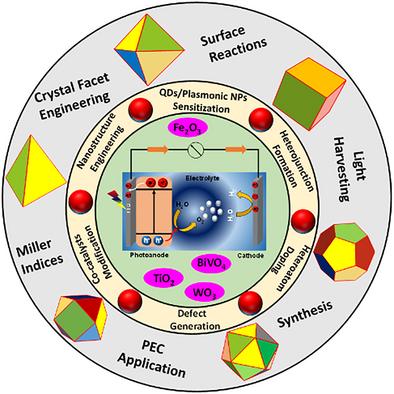
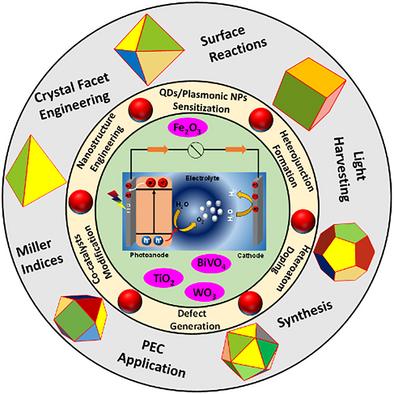
The surface properties of nanostructured materials, especially the role of facets, have emerged as a central focus in improving photoelectrochemical (PEC) performance. High-/low-index facets in semiconductor nanostructures feature unique atomic structures, chemical reactivity, and electronic characteristics, critically influencing light absorption, charge separation, and catalytic activity, significantly enhancing the PEC efficiency. High-index facets, distinguished by distinct atomic structures, generally demonstrate enhanced catalytic activity owing to their higher surface energy and increased density of reactive sites. However, they tend to be less stable compared to low-index facets. In contrast, low-index facets offer better thermodynamic stability but may have reduced catalytic activity. Achieving the balance between these properties is critical for designing materials that maximize performance and durability in PEC water-splitting applications. Recent developments in synthetic techniques, including hydrothermal/solvothermal procedures and epitaxial growth, have facilitated precise control over the exposure of specific facets, allowing for the customization of nanostructured materials to optimize efficiency. This review paper comprehensively analyzes the faceted materials and their diverse methodologies for synthesis (ex situ and in situ), modification, and transformation of geometrical arrangements into facets of various semiconductor materials. A deeper understanding of crystal-facet engineering in crystals with tailored configurations has revealed substantial potential for the systematic design and synthesis of advanced micro-/nanostructures.
期刊介绍:
With an impact factor of 4.495 (2018), ChemCatChem is one of the premier journals in the field of catalysis. The journal provides primary research papers and critical secondary information on heterogeneous, homogeneous and bio- and nanocatalysis. The journal is well placed to strengthen cross-communication within between these communities. Its authors and readers come from academia, the chemical industry, and government laboratories across the world. It is published on behalf of Chemistry Europe, an association of 16 European chemical societies, and is supported by the German Catalysis Society.





 京公网安备 11010802042870号
京ICP备2023020795号-1
京公网安备 11010802042870号
京ICP备2023020795号-1

 分享
分享
 求助内容:
求助内容: 应助结果提醒方式:
 扫码关注我们
