Sinisa Bjelic, Stella Hernandez Maganhi, Ran Friedman
{"title":"Unveiling the Catalytic Mechanism of Abl1 Kinase: A Single-Magnesium Ion Pathway for Phosphoryl Transfer.","authors":"Sinisa Bjelic, Stella Hernandez Maganhi, Ran Friedman","doi":"10.1021/acs.biochem.4c00838","DOIUrl":null,"url":null,"abstract":"<p><p>Abl1, a nonreceptor tyrosine kinase closely related to Src kinase, regulates critical cellular processes like proliferation, differentiation, cytoskeletal dynamics, and response to environmental cues through phosphorylation-driven activation. Dysregulation places it centrally in the oncogenic pathway leading to blood cancers. making it an ideal drug target for small molecule inhibitors. We sought to understand the underlying mechanism of the phosphoryl-transfer step from the ATP molecule to the substrate tyrosine, as carried out by the Abl1 enzyme. By calculating free energy profiles for the reaction using the empirical valence bond representation of the reacting fragments paired with molecular dynamics and free energy perturbation calculations, a combination of several plausible reaction pathways, ATP conformations, and the number of magnesium ion cofactors have been investigated. For the best-catalyzed pathway, which proceeds through a dissociative mechanism with a single magnesium ion situated in Site I, a close agreement was reached with the experimentally determined catalytic rates. We conclude that the catalytic mechanism in Abl1 requires one magnesium ion for efficient catalysis, unlike other kinases, where two ions are utilized. A better overall understanding of the phosphoryl-transfer reactions in Abl1 can be used for type-I inhibitor development and generally contributes to a comprehensive overview of the mechanism for ATP-driven reactions.</p>","PeriodicalId":28,"journal":{"name":"Biochemistry Biochemistry","volume":" ","pages":"1415-1424"},"PeriodicalIF":3.0000,"publicationDate":"2025-03-18","publicationTypes":"Journal Article","fieldsOfStudy":null,"isOpenAccess":false,"openAccessPdf":"https://www.ncbi.nlm.nih.gov/pmc/articles/PMC11924223/pdf/","citationCount":"0","resultStr":null,"platform":"Semanticscholar","paperid":null,"PeriodicalName":"Biochemistry Biochemistry","FirstCategoryId":"1","ListUrlMain":"https://doi.org/10.1021/acs.biochem.4c00838","RegionNum":3,"RegionCategory":"生物学","ArticlePicture":[],"TitleCN":null,"AbstractTextCN":null,"PMCID":null,"EPubDate":"2025/3/5 0:00:00","PubModel":"Epub","JCR":"Q3","JCRName":"BIOCHEMISTRY & MOLECULAR BIOLOGY","Score":null,"Total":0}
引用次数: 0
Abstract
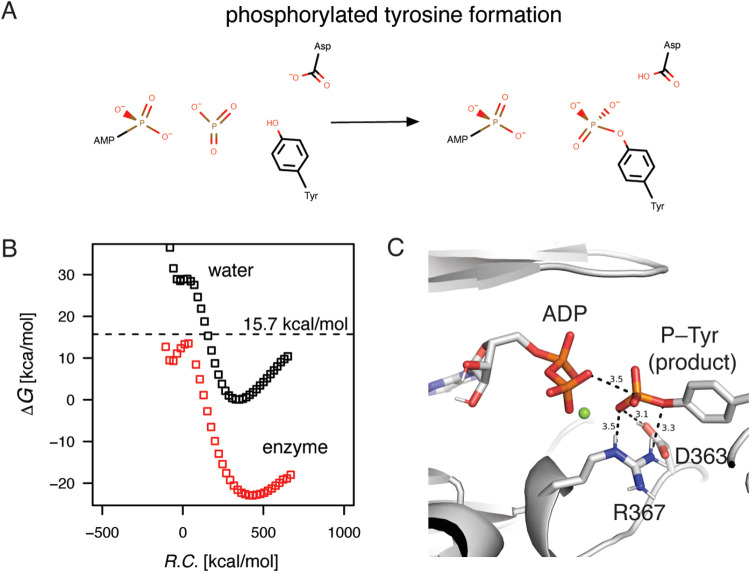
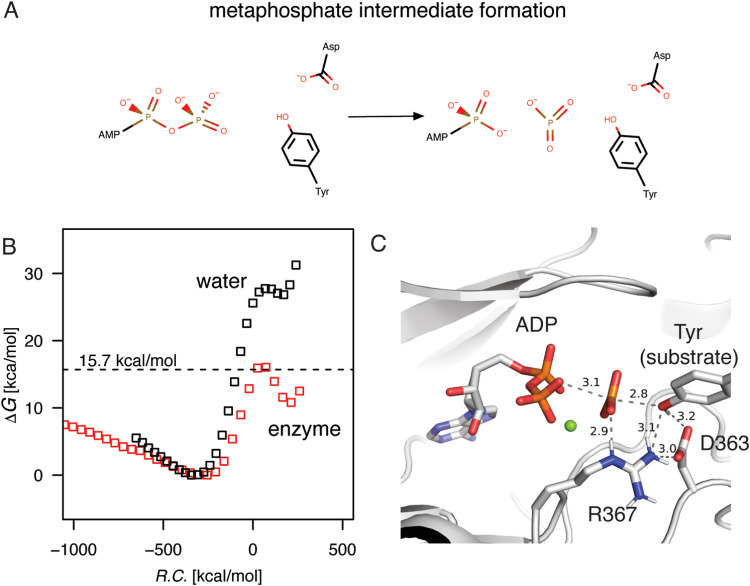
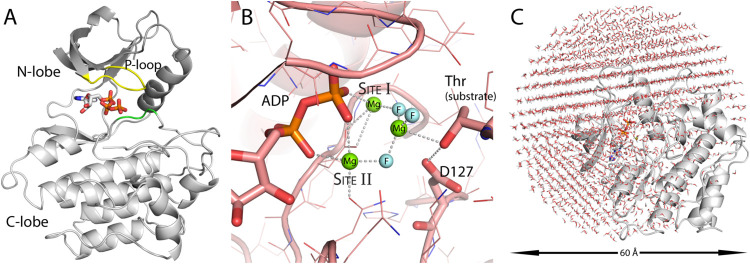
Abl1, a nonreceptor tyrosine kinase closely related to Src kinase, regulates critical cellular processes like proliferation, differentiation, cytoskeletal dynamics, and response to environmental cues through phosphorylation-driven activation. Dysregulation places it centrally in the oncogenic pathway leading to blood cancers. making it an ideal drug target for small molecule inhibitors. We sought to understand the underlying mechanism of the phosphoryl-transfer step from the ATP molecule to the substrate tyrosine, as carried out by the Abl1 enzyme. By calculating free energy profiles for the reaction using the empirical valence bond representation of the reacting fragments paired with molecular dynamics and free energy perturbation calculations, a combination of several plausible reaction pathways, ATP conformations, and the number of magnesium ion cofactors have been investigated. For the best-catalyzed pathway, which proceeds through a dissociative mechanism with a single magnesium ion situated in Site I, a close agreement was reached with the experimentally determined catalytic rates. We conclude that the catalytic mechanism in Abl1 requires one magnesium ion for efficient catalysis, unlike other kinases, where two ions are utilized. A better overall understanding of the phosphoryl-transfer reactions in Abl1 can be used for type-I inhibitor development and generally contributes to a comprehensive overview of the mechanism for ATP-driven reactions.
期刊介绍:
Biochemistry provides an international forum for publishing exceptional, rigorous, high-impact research across all of biological chemistry. This broad scope includes studies on the chemical, physical, mechanistic, and/or structural basis of biological or cell function, and encompasses the fields of chemical biology, synthetic biology, disease biology, cell biology, nucleic acid biology, neuroscience, structural biology, and biophysics. In addition to traditional Research Articles, Biochemistry also publishes Communications, Viewpoints, and Perspectives, as well as From the Bench articles that report new methods of particular interest to the biological chemistry community.



 京公网安备 11010802042870号
京ICP备2023020795号-1
京公网安备 11010802042870号
京ICP备2023020795号-1

 分享
分享
 求助内容:
求助内容: 应助结果提醒方式:
 扫码关注我们
