{"title":"Reciprocal relations between ADHD and risky behavior in adolescence: a between and within-person longitudinal analysis","authors":"Natali Goueta, Naama Gershy, Yehuda Pollak","doi":"10.1111/jcpp.14128","DOIUrl":null,"url":null,"abstract":"<div>\n \n <section>\n \n <h3> Background</h3>\n \n <p>The present study sought to extend the existing knowledge on the relationship between risky behavior and ADHD by studying transactions between these two variables within participants and across various time scales.</p>\n </section>\n \n <section>\n \n <h3> Methods</h3>\n \n <p>Participants were 281 adolescents (170 girls), age 13–18 years old (<i>M</i> = 14.8, <i>SD</i> = 1.3), and 1 of their parents. Risky behavior and ADHD symptoms measurements were taken at varying time intervals: annually, 4-monthly, and weekly. Random Intercepts Cross-Lagged panel modeling (RI-CLPM) was used to examine longitudinal bidirectional associations between risky behavior and ADHD symptoms.</p>\n </section>\n \n <section>\n \n <h3> Results</h3>\n \n <p>At the between-person level, positive associations between risky behavior and ADHD symptoms were found in all time scales. At the within-person level, according to adolescents' reports, ADHD symptoms did not predict subsequent fluctuations in adolescents' risky behavior, though according to parental reports on adolescents' risky behaviors, a cross-lagged effect of risky behaviors on ADHD symptoms was evident in the annual time scale.</p>\n </section>\n \n <section>\n \n <h3> Conclusions</h3>\n \n <p>Between-person relations between ADHD and risky behavior were established, suggesting an underlying common factor. Within-person relations were suggested only in parent reports and specific time scales. Our research underscores the critical need to differentiate between inter-individual and intra-individual effects when investigating the interplay between ADHD and risky behavior over time.</p>\n </section>\n </div>","PeriodicalId":187,"journal":{"name":"Journal of Child Psychology and Psychiatry","volume":"66 8","pages":"1209-1222"},"PeriodicalIF":7.0000,"publicationDate":"2025-03-05","publicationTypes":"Journal Article","fieldsOfStudy":null,"isOpenAccess":false,"openAccessPdf":"https://onlinelibrary.wiley.com/doi/epdf/10.1111/jcpp.14128","citationCount":"0","resultStr":null,"platform":"Semanticscholar","paperid":null,"PeriodicalName":"Journal of Child Psychology and Psychiatry","FirstCategoryId":"3","ListUrlMain":"https://acamh.onlinelibrary.wiley.com/doi/10.1111/jcpp.14128","RegionNum":1,"RegionCategory":"医学","ArticlePicture":[],"TitleCN":null,"AbstractTextCN":null,"PMCID":null,"EPubDate":"","PubModel":"","JCR":"Q1","JCRName":"PSYCHIATRY","Score":null,"Total":0}
引用次数: 0
Abstract
Background
The present study sought to extend the existing knowledge on the relationship between risky behavior and ADHD by studying transactions between these two variables within participants and across various time scales.
Methods
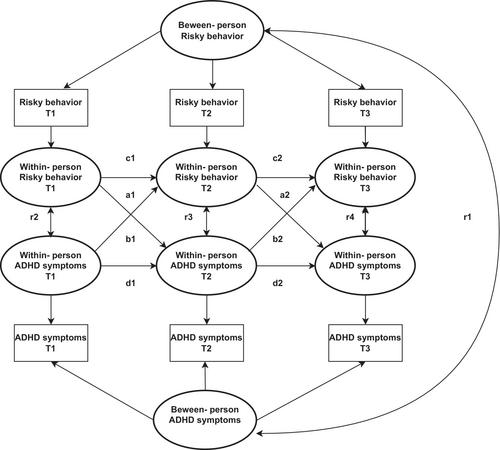
Participants were 281 adolescents (170 girls), age 13–18 years old (M = 14.8, SD = 1.3), and 1 of their parents. Risky behavior and ADHD symptoms measurements were taken at varying time intervals: annually, 4-monthly, and weekly. Random Intercepts Cross-Lagged panel modeling (RI-CLPM) was used to examine longitudinal bidirectional associations between risky behavior and ADHD symptoms.
Results
At the between-person level, positive associations between risky behavior and ADHD symptoms were found in all time scales. At the within-person level, according to adolescents' reports, ADHD symptoms did not predict subsequent fluctuations in adolescents' risky behavior, though according to parental reports on adolescents' risky behaviors, a cross-lagged effect of risky behaviors on ADHD symptoms was evident in the annual time scale.
Conclusions
Between-person relations between ADHD and risky behavior were established, suggesting an underlying common factor. Within-person relations were suggested only in parent reports and specific time scales. Our research underscores the critical need to differentiate between inter-individual and intra-individual effects when investigating the interplay between ADHD and risky behavior over time.
期刊介绍:
The Journal of Child Psychology and Psychiatry (JCPP) is a highly regarded international publication that focuses on the fields of child and adolescent psychology and psychiatry. It is recognized for publishing top-tier, clinically relevant research across various disciplines related to these areas. JCPP has a broad global readership and covers a diverse range of topics, including:
Epidemiology: Studies on the prevalence and distribution of mental health issues in children and adolescents.
Diagnosis: Research on the identification and classification of childhood disorders.
Treatments: Psychotherapeutic and psychopharmacological interventions for child and adolescent mental health.
Behavior and Cognition: Studies on the behavioral and cognitive aspects of childhood disorders.
Neuroscience and Neurobiology: Research on the neural and biological underpinnings of child mental health.
Genetics: Genetic factors contributing to the development of childhood disorders.
JCPP serves as a platform for integrating empirical research, clinical studies, and high-quality reviews from diverse perspectives, theoretical viewpoints, and disciplines. This interdisciplinary approach is a key feature of the journal, as it fosters a comprehensive understanding of child and adolescent mental health.
The Journal of Child Psychology and Psychiatry is published 12 times a year and is affiliated with the Association for Child and Adolescent Mental Health (ACAMH), which supports the journal's mission to advance knowledge and practice in the field of child and adolescent mental health.